


China's economy rebalancing 'no cure-all'
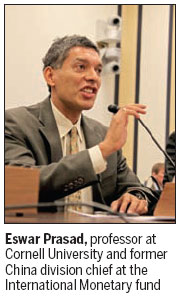
It's wrong to think China's growth is still primarily driven by exports and investment, a US economist told a congressional commission that monitors and investigates national security and trade issues between the two countries.
"China has made substantial progress on reducing its external imbalances, with the surpluses on both the current account and the trade balance falling sharply from their peaks in 2007," Eswar Prasad, a professor at Cornell University and a former China division chief at the International Monetary Fund, told a hearing of the US-China Economic and Security Review Commission in Washington on Thursday.
"Recent data suggest that it is time for a revision of the view that the country's growth is driven largely by exports and investment," he told the commission that was set up in 2000.
Private and government consumption together accounted for more than half of China's output growth in 2011-12, signaling a significant change in the composition of domestic demand. Meanwhile, physical capital investment, the main driver of growth over the previous decade, is no longer the dominant contributor to growth, while a shrinking trade balance in fact made a negative contribution to growth in these two years, according to Prasad, also a senior fellow at the Brookings Institution, a Washington-based think tank.
Data from the State Administration of Foreign Exchange and National Bureau of Statistics show that in 2007 China's current account and trade surpluses hit their peaks of 10.1 percent and 7.6 percent of GDP, while in 2012, they both fell below 3 percent of GDP.
Despite the progress, Prasad told the commission that major challenges remain to put in place reforms needed to improve the quality and efficiency of growth, continue the shift away from capital-intensive production, generate more employment and allow more growth benefits to filter down to the average household.
Nicholas Borst, a research associate and China program manager at the Peterson Institute for International Economics, also told the commission that China's external surpluses have come down significantly over the past few years, but he said the reductions may be temporary because they were driven by global economic weakness and unsustainable high levels of investment in China.
He warned the group of about 10 commissioners that while China's economic rebalancing would benefit the US, it's not a cure-all for its current economic woes, nor should imbalances in China be used as a scapegoat for the huge US public debt and the global financial crisis.
"Chinese economic rebalancing would be helpful, but domestic policy decisions will ultimately determine the fate of the United States economy," Borst said.
Prasad told the commissioners that China's 12th Five-Year Plan (2011-15) appeared to herald a turning point in the country's economic development.
"It represented, at least in rhetoric, a marked shift in emphasis from high growth to the quality, balance and sustainability of that growth. The longer-term objective of the plan was to reorient growth to make it more balanced and sustainable from different perspectives, economic, social and environmental," he said.
To Prasad, China's rapid GDP growth of 7.8 percent and industrial production growth of 10 percent in 2012, but relatively low inflation with the Consumer Price Index below 3 percent, have given Chinese policymakers the luxury of focusing on long-term policies to make growth more balanced and sustainable.
China's main challenge is to maintain a rapid productivity growth, which requires a shift toward higher value-added production, a more efficient allocation of resources through a better financial system and more balanced growth, he said.
Although China's overall trade imbalance fell steadily and sharply from 2007 to 2012, the bilateral trade surplus between China and the US increased in the past years to $300 billion in 2012. Prasad said these numbers are overstated because about two fifths of China's trade is processing trade, with relatively low value added in China.
Prasad said the growing domestic consumption and likely currency appreciation will help boost US exports to China, which is already the fastest growing market for US exports.
chenweihua@chinadailyusa.com
















