Waste not, worry not
The world's food shortage may be solved by reducing profligacy
By 2075, the world's population will have grown by about 50 percent to 9.6 billion people, according to the United Nations. Even without adjusting for more meat-intensive diets, feeding those extra 3 billion people will require the world's farmers to produce at least 50 percent more food.
Today, agriculture occupies about one-half of the world's available agricultural land of 10 billion hectares. Where will the extra land come from? Virgin land, on which new crops could be grown, supports the world's ecosystems. Increasing the amount of farmed land will conflict with the need to preserve the world's ecology, including its plant and animal life, forests, clean water and air.
Although the huge increase in global food production since 1960 has been met with only a 12 percent increase in farmed land, the amounts of energy, water and natural resources used for food production have grown by much more. New, large increases in food production will place an enormous strain on the world's limited resources. How can these demands be met?
There is a better place to look for more food supplies. Between 1.2 and 2 billion tons - or between 30 percent and 50 percent of the world's food production - is wasted every year. It is estimated, for example, that 45 percent of China's rice crop does not reach the table. In Vietnam, the proportion of rice wasted rises to 80 percent. Every year, in the UK, about 30 percent of the vegetable crop is discarded. India wastes almost as much grain - 21 million tons - as the whole of Australia's grain production. A halving of global food waste, from 50 percent to 20-25 percent, would feed an extra 1.5 billion people. It might even be possible to feed the world's peak population in 2075 - an extra 3 to 3.5 billion people - just by cutting food waste.
Everyone knows that food is wasted, yet very few people are aware of the amounts of food involved, or the main causes of waste, which vary depending on the stage of a country's development. Inefficient harvesting, transport and storage are the main causes of waste in poorer countries. Poor farmers depend on being able to store less perishable foodstuffs, such as cereals and root crops, so as not to have to sell their crops during low-price periods such as harvest time. But food-storage facilities are often badly constructed or old, allowing water, rodents or thieves to enter and spoil or remove the food.
Harvesting, often done by manual workers, leaves piles of grain, vegetables or fruit that have to be picked up and moved from the field to the market by way of one container or another. By contrast, in one food-producing part of the UK, two men can transport 100,000 tons of onions each year by using transport designed around a 7-meter shipping container. The harvested onions are placed from the harvest directly into the container. The container is loaded onto a lorry and can be shipped for processing anywhere. This avoids the waste that is involved in moving piles of onions and storing them.
In richer, developed countries, most food waste occurs higher up the food chain, at the level of retailer and consumer. Supermarkets dominate the food supply in the developed world. They organize their food purchases to benefit themselves at the expense of the farmers, who are forced to conform to their demands because of their buyer dominance. A supermarket places an advance order with a farmer for a fixed amount to be delivered at a certain time. Farmers overproduce to ensure they can meet the supermarket deadlines. The unwanted surplus is left to rot in the field. Some produce may be rejected by the supermarket because although the food is of good quality, it does not look right: the potatoes are too small, the oranges are too big or the spinach has grass in it. Supermarkets mark their food supplies with conservative "sell-by" dates in order to avoid legal action by consumers. Every day they throw away food that is not sold.
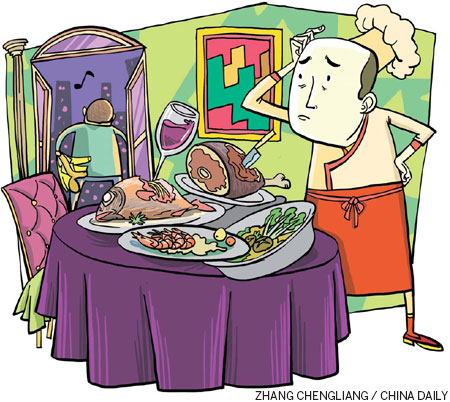
About 50 percent of food purchased by developed-world households is wasted, perhaps because an in-store promotion has persuaded the household to buy too much, or because the "sell-by" date has passed, although usually the food is good to eat for several days afterwards. Restaurants try to "economize" by ordering too much food (the cheapest of their inputs) so that they do not have to make last-minute expensive food orders to meet unexpected demand.
Food waste involves wasting the resource inputs that have gone to produce the food. Agriculture uses about 70 percent of all the water used by humans. Producing one kilogram of beef requires 15,400 liters of water, a kg of sheep's meat needs 10,400 liters and a kg of pork uses 6,000 liters.
As societies become richer they switch their diets toward meat. In China, annual meat consumption per person increased from 20 kg to 29 kg between 1981 and 2004, while grain consumption fell from 145 kg to 78 kg. Between 1960 and 2000, world meat consumption per person increased by 50 percent, by two times in east Africa and by three times in Asia.
It is likely that continued economic growth in poorer societies like China will continue to increase demand for meat. But meat-producing animals are wasteful users of energy, water and the other resources needed to produce them. Big increases in meat production will require huge additions to resource supply, particularly water - already a scarce commodity in many parts of northern China.
A picture published in China Daily on Jan 25 showed the wasted food remaining from a New Year banquet held for 75 tables by a state-owned enterprise in Guangzhou. Such food waste is not rare in China. Part of the problem is that in China a number of dishes are ordered for the purpose of tasting the food as much as eating it. The other part is that food is greatly undervalued everywhere, because governments around the world, not just in China, have made cheap food a principal objective of social policy.
But using non-legal or non-monetary means to persuade people not to waste food is unlikely to have a significant effect. A basic law of economics is that a scarcer resource commands a higher price. Food in Switzerland is 25-30 percent more expensive than in neighboring France, because the Swiss pay large subsidies to their farmers and wish to discourage food waste. Other countries must find ways to pursue the same path as Switzerland. Only if food becomes much more expensive will consumers learn to treat it with the respect it deserves, and invest in ways of not wasting it.
Cutting food waste is a part of the enormous task of gradually pricing the costs of environmental degradation into everyday living in order to change living habits. For example, it is becoming clear that the severe air pollution in Beijing makes the introduction of Chinese clean-air pollution taxes much more attractive. Since the 1970s, societies in most developed countries have come to accept that cigarettes and auto fuel should be highly taxed for environmental and health reasons, as well as to finance the provision of governmental services. Food, a scarce resource, will have to go the same way in order to equate environmental demands with a larger and wealthier global population.
The author is a visiting professor at Guanghua School of Management, Peking University. The views do not necessarily reflect those of China Daily. Contact the writer at gileschance@gsm.pku.edu.cn.