


Not so fast on the burgers and nuggets
|
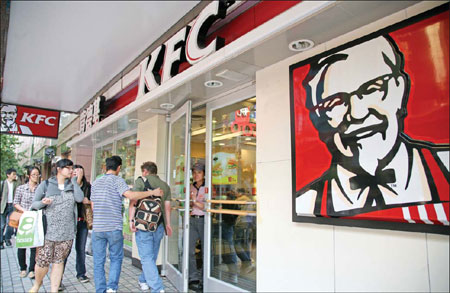
The colonel and his bowtie are ubiquitous features of Chinese cities. Provided to China Daily |
Like cold french fries, fast food is taking on a jaded look
China may be losing its appetite for what was once the most popular form of foreign cuisine - fast food.
As a widespread and relatively affordable Western options for Chinese consumers, one can travel to some of the most remote locations in China and come across the golden arches or the colonel and his bowtie.
But in November the country's biggest fast-food supplier, Kentucky-based Yum Brands Inc broke the news of faltering fourth quarter sales to investors. In January, the company told investors that its previously forecast 4 percent drop in sales would most likely be closer to a 6 percent drop. China made up 44 percent of the company's sales in 2011.
Reacting to the sudden sales fall from the company's 4,700 outlets in China, David Novak, CEO of Yum Brands, said in a statement the company would focus more on the US and other international markets.
"For the fourth quarter, stronger-than-expected operating performance from Yum Restaurants International and our US division is offsetting softer sales in China," he says.
The reason given for updating the lower-than-expected sales figures was a food scandal that embroiled the company in late December last year after Chinese officials discovered one of Yum's primary poultry suppliers for hundreds of KFC outlets was discovered to be using antibiotics and growth hormones in its chickens.
The affected birds were also being supplied to KFC's biggest competitor in China, McDonald's, the state broadcaster China Central Television reported after a year-long investigation into the supplier, Liuhe Group Co.
Following the investigation, both companies said they would pay more attention to food safety. Late last moth, KFC China, a division of Yum Brands, announced new quality control measures, including eliminating more than 1,000 unqualified chicken houses.
McDonald's Corp blamed a 0.9 percent drop in sales during the fourth quarter on the chicken scare.
But the sliding stock prices among fast-food giants may be due to more than just a food safety scare, says Matthew Crabbe, a China consumer analyst and author of the book Fat China, which focuses on the nation's eating and obesity trends.
Once coveted as China's only "upscale" Western dining options, more than a decade ago, fast-food restaurants like McDonald's and KFC were considered a trendy dining locale.
But Crabbe, who has spent the past 15 years observing China's consumption trends, says the reason for decreasing interest in Western fast food is simply because the novelty has worn off.
"They suffer from familiarity fatigue, and no matter how much they continue to innovate, in more developed regional markets in China, they are old hat."
This is why Western fast food brands are now eyeing new locations further afield, he says.
"Beijing now has a huge range of catering outlets, from fast-food brands, foreign and domestic, to high-end fine dining that would rival the offerings in any city in the world - and everything in between.
"Remaining interesting and attractive to consumers in such a market therefore gets increasingly difficult."
More recently, as consumers became increasingly cautious following a string of food scandals, Western fast food restaurants were perceived as a safe alternative.
"Those who dine in cheaper Western restaurants are mainly students and young white-collar workers," Luo Juan says, analyst from Forward and Intelligence Co Ltd, an catering industry analyst in Shenzhen.
He says as the government strengthens its supervision over food safety, restaurants will be held more accountable for operating standards.
Now, with the novelty of eating Western food gone, losing the image of providing safe, high-quality food in the eyes of China's consumers could stifle the rampant Chinese growth enjoyed by some of the world's largest fast-food producers.
"Fast-food restaurant companies will often cite rising costs of operations in China as a key reason for financial woes, or the slowing consumer economy," Crabbe says.
"But the main problem is that they run out of ways in which to remain fresh in the market, ahead of the constant arrival of new entrants that will eat into their market share just because those competitors are new, unexplored and therefore interesting to consumers who have low brand loyalty and a high expectation of a constant supply of new things to try."
Contact the writer at toddbalazovic@chinadaily.com.cn.
















