


Joint effort key to curb poaching
|
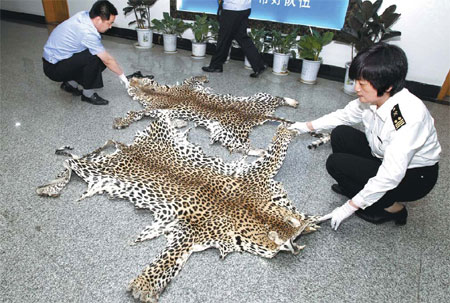
Zhengzhou customs officers display two leopard furs that they confiscated in a 2011 crackdown on smuggling of rare wild animal products. The two furs, found in an undeclared parcel from Senegal, were worth 120,000 yuan ($19,280). Provided to China Daily |
Improving public awareness vital part of animal protection: expert
The war against wildlife trafficking cannot rely on any single country; it needs strong international cooperation.
That's according to one of China's leading specialists in wildlife protection, who said the illegal trade in wildlife is now a "transnational crime" and only the joint efforts of "origin, transit, and destination countries" will result in effective control.
Wan Ziming, director of law enforcement and training in China for the Convention on International Trade in Endangered Species of Wild Fauna and Flora, said the illegal trade in wildlife, as well as its parts and products, is estimated to be worth $7.8 billion to $10 billion per year.
The figures make wildlife trade the world's fourth-largest smuggling activity, after drugs, counterfeit goods and human trafficking.
He used elephant tusks as an example of how a wildlife crime chain might work, explaining the main problems often involve a lack of integrated data between countries affected by a chain, strict local law enforcement, and international coordination.
"There are often many countries involved in the whole process, from when an animal is first poached, to how it's transported, and where and how it is sold," he said.
"We cannot expect too much from any single country, especially if that country does not have sufficient law enforcement support."
Wan also compared the illegal trade in high-value wildlife parts, such as rhino horn, shatoosh (a shawl woven with the down hair of the Tibetan antelope) and ivory, to that of drugs in that both are intricate and require international cooperation to be effectively tackled.
Daniel M Ashe, director of the US Fish and Wildlife Service, told delegates at the 16th meeting of CITES member states, being held in Bangkok, Thailand, on Monday that there is a new generation of wildlife traffickers across the world, and law enforcement capacity should be stepped up through joint efforts by countries right along the chain.
A recent operation held in China illustrated just the kind of international cooperation that officials want to see.
The monthlong clampdown on wildlife crime, dubbed "Cobra", was held at the start of the year and brought together police, customs and wildlife officers from 22 countries in Asia, Africa, and North America.
It was targeted at some key species that have been subject to illegal wildlife trade in the past, such as Asian big cats, elephants, great apes, pangolins and rhinos, and resulted in a large number of arrests and seizures.
According to Wan, Cobra's plan was started at last year's China-ASEAN Technical Consultation on CITES Enforcement Cooperation.
China has since taken the lead by chairing an International Coordination Team, to coordinate operation teams at all regional and national levels.
One of its members is Adan Alio from Kenya, an officer with Lusaka Agreement Task Force. He said the main efforts are to track and dismantle criminal networks.
"Until the top criminals behind the chains are taken down, the poaching and illegal trade will continue," he said.
Wan added: "We applied the experiences from previous operations by the International Criminal Police Organization (better known as Interpol), and the World Customs Organization to the current situation.
"By using the communication networks of all relevant sub-regional, regional and international partner institutions, we were able to coordinate forces from each country to exchange information, intercept goods, and carry out investigations."
Tens of thousands of wildlife, customs and police officers in all the countries participated in the Cobra operation, which helped launch more than 200 wildlife criminal cases, and arrest more than 100 suspects, as well as confiscate huge numbers of wildlife and plants.
Uttam Kumar Karkee, a senior superintendent from the Nepal police, said international cooperation such as this is vital in fighting wildlife crime.
"Operation Cobra proved itself to be an excellent model for fighting trans-national crime," he said.
Wan added: "Confidentiality is crucially, as is speed - efforts like this have to be done quickly and over a short space of time.
"That's why all the member states agreed not to disclose any information to the media before the cases were wound up."
On the Chinese side, up to 10,000 wildlife, customs and police officers were involved in the operation, resulting in 90 arrests connected to 80 individual cases.
Within each member country, too, similar locally targeted efforts were made
A World Wide Fund for Nature report released last year, the Wildlife Crime Scorecard, assessed the performance of 23 countries on their compliance to the CITES's commitment at protecting against crime involving tigers, rhinos, and elephants.
Many countries were scored "red", indicating major deficiencies in compliance and enforcement, mostly for regulatory deficiencies and lack of enforcement resources regarding domestic ivory markets.
In Asia the red countries included Laos, Myanmar and Thailand.
The report suggested various ways to improve domestic compliance, including the introduction of national policies, strengthening law enforcement, greater international coordination, improved data collection for wildlife crime analysis, and the introduction of heftier penalties that would constitute a credible deterrents and raise public awareness.
"Educating the public is also essential, and has proved very effective in the past," Wan said.
Pu Zhendong contributed to this story.
yangyao@chinadaily.com.cn
















