


Investment in railways rises
|
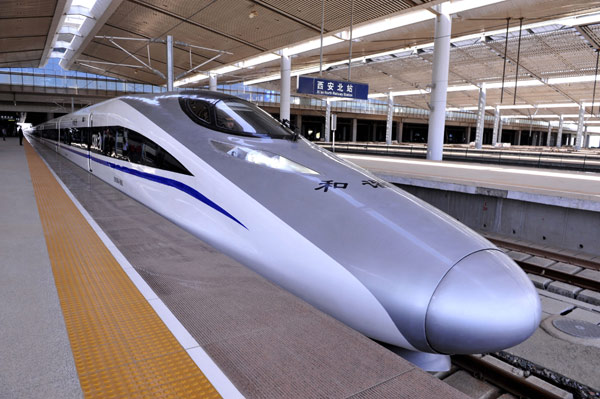 A high-speed train in Xi'an, Shaanxi province. Tang Zhenjiang / For China Daily |
Expert says funding could speed up in few months as uncertainty fades
Fixed asset investment in China's railways rose 25.7 percent year-on-year to 37.63 billion yuan ($6 billion) in the first two months of the year, the railways authority said on Thursday.
The investment is a part of the ministry's 650 billion yuan fixed-asset investment package this year, slightly higher than last year's 631 billion yuan.
But compared with the 70.9 percent rise in January, the 25.7 percent growth in the first two months suggested a substantial dip in February's investment.
During the same period, infrastructure investment, the largest part of fixed-asset investment, rose 20.9 percent to 25.14 billion yuan, slowing from the 62.3 percent growth in January.
Li Daxiao, director of Yingda Securities Research, said fluctuation between months is normal.
Zhao Jian, a professor at School of Economics and Management under Beijing Jiaotong University, said though the first two months' investment only accounts for 5.79 percent of the annual target, investment could accelerate in the coming months.
Whether the annual target is met will be decided by the central government's attitude, which is shadowed with some uncertainty after the announcement that the ministry will be dismantled and the commercial part will run independently, Zhao said.
In a bid to reduce bureaucracy, the latest administrative reform unveiled at the ongoing National People's Congress said the original Ministry of Railways will split into two entities, with the policymaking part taken over by Ministry of Transport, and the commercial operation taken over by the newly established China Railway Corp.
How well the investment plan goes depends on several factors.
In 2011, the railway construction boom unexpectedly slowed after former minister Liu Zhijun was investigated for corruption and a deadly high-speed train crash occurred in July. Since the third quarter of 2012, railway investment has gained momentum again as the nation has tried to stimulate the decelerated economic growth.
Records show the ministry increased its planned investment amount three times in the middle of 2012. As a result, fixed-asset investment last year hit 631 billion yuan, compared with 586.3 billion yuan in 2011.
In line with the investment expansion, the rail ministry also increased its bond issuing size.
Last year, the ministry sold a record 164 billion yuan in bonds, helping it settle unpaid bills.
China's rail network is set to reach 120,000 kilometers under the five-year plan ending in 2015.
By the end of 2012, China had 98,000 km of rail network.
This means that a total of 22,000 km of new rail will be built during the 2013-2015 period. And investment in railways infrastructure could reach 1.33 trillion yuan during the period, Shanghai Securities Daily reported.
The split of the ministry is unlikely to affect investment in railways and will help the industry better meet market demand, Railway Minister Sheng Guangzu told reporters at the NPC this week.
"We view the reform positively. We expect it will be easier for China Railway Corp to restructure its assets and debt as an incorporated company rather than the Ministry of Railways, providing increased flexibility to the funding of railway projects," Barclays Plc analysts led by Patrick Xu said in a note to clients.
The previous speculation that the authority would be merged with the transportation ministry also helped to dent the interest rate of the railway bonds, which hit a seven-month low at end of February.
Li Daxiao said bonds issued by the railway ministry are very popular in the market, which potentially could be even expanded, though the 2.66 trillion yuan liability has put the ministry's debt-to-asset ratio at 61.81 percent at the end of September.
"China's bond market is big enough. Financing is not a problem. The problem is if the ministry and the central government have enough willingness to scale up the investment," Li said.
China's railway transportation capacity, both in freight and passengers, is still lagging far behind the economy's demand, Li said.
Expanding its capacity would greatly ease the tension between supply and demand and reduce the cost of logistics, as the cost of train freight is merely one-third of that of the road freight, Li added.
zhengyangpeng@chinadaily.com.cn
















