


China's media challenge in Africa
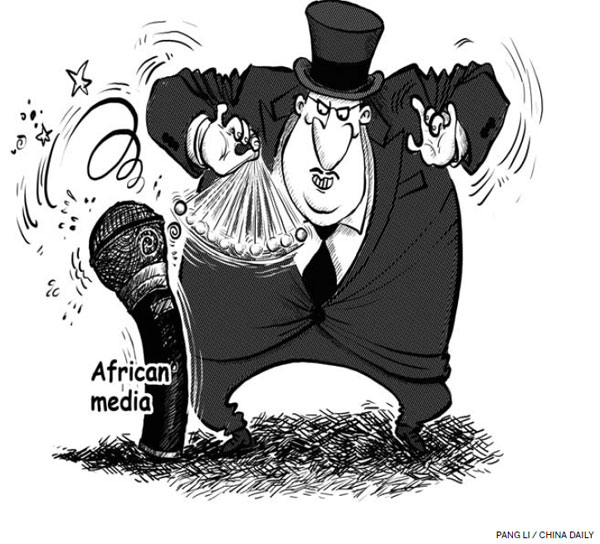
Even a cursory look at the African media will reveal its uncanny similarity between Eurocentric media trends and the contours of Sub-Saharan African press, which can be attributed to historical reasons.
The contact Africa has had with the West over the years has a lot to do with how the average African processes and presents his thoughts. The dyed-in-the-wool Western influence discernible in an Africa that was once colonized has a lot to do with the mind-capturing methods the West employed and deeply anchored its abiding influence in.
Obviously, many years of education and religious practices inspired by the West have molded preferences whose persuasion traverses virtually all facets of life - media consumption and appreciation included. Even decades into independence, top-level media executives and editors across most of Anglophone and Francophone Africa trace their professional training and lifestyles to the West. The prism that informs civility, excellence and success in most of Africa is largely Western.
More specifically, Western media organizations and products, including CNN, VOA, The New York Times, The Washington Post, BBC, Financial Times, and The Times, London, remain the predominant pacesetters of what is considered excellence in the world of journalism for most of Sub-Saharan Africa. In fact, only in recent years have Al-Jazeera and CCTV made inroads into the African news consumption psyche.
As a matter of fact, if the trend of depending on the West for breaking world news continues unchecked, China could, unfortunately, continue holding the shorter end of the stick when it comes to winning the hearts and minds of the African people. And all this in spite of China's heightened visibility in Africa, particularly in recent years.
But even before we get to the hearts and minds of Africans whose lives have been dramatically transformed by China's involvement in multiple development engagements, there is a much more basic level of cooperation between the two entities that begs careful, but urgent, redress. And that has to do with the need to forge a closer and, more importantly, organic relationship between China and Africa.
Such a relationship can only be forged through a systematic and deliberate cultural fusion pursued through the same instruments the West rode on to win the hearts and minds of the African territory it previously occupied. Of course, the approach will have to do away with the West's master-servant equation and instead fashion itself along China's win-win approach of engaging significant others.
China, however, has a heap of negative historical factors to deal with before forging new methods of engaging Africa afresh through the media. And that is the persistent and virulent bad-mouthing of China by the West, because of which many Africans are primed - through a beadwork of myths - to approach many a Chinese product with utter circumspection. Perhaps the fact that China does not belittle Africa in its media outlets, as opposed to the Western media, is a good entry point to weave a new narrative between China and Africa.
For China to compete favourably with a deeply entrenched West in the media world, a lot more than propagating a relationship strictly through news organs is necessary. For instance, a lot more cultural exchanges that include scholarships and fellowships between Africa and China are crucial. The study of the liberal arts, especially Chinese literature, in African schools and universities could create a whole new world of understanding between Chinese and African peoples. The same has worked wonders for the West in Africa for decades.
I also feel that the view of the cosmos that informs African thought and imagination is by and large a puzzle for Chinese, and vice-versa. Of course, an African has his way of interpreting the universe, which is remarkably different from that of the Chinese and, therefore, unless media products are sensitive to these realities and distinctions, the mismatch between product and intended influence will persist.
However, a billion Africans and a billion Chinese have many a symbiotic way of communicating and communing with each other, and engaging in one of the greatest cultural, artistic and scholarly exchanges of the 21st century, apart from expanding their economic and trade cooperation.
China is engaging Africa (and vice-versa) at a time of negative population and economic growth in the West, and it is doing so without the baggage of historical injustice of colonialism and slavery. A resurgent China joined by a burgeoning Africa in times of the "knowledge economy" can only thrive in mutual prosperity.
The role of multimedia journalism sectors, both Chinese and African, is critically important in this great endeavor, for the media are the driving catalysts of these purely 21st century dynamics.
The Sino-African moment is nigh.
The author is culture editor with Diplomat East Africa, a Kenya-based magazine, and vice-chair of Kenya-China Friendship Association.
















