


China, the world and wealth, according to Mr Brics
|
Jim O'Neill says the BRICS' achievements economically are much bigger than politically. Jin Yi / for China Daily |
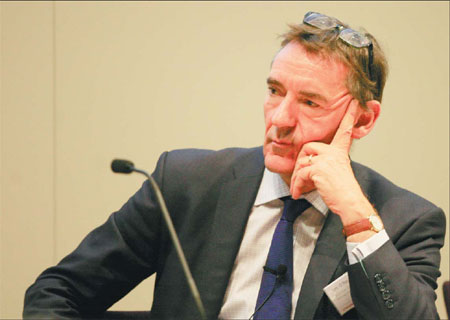
For Jim O'Neill, the economic grouping he gave a name to is a key building block in the world economy and an important cog in global trade, finance
Nearly 12 years ago, when Jim O'Neill, then chief economist for Goldman Sachs, coined the acronym BRIC for Brazil, Russia, India and China, he had never properly visited three of the four countries (the exception was China), and spoke none of their languages.
But O'Neill predicted that in a decade BRIC countries' combined share of global GDP could rise from 8 percent to about 14 percent, and that China's might approach that of Germany's, and time has proven him right.
BRIC economies grew spectacularly, capturing the world's attention and putting the term BRIC into the financial lexicon, and shaping investors', financiers' and policymakers' view of the emerging markets.
The BRICS countries (South Africa joined the grouping in late 2010), account for nearly 26 percent of the world's land mass, 43 percent of global population, 17 percent of trade, receive 11 percent of foreign direct investment, and have 25 percent of global GDP in terms of purchasing power parity and about one-fifth of global nominal GDP.
"Economically the achievements are much bigger than politically," says O'Neill, who some have dubbed Mr Brics and who is now chairman of Goldman Sachs Asset Management.
Economically, the BRICS countries, South Africa being the exception, have become much bigger, much more quickly than he had expected, even if they have lost some momentum in the past 12 months.
In 2011 alone their collective GDP rose by about $2.3 trillion (1.8 trillion euros), equivalent to that of Italy's GDP.
"By 2015, if not before, the combined size of the BRICS economies seems highly likely to become as big as that of the United States and they are set to become as big as the G7 by 2027," O'Neill says.
"It is transforming everything in the world economy including the patterns of world trade and finance."
Indeed, O'Neill remains confident about emerging markets, China in particular, and says he believes its growth will pick up again.
China is the most important BRICS member, he says, its GDP now being $8.3 trillion, as big as the GDP of the other BRICS countries combined.
O'Neill first came to China in 1990 and has since witnessed a major transformation in the country.
He shaped an era for Goldman Sachs Asset Management by shifting the focus from G7 countries to emerging markets, particularly China.
Last year GSAM contributed $5.2 billion to Goldman Sachs' overall revenue, more than the investment banking arm of the firm.
"The importance and scale of China for the world, never mind within the BRICS group, is next to none and vital for us all," O'Neill says.
As a result, the decisions that China makes in its own right and within BRICS are extremely important, he says.
China's leaders elected at the National People's Congress recently are trying to shift the country from being export driven to being focused more on domestic consumption, at the same time maintaining full employment and social stability.
O'Neill reckons that with China everything has to be kept in perspective. Its GDP of $8.3 trillion is more than half that of the US, so China growing by nearly 8 percent a year is analogous to the US growing nearly 4 percent, he says.
"I had assumed for the last three years that this decade, China would grow by around 7.5 percent and I am happy with that."
He says he is surprised by the weakness of retail sales this year that suggests consumption in China needs to grow a lot and may need more policy support.
But O'Neill says that assuming the government does achieve its policy aims eventually, that should mean China will succeed in doubling GDP and incomes this decade, something that will be good for the world.
Other BRICS countries need to concentrate on their own priorities rather than being preoccupied with China, because each has a lot to do, he says.
India needs to undertake substantial reform and improve its macro-economic conditions, he says. Russia needs to reduce its dependency on oil and improve the rule of law, and Brazil needs to become more competitive and allow for more investment outside commodities.
The last 12 months have been economically disappointing for some of the BRICS countries, especially Brazil and India, O'Neill says, and it is important that each does something to encourage stronger vitality and growth this year and next.
"I still think South Africa is quite fortunate enough to be in the group as economically it is rather small compared to the others."
He says its membership can be justified on the basis of its being a gateway to Africa, and if it can take a leading role in increasing trade links across the continent and improving the continent's infrastructure, this will bolster its credentials.
As a grouping, BRIC was institutionalized in September 2006 at the initiative of Russia, and the fifth summit is taking place in Durban, South Africa, from March 26.
O'Neill says he is awaiting the summit eagerly to see whether the formation of a development bank, foreshadowed at the summit in New Delhi last year, goes ahead.
"As of yet the BRICS group has not really achieved anything, hence the BRICS bank idea is so important for them as a collective force."
If the BRICS bank is announced, "this will be the beginning of an institution that sort of becomes a World Bank for their universe and the World Bank becomes less important for this huge sphere of influence".
Asked what BRICS can do to promote world economic recovery, O'Neill says Goldman Sachs has a measuring tool called a growth environment index that takes in 180 countries, which are scored on a scale of 0 to 10, 10 being the best.
In the last update, among BRICS members China's score was top at 5.4, Brazil's was 5.3, Russia's a little below that, and India's about 4.
O'Neill says all could learn from South Korea, which scored 7.9 and was ranked third. O'Neill says the lesson the BRICS countries can draw from this is the importance of broad and deep education, of making the best use of all technologies and of being flexible and adapting to change.
zhangchunyan@chinadaily.com.cn
















