


Heilongjiang: Hub for trade with Russia
|
Heilongjiang Deputy-Governor Sun Yao (right) meets a government official from Amur Oblast, Russia. Provided to China Daily |
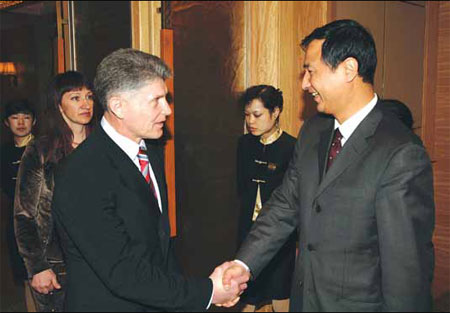
Editor's note: The author is Heilongjiang Deputy - Governor Sun Yao, who outlines the province's efforts to further open its border areas to Russian trade and its overall partnership with the neighboring country.
Heilongjiang shares a 2,981-kilometer border with the Russian regions of Primorsky Kray, Khabarovskiy Kray, Jewish Autonomous Oblast, Amur Oblast and the Baikal.
We now have 15 border ports to Russia as we serve as the bridgehead and hub of Sino-Russian economic and trade cooperation.
In 2012, Sino-Russian trade in Heilongjiang totaled 21.3 billion yuan ($3.42 billion), a quarter of the nation's total.
Investment from Heilongjiang enterprises in Russia accounts for one-third of the overall figure from China.
Cargo transported through Heilongjiang ports reached 25 million tons last year, half of the total.
Russia is now the third-largest source of inbound tourists to China, while China ranks second in the Russian tourism market.
In recent years, more than a half of Russian tourists on their first trip to China came to Heilongjiang and more than half of Chinese visitors toured Russia via the northeastern province.
With the deepening of the strategic partnership between China and Russia, the province's level of economic and trade cooperation in Russia has also grown rapidly.
In the past, the province mostly imported logs from Russia.
Through years of effort, imported goods from Russia have grown to include crude and refined oil, iron ore, soybeans, coal, chemical fertilizers and electric power.
In the past year, Heilongjiang imported enough crude oil, timber and paper pulp from Russia to supply 7 percent of the nation's needs.
Forty-six percent of imported wood products from Russia are processed or deeply processed.
In 2012, potassium fertilizer imported from Russia to Heilongjiang accounted for one-fifth of the nation's total volume, meeting 17 percent of domestic market demand.
The amount of iron ore imported has also increased rapidly. Some 43.2 percent of the nation's imports of the mineral from Russia arrive in Heilongjiang.
The province has installed four electric transmission lines between Heihe and Amur Oblast, which created a new model in the nation for cross-border purchases of electricity.
Heilongjiang will buy an estimated 3.35 billion kilowatt-hours of electricity from Zeya River Hydropower Station in Amur Oblast this year.
The energy will meet domestic demand and also benefit the environment, making it a win-win project.
Russian coal has become very popular among Chinese iron and steel enterprises in recent years due to its reasonable price and good quality,
As well, more and more Heilongjiang entrepreneurs are going to Russia to develop their businesses.
Heilongjiang Dongning Jixin Group invested and constructed the Ussuriysk Kangji Economic and Trade Cooperation Zone, one of eight overseas economic and trade cooperation zones ratified by the Ministry of Commerce. Twenty-five Chinese enterprises have now joined the zone.
In Ussuriysk, shoes made at the Kangji Economic and Trade Cooperation Zone and the Huayu Industrial Park - also comprised of Heilongjiang enterprises - meet one-10th of the Russian market demand.
Composite flooring, windows, doors and furniture made in Kangji are now sold in Europe and North America.
A thin-film solar power station in the zone can satisfy most of the electric power demand for the enterprises.
The zone provides the most profit and tax from Chinese companies in Russia and has won high recognition from the government.
Many other enterprises in Russian industrial zones have become successful examples, creating a favorable environment for Chinese enterprises to step out together and also promote the cooperation and development in border areas.
Amur Sirus Power Equipment Ltd is the only Chinese enterprise in the electric power equipment markets in Russia and Kazakhstan.
It has the most professional team in electric power cooperation with Russia including more than 150 translators.
The company's efforts helped a large number of Chinese equipment makers acquire the Russia's GOST certification for export of equipment as well as other use and network access licenses.
In 2011, the company, domestic design institutes, equipment manufacturers and installation firms established the Electric Power Cooperation Union with Russia.
They aim to jointly explore the Russian electricity market.
There are now 66 members in the union that have received orders for many large projects.
In the agricultural sector, Heilongjiang Dongning Huaxin Industry and Trade Co Ltd developed the Sino-Russian Modern Agriculture and Economic Cooperation Zone in Primorsky Kray.
Planters in the zone produce soybeans, corn and the most wheat in Primorsky Kray for six consecutive years, winning the award for "the best agricultural enterprise in Primorsky Kray" five times.
In the zone, 98 percent of the agricultural production uses advanced agricultural machinery and transport vehicles.
In addition to grain crops, pork and beef from the zone are sold in the markets of Vladivostok and Ussuriysk, where it supplies 80 percent of the market.
In 2011, Huaxin Group signed a strategic cooperation agreement with Heilongjiang Beidahuang Agriculture Co Ltd that brought a new model of agricultural development to Russia.
A number of farmers from Heilongjiang are planting in the zone, setting a solid foundation to meet the goal of producing 1 million tons of grain every year. Downstream operations include soybean and corn deep processing, dairy products and fuel ethanol production.
Headed by Huaxin Group, the Heilongjiang Agricultural Industry Cooperation Union to Russia was established last year to help more domestic enterprises establish operations in the neighboring country.
Heilongjiang strives to be the big channel for economic and trade cooperation to Russia by providing better services for domestic enterprises to expand in the Russian market.
The province has constructed a convenient transport system of rail, highways, waterways, aviation and pipelines.
Harbin Taiping International Airport is the gateway airport to Russian's Far East region, with its number of routes to Russia ranking second only to Capital International Airport in Beijing.
Heilongjiang has three winter routes at Tongjiang, Raohe and Heihe that provide customs clearance in all four seasons.
It continues to develop the big transport channel from Harbin to Mudanjiang and Vladivostok using the Heilong, Songhua and Wusuli rivers to the Amur River and Nikolayevsk port.
The Harbin International Economic and Trade Fair is China's largest trade fair focused on Russia and one of three fairs supported by the Russian Federation government.
In the past five years, some 25,800 Russian merchants and customers have participated in the fair, while 73 of Russia's 83 provinces organized delegations to the 23rd Harbin fair last year.
Heilongjiang has also built Chinese commodities and trade centers in Moscow and Ekaterinburg that provide a significant cooperation platform for both Chinese and Russian enterprises.
We have strong confidence in the positive prospects for Heilongjiang's trade with Russia, a country whose territory accounts for one-eighth of the world's land. It is not only rich in natural resources, but also has strong industrial strength and economic development potential.
In particular the country has great infrastructure investment demand and the potential for the improved livelihood of its people, which provide unparalleled opportunities. In addition, Russia's accession to the WTO last year will drive the country to significant economic growth as it did in China.
In the next step, Heilongjiang will grasp the opportunities and take Sino-Russian trade to heights.
The provincial government will continue to support the downstream processing sector and enhance the logistics system.
Relying on Russia's strong advantages in resources and market demand in Northeast Asia, we will foster a solid industrial foundation and competitive resource- and capital-intensive industries.
We will place an emphasis on timber processing, metallurgy, oil chemistry, coal oil, agricultural processing, construction materials, household goods, logistics, autos, agricultural machinery, excavation and power station equipment.
Second, Heilongjiang will innovate new trade cooperation models to drive growth both in cargo and service trades.
China has low financing costs, while Russia enjoys low energy and resource prices. Heilongjiang's finance sector can offer more projects for Russia's energy and resource projects and could also be suited to the power, agriculture, mining and forestry sectors.
Third, we will boost Sino-Russian e-commerce. Online shopping has thrived in China and it could be promoted to more consumers both in Russia and China. We should promote more B2B, B2C and C2C models to Russian businesses.
The focus of the next step is to integrate the logistics, e-settlement and quality supervision systems and optimize the local currency settlement system. More talent who have mastered e-commerce, trade and the Russian language are expected to be developed in Heilongjiang.
Fourth, we will launch more activities amid Russia's China Tourism Year this year. We will enhance the promotion to more agencies, expand more direct airline routes and develop border river and cross-country tours.
We expect to attract more tourists in South China to tour Russia and attract more Russian tourists to more provinces in China.
Fifth, we will bridge more enterprises in the two countries. In the 1950s, many experts came to China, and brought in a batch of key projects, which still take the lead in China in terms of their scale and competitiveness. We will expand trade among more competitive enterprises.
Heilongjiang will play vigorous role as a bridgehead and hub and make greater contribution to bilateral trade cooperation.
















