


Robots are freed from cage at work
|
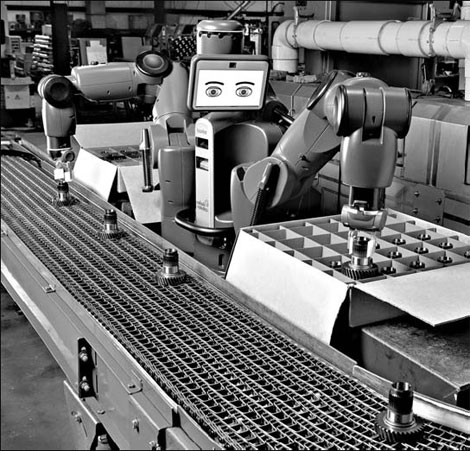
Baxter from Rethink Robotics, which has been shipped to manufacturers since January, is in a new class of robots that can work directly with people. Rethink Robotics |
Factory robots are usually caged off from humans on the assembly line lest the machines' powerful steel arms deliver an accidental blow.
But now, gentler industrial robots are coming out from behind their protective fences to work shoulder-to-shoulder with people. It's an advance made possible by sophisticated algorithms and improvements in sensing technologies like computer vision.
The key to these new robots is the ability to respond more flexibly, anticipating and adjusting to what humans want. That is in contrast to earlier generations of robots that often required extensive programming to change the smallest details of their routine, said Henrik Christensen, director of the robotics program at the Georgia Institute of Technology.
"Researchers in labs worldwide are building robots that can predict what you'll do next and be ready to give you the best possible assistance," he said.
One of those researchers is Julie A. Shah, an assistant professor in the department of aeronautics and astronautics at the Massachusetts Institute of Technology.
Dr. Shah once taught robots to do tasks the old way: by hitting a button that told them "good," "bad" or "neutral" as they did each part of a job. Now she has added a technique called cross-training, in which robots and humans exchange roles, learning a thing or two from each other.
In a recent study, Dr. Shah and a student had teams perform a chore borrowed from the assembly line: the humans placed screws and the robots drilled. The teammates exchanged jobs and the robots observed the humans as they drilled.
"The robot gathers information on how the person does the drilling," adding that information to its algorithms, Dr. Shah said. "The robot isn't learning one optimal way to drill. Instead it is learning a teammate's preferences, and how to cooperate."
When the cross-trained teams resumed their original roles, robots and people did their jobs more efficiently. The time that the humans were idle while waiting for the robot to finish a task dropped 41 percent and the time that humans and robots worked simultaneously increased 71 percent, when compared with teams working with robots trained the old way.
"By learning the human's role, the robot can better anticipate actions and be a better partner, even if in the end it will only do one role," said Andrea Thomaz, an assistant professor of interactive computing at Georgia Tech.
The humans on the teams also improved their teamwork skills, said Illah R. Nourbakhsh, professor of robotics at Carnegie Mellon University and author of the book "Robot Futures," published this month by M.I.T. Press. "In the future, this idea of cross-training will turn out to be really important as robots start to work shoulder-to-shoulder with us," he said. "We are not very good at adopting the point of view of a robot. This study showed that we can learn, though, with the right signals."
Gentle, helpful robots are arriving in the marketplace. Since January, Rethink Robotics of Boston has been sending customers its two-armed robot called Baxter, which costs $22,000 and can work uncaged, moving among people.
Baxter can lift objects from a conveyor belt. "You don't have to tell it the exact velocity," said Rodney Brooks, Rethink's founder, chairman and chief technology officer. "It sees objects and grabs them, matching its speed to the speed of the object."
A Danish company, Universal Robots, sells a one-armed robot for $33,000 that can also be used without a cage.
The new robots will soon have even more advanced skills, said Stefan Schaal, a professor of computer science, neuroscience and biomedical engineering at the University of Southern California.
In the future, Mr. Schaal said, robots will be able to go on the Internet and exchange information, leading to vast gains in what they can accomplish.
"It will take time before we get there," he said, "but it will happen."
The New York Times
















