


Sky's the limit for business aviation
|
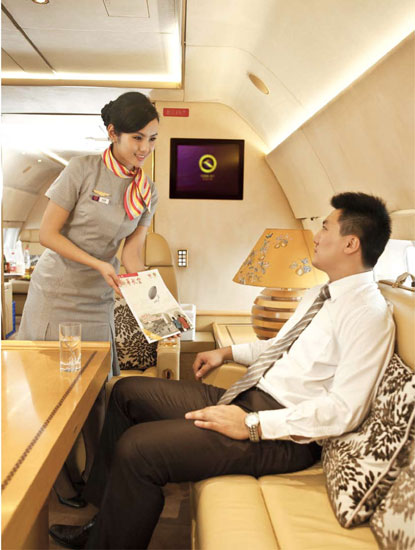
A flight attendant in a business aircraft runing by Deer Jet was servicing the only passenger in a charter flight. Provided to China Daily |
Rival operators compete for their share of a market which experts say is set to soar
When Ji Xingzhuo first launched his business jet operation, in Hong Kong in 2006, China had only about 20 business aircraft in total.
By 2012, the number in the Chinese mainland had risen to 187 - the most in the Asia and Pacific region - with Ji's company operating 17 of them.
Now the chairman of Air Taxi (Hong Kong) Business Jet Co Ltd, Ji has witnessed, first hand, the boom in China's business aviation market, particularly since 2008.
His company flies jets between the Chinese mainland, Hong Kong, Macao and some foreign cities in Southeast Asia.
"My clients are mainly high-end tourist companies and they use the jets to transport their customers," he said.
Statistics from JetNet LLC, the air industry market research firm based in the US, show that China's business aircraft fleet increased 103 percent in the decade to 2012.
The sector has outperformed the growth of the general civil aviation industry in China, which experienced a 28 percent rise in 2011, according to Li Jiaxiang, head of the Civil Aviation Administration of China.
The number of business jet operators is also growing fast.
Three big players have dominated the business aviation market since 2003, but all have experienced mixed fortunes during the years.
More general aviation enterprises have also shifted their attention to the business end of the market.
There were 15 business jet operators in China in 2012 and 41 enterprises were preparing to launch operations, according to the CAAC, with many operators reporting that the economic slowdown has done little to dampen enthusiasm to enter the fray.
"Our aircraft are flying over 70 hours monthly and the business has been largely unaffected by the recession," said Wang Chenglong, regional sales manager at Hanhua Airlines, a business jet operator based out of Dalian, in Liaoning province.
Hanhua, which made its first business flight in July 2012, has two Bombardier Challenger 300 aircraft and about 70 percent of its clients are private entrepreneurs.
Donghai Jet Co Ltd, based in Shenzhen, in the south of Southern China's Guangdong province, runs six business jets and each of those are in the air for around 10 hours a week, said Zhou Xiaoxiao, the deputy manager of its marketing department.
Zhou said its clients are mainly private-owned energy businesses.
Hanhua and Donghai say they are both optimistic about prospects for the business aviation market.
Deer Jet Co Ltd, a subsidiary of air transportation, real estate, retailing, financial solutions, and tourism conglomerate HNA Group, is considered the largest business jet operator in China with 55 aircraft.
It is forecasting that China's business jet fleet will be over 500-strong by 2015, although officials admit the slowdown has had some affect on its levels of business.
"The potential demand for business jets is huge and the market will develop fast, when the economy improves," Deer said in a statement.
However, it has been far from clear blue skies for the some in the sector.
The government's strict regulations to fight corruption and encourage frugality is expected to hit some operators hard, especially those flying in and out of Beijing.
"Our business departures from Beijing have dropped by over 20 percent since the regulations were released in late 2012," said one business jet operator, who refused to be identified.
In response to the austerity measures, not just government officials and those from State-owned companies have cut back on extravagant travel, even some private-owned companies have scaled back their business jet reservations, he added.
Making a profit is already hard for many in the industry, with operating costs still soaring higher than incomes in some cases.
Even the larger operators say they are finding it hard to keep their figures in the black, according to some industry experts.
Despite the tighter budgets, operators say they have no choice but to continue spending on new fleets, staff and marketing.
"The clearance fee from Beijing increased recently and the cost of flying from Beijing to Boao in Hainan province also rose by about 100,000 yuan ($16,180) this year," said one manager.
High taxes are also making some wary of buying new aircraft, especially import taxes, with operators having to pay 4 to 5 percent customs duty and 17 percent value added tax on new aircraft purchases.
"That tax is one reason why I set up my company in Hong Kong," said Ji Xingzhuo.
The high cost of jet fuel in China is another consideration, Ji added, and his fleet is usually refueled overseas.
And on top of those issues, Ji said he has to deal with a shortage of qualified staff.
"Professional managers, who understand aircraft, sales and management, are very rare in China right now," he said, "as are pilots."
He hired a management company to run Air Taxi when it first started, and since then he has trained his own workforce - but now he finds that competitors try to poach members of his team.
The problem is becoming more serious, he added, and as a result he has had to raise wages to hold onto employees, as they are often tempted away by higher salaries.
Cut-throat competition among operators is also forcing down income.
Some industry insiders say the operators are charging 30,000 to 40,000 yuan per hour, just to hold onto business, which experts suggest is unsustainable in such an expensive industry.
Some suggest that consolidation in the industry is inevitable.
"No more than 20 operators will survive in this market," said Gao Yuanyang, director of the General Aviation Industry Research Center at Beihang University.
"Any successful operator needs a fleet of at least 15 aircraft," he added.
As smaller operators struggle under rising costs, the larger ones have been able to focus on the very top end of the market, which continues to grow strongly.
Wu Jingkui, sales and marketing vice president of Cessna Aircraft Company in North Asia, told the CAAC Journal recently that business jets are still considered luxury in China, but that it is important to remember that their use does reduce time costs, and increase work efficiency of top executives.
But industry insiders still consider there is room for the market to grow in China, across all levels of service.
To increase the operational efficiency of their aircraft, some operators have already started offering seats to individual passengers on return charter flights, to bring in some much-needed income.
Wei Yuhang, the manager of the trustee department at Hanhua Airlines, said it now considers offering seats on some fixed routes to paying passengers, if there is room on a plane.
"Business jets can often seat a lot more than just a couple of passengers per fight," added Air Taxi's Ji.
He is preparing to open a new service, too, to raise flight occupancies, which will offer seats on his business jets on regional routes in China.
In the regions the civil aviation authority does not cover, such as Yunnan and Guizhou provinces, business jets with around 15 seats can work as normal commercial operators.
On his new service, Ji said ticket prices will be higher than other larger civil aviation operators, but they will be much lower than chartered flights.
"I like to think of it as a kind of supplementary service for the regional aviation sector," he added.
Wang Ying contributed to the story
















