Chinese artist's abstractions on display
|
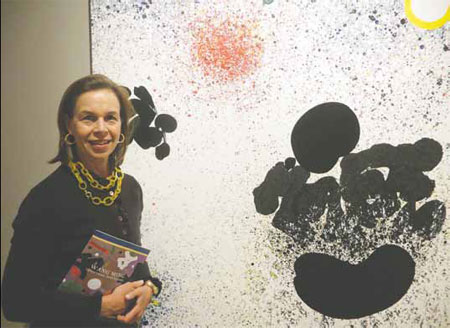
Lee Potter, co-director at David Findlay Jr Gallery in New York, stands in front of one of Chinese abstract-expressionist painters Wang Ming's paintings. An exhibit of Wang's work will be on display at the gallery until May 25. Caroline Berg / China Daily |
Wang Ming's journey has been long, but his passion for painting remains unflappable, even in his 90s.
"He is a force of nature," said Lee Potter, co-director at David Findlay Jr Gallery in New York. "His studio is like a maze that you have to get around because his work is stacked up all over the place."
The self-taught artist was born in Tianjin, China, in the 1920s, and immigrated to the US in 1951. Wang has since spent six decades pursuing a synthesis of East and West, or yin and yang, in his art.
"[Wang's] works are always looking at two views at once and putting it all together," said Jeffrey Wechsler, former curator at the Zimmerli Art Museum at Rutgers University in New Jersey. "Looking at the art, it's a natural unity of Eastern and Western aesthetics, and artistic philosophies."
The exhibit Wang Ming: Universal Dimensions, which opened on Saturday, will be on display through May 25, at the Findlay gallery.
The show will be a retrospective of Wang's work over the decades, representing 30 paintings, drawings and watercolors that embrace Abstract Expressionism.
"The thing about [Wang] is he'll work on a picture in the '70s, and then he'll go back in the '90s and paint something over it - typically it's a black calligraphic addition he'll put into the painting," Potter said.
Wang abides by the Taoist philosophy that no true division exists between past, present and future, which lends to his tendency to return to seemingly completed works and add to them, according to Wechsler.
Wang's enduring fascination with celestial beings adds to his art's ever-present themes of the continuous and worlds without boundaries. He draws so that his art can be viewed in any orientation.
"He's always had interest in space - open space, the cosmos and the freedom of having no up or down," Wechsler said.
In 1938, when he graduated from high school, Wang and two friends left their families and walked for four months to escape Japanese occupation in eastern China. Wang eventually moved to Taiwan and found work as an air traffic controller during which he developed his love for sky and space.
After relocating to Washington, Wang established a frame shop and began experimenting with celestial images while combining acrylic paints with the traditional Chinese calligraphy art form.
"When the Hubble [Space Telescope] photographs started coming in, [Wang] basically saw this as a parallel to what he'd been doing already," Wechsler said.
The spattering technique Wang employs is very logical for presenting celestial and cosmic forms, such as stars, planets and nebulae, according to Wechsler.
"He's presenting the nature of the cosmos within the context of abstract painting with different calligraphic shapes and forms within a technique which ties into the subject very, very well," the independent curator said.
In his experience, Wechsler has found people really respond to Wang's work and his universal style makes for a "terrific entry" for beginners getting into abstraction.
'Many of the techniques, concepts and ideas behind abstract expressionism, which American critics said was exclusive to the US and something that was really born in the US, are actually found in traditional Eastern art that goes way, way back," said Wechsler, who in 1997 published the book Asian Traditions/Modern Expressions: Asian American Artists and Abstraction, 1945-1970.
Wechsler said Wang is only continuing the abstraction tradition while applying a modern spin to the art form.