


Abe unable to read situation
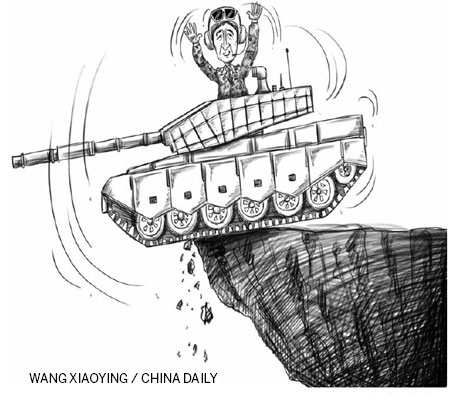
Japanese Prime Minister Shinzo Abe has drawn international criticism because of his revisionist approach to history. Of late, Abe joined his associates to raise the rallying cry of "long live (banzai)the emperor" during the first ceremony to mark the anniversary of the restoration of Japan's sovereignty after the seven-year occupation by United States-led forces after the end of World War II.
This, together with his previous provocative actions, has outraged peace-loving countries and has left them wondering whether the commemoration was aimed at reviving Japan's militarist past under Abe's leadership.
Without showing the slightest sense of guilt and responsibility, Abe has stepped up efforts to whitewash Japan's war crimes. On April 23, a group of 168 Japanese lawmakers visited the Yasukuni Shrine, which honors World War II criminals. The gathering was the largest since 1989. Without being present in person, Abe donated religious ornaments to the Yasukuni Shrine on April 20 when three of his cabinet ministers visited the shrine.
Abe defended his cabinet members saying it was natural to pay homage to the war dead who sacrificed their lives for the country and that his administration would defend the right of people to pay such visits, without giving in to any threat. Abe's statement that the definition of aggression is yet to be established academically and internationally reflects his blatant attempt to deny Japan's militarist history.
Abe has never shied away from showing his nationalistic streak. At present, he is busy tightening his grip on Japanese nationalists and translating his extreme right-wing speeches into actions in a bid to ensure that his party, the Liberal Democratic Party, wins a comfortable victory in the Upper House election in July.
Just one day before he left for Moscow, Abe wore a camouflage jacket and helmet, and climbed atop a tank during an election campaign and said that provocative actions against Japan's sovereign sea and land will not be tolerated.
In fact, Abe, the first Japanese prime minister born after World War II, had made his intentions to rewrite Japan's nationalist history clear after being elected prime minister for the first time in 2006. During his first stint in office, Abe expressed doubts over the validity of the Tokyo Trials, saying that the people convicted of being class-A war criminals by the Tokyo tribunal were not criminals under Japan's domestic laws. He also engineered changes to the Fundamental Law of Education to enhance the sense of patriotism among Japanese students.
After making a rare comeback to Japan's top job in December 2012, Abe has more than once indicated his intentions to replace a 1995 statement by Tomiichi Murayama, then prime minister, in which he apologized for the colonial rule and atrocities committed by Japan before and during World War II and which was endorsed by successive Japanese governments for nearly two decades.
These are clear signs of militarism rearing its head in Japan. Abe stepped down six years ago because of his dismal approval ratings and a series of LDP scandals. But now his public approval rating is about 70 percent, which emboldened him and his right-wing allies to fan nationalistic passions. And the misled public seems to support him, creating a larger stage for the right-wingers in Japan.
Abe's hawkish statements and behavior are firmly in line with his right-wing thinking. After the center-left Democratic Party of Japan suffered a crushing defeat at the hands of the LDP last year, Japan swung to the extreme right and has since sought to strengthen its alliance with the United States and other Asia-Pacific countries to contain China.
Abe's political views are highly influenced by his grandfather Nobusuke Kishi, once a war crime suspect who later became Japan's prime minister. Abe has stepped into his grandfather's shoes and has repeatedly expressed his desire to revise the country's post-war pacifist constitution to give teeth to the Self-Defense Forces. His gospel of building a "beautiful country" which can be proud of its traditions and unique culture is a pretext to further his right-wing agenda. His "long live the emperor" slogan mirrors his intention to revive Japan's militarist past.
But by following this path, Abe is making a fool of himself. Japan is guilty of waging wars before and during World War II, and this truth can never be effaced from history. As Japan's prime minister, Abe should have realized that and tried to establish the right historical view about Japan's past and mend the country's fences with its neighbors. It's time he realized that his lamentable lack of foresight and right-wing zeal will sour Japan's relations with its neighbors and bring utter disgrace on the country.
The author is dean of the School of Japan Studies, Nankai University, Tianjin.
















