


Li's overseas trip just a first step
China's development depends on its success in integrating itself into the world around it
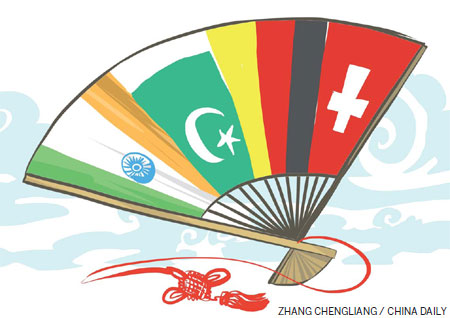
The itinerary of Li Keqiang's first foreign trip since becoming premier has surprised many. In Asia he chose to visit India and Pakistan, and in Europe, Germany and Switzerland. Long-running border disputes have made China's relationship with India a difficult one, while in Europe, both France and Britain, with their size and co-membership of the United Nations Security Council alongside China, would appear as more obvious destinations. With President Xi Jinping choosing Russia for his first overseas visit in April, it is notable that no country on the American continent, nor in central Asia, nor the Middle East has featured in the initial travel plans of the two Chinese leaders.
China is entering a new phase of its development as a global power. Over the next decade the Chinese economy will approach that of the United States in size. As this happens, inevitably China's relationship with the rest of the world will deepen and broaden. In isolation, China cannot reach its full potential. Its continued development depends on its success in integrating itself into the world around it.
Yet China's unique history means that today the country has few significant friends and allies of long standing. For thousands of years, China felt itself to be the center of the world, the Middle Country. The idea that other countries could consider themselves to be on the same level as China was unthinkable. In those days, the question of Chinese allies did not arise, because there was no need for them.
The response given in 1793 by the Emperor Qianlong to the English trade mission led by Lord Macartney expresses the position: "Our dynasty's majestic virtue has penetrated unto every country under heaven, and kings of all nations have offered their costly tribute by land and sea. As your ambassador can see for himself, we possess all things. I set no value on objects strange or ingenious, and have no use for your country's manufactures."
A century and a half later, the backing given by the US to the Kuomintang, today's ruling party in Taiwan, in the Chinese civil war underlies today's uneasy relationship between the two largest world economies. The Taiwan Relations Act of 1979 places a legal obligation on the US government to support Taiwan in any conflict with the mainland. It was not until 1971, 22 years after the founding of the People's Republic of China, that most major countries followed the United Nations in recognizing Mao's government in Beijing as the rightful Chinese government.
Today, China's rapid emergence to a leadership role is disturbing the global balance of power that has existed since 1945. While China remains under the spell cast by its long history of splendid isolation, it is easy for it, the big new boy on the global block, to become isolated and friendless as its neighbors join together to resist the growth of Chinese influence.
So as China's power grows, and in the presence of the US-led Trans-Pacific Partnership, which excludes China, Beijing has a growing and powerful need for strategic allies among the world's leading economies. Perhaps India, which has never enjoyed a warm relationship with China, can become a good Chinese acquaintance, if not a close friend. A steady Sino-Indian relationship would help to provide a balance in East Asia against the negative waves emanating from a US-backed Japan.
But in the presence of one of China's long-standing friendships, with India's traditional enemy Pakistan, there are probably limits to how far Sino-Indian friendship can develop.
Despite Europe's economic difficulties, the region remains a key trade partner for China, and of first-order importance as much for its economic size as for its technological and cultural leadership. By including Germany and Switzerland in his first overseas visit, the Chinese premier has shown that China is focusing on developing friendships with countries in Europe that are economically stable, large enough to have significant influence within the European region, and geographically central.
Germany and Switzerland have developed strong, positive economic and political relationships with China. Both were investors in China at the beginning of the opening-up period. In fact, as Li has pointed out, the China joint venture by a Swiss elevator company was the first to be signed in China after 1979. Germany's two famous automotive joint ventures in China involving Volkswagen, First Auto in Changchun and Shanghai Auto have been market leaders since they were signed in 1985.
None of the other major European countries qualify as potential long-term partners for China in Europe in the way that Germany and Switzerland do.
The first two obvious candidates, France and Britain, have both had an up-and-down relationship with China. Neither Britain nor France has recovered from the financial crisis, and it looks as if both will go through several more years of economic difficulty. Elsewhere in Europe, Italy appears to have become ungovernable, and, like Spain, is undergoing considerable hardship in its efforts to stabilize its economy.
Moreover, Li had a particular reason to visit Switzerland, to put the finishing touches to the Sino-Swiss free-trade agreement under discussion since 2010. This will be the most important of the dozen or so free trade agreements that China has arranged, because Switzerland is among the world's 20 largest economies, and is also a very advanced manufacturing and financial services economy.
The Sino-Swiss FTA provides Chinese companies with a platform in the heart of Europe from which they can penetrate the European economy to acquire new markets and new technology. In fact, the expectation of a Sino-Swiss FTA has recently generated a wave of Chinese investment in Switzerland, while in the first three months of this year Sino-Swiss trade grew more than doubled year on year, with Switzerland showing a large surplus in its Chinese trade.
A strong economic relationship between China and Switzerland is of fairly recent origin, but Germany has been one of China's most important investors and trade partners since 1980, with all of Germany's mighty industry, ranging from autos (VW, BMW, Mercedes) to chemicals (Bayer) to engineering (MAN, Siemens and Thyssen), investing heavily in the Chinese economy. Germany is proving to be a powerful Chinese ally in the row between China and Europe over the European activities of China's solar and electronic companies, which the European Union is trying to limit on grounds of unfair competition.
With Huawei, one of China's leaders in electronic equipment manufacture, recently abandoning its efforts to penetrate the US market under considerable pressure, it is very important, both for Huawei and for the rest of China's industry, that both sides find a good solution to their disagreement. A top-level intervention in the China-EU trade dispute is called for, and Li's visit to Germany is well timed in this regard.
By 2023, the Chinese economy will have more than doubled in size from today, and China will truly be a dominant player on the global stage. For China, Li's first overseas visit represents a first step to a new level of global involvement and integration.
The author is a visiting professor at Guanghua School of Management, Peking University. The views do not necessarily reflect those of China Daily.
















