


Philippines sends message against ivory trafficking
|
Government workers use a backhoe on Friday to destroy smuggled elephant ivory tusks that had been confiscated at the Parks and Wildlife center in Quezon City in the Philippines. Erik De Castro / Reuters |
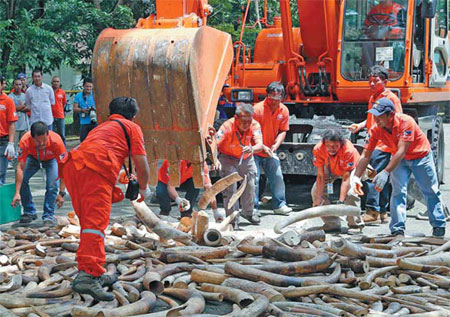
The Philippines began destroying five tons of elephant tusks on Friday in a landmark event aimed at shedding its image as one of the world's worst hotspots for illegal African ivory trading.
The backhoe of a bulldozer began crushing hundreds of tusks in a wildlife bureau parking lot, as the nation became the first in Asia to eliminate its multi-million-dollar stockpile.
"This act is a strong statement to the rest of the world that the Philippines will not tolerate the illegal wildlife trade," Environment Secretary Ramon Paje said.
The five tons of ivory came from a total of about 13 tons seized by customs officers since the mid 1990s, with the two biggest hauls at Manila's seaport and international airport in 2005 and 2009.
The rest of the ivory, worth millions of dollars on the black market, was stolen over the years.
Most of it went missing while being kept by the customs bureau, a notoriously corrupt organization in the Philippines, and a wildlife bureau officer is on the run after being charged with stealing about 700 kg.
The Philippines was in March named by the Convention on International Trade in Endangered Species, or CITES, as one of eight nations that was failing to do enough to tackle the illegal trade in elephant ivory.
The United Nations and conservations groups have warned the demand for ivory is leading to the slaughter of thousands of African elephants each year, which could eventually lead to their extinction.
The Philippines was named because of its role as a transport hub for African ivory being smuggled into countries such as Vietnam and Thailand, where demand has skyrocketed in recent years.
The ivory is highly sought after for statues, trinkets and other items to showcase wealth.
Demand is also high among Catholics in the Philippines, with the ivory used for religious icons.
Paje said the destruction of the ivory was one part of the government's action plan submitted to CITES since March to show it was trying to curb the trade.
Another was the launch on Friday of a multi-government-agency taskforce focused solely on the ivory trade.
"The Philippines will not be a party to this massacre (of African elephants) and a conduit for the cycle of killing," Paje said.
The executive director of the London-based Environmental Investigation Agency, Mary Rice, praised the Philippines for taking the lead in destroying its stockpiles.
"This is a really significant event. It is the first time a consuming country and an Asian country has decided to dispose of its seized stockpiles," Rice, who was in Manila to witness the event, told AFP.
Rice said thousands of kilograms of seized ivory were sitting in storehouses in other cities around Asia and other parts of the world.
Some African nations have previously burnt ivory stockpiles, most recently Gabon last year.
The UN and conservation groups warned in a major report in March that African elephants faced the worst crisis since global trade in ivory was banned almost a quarter-century ago.
Illicit trade in ivory has doubled since 2007 and more than tripled over the past 15 years, according to the report, which estimated that only about 420,000 to 650,000 elephants remain in Africa.
About 25,000 African elephants were estimated to have been killed for their ivory in 2011, the report said, and conservationists believe last year was even worse.
The Philippine efforts to destroy the tusks were complicated as the government backtracked on an initial plan to burn the tusks due to protests from environment groups about open-air fires.
A second plan to crush them with a roller was also cancelled after it was realized the tusks were too tough.
The third plan of crushing them with a backhoe, one-by-one, was expected to last at least a day. The government said the remnants of the tusks would then be burned at an animal crematorium.
(
















