


Undetected river pollution sparks criticism
|
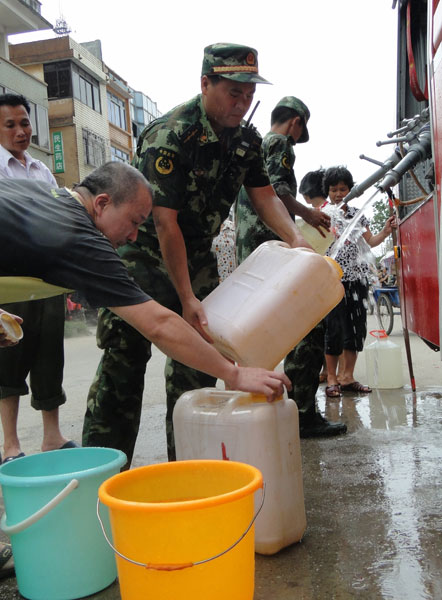
Firefighters from Fengkai county, Guangdong province, provide clean water for residents. Fengkai authorities warned on Saturday that water in a section of the Hejiang River has been tainted by pollution upriver. Wei Shiming / for China Daily |
Heavy metal contamination affects usual water supply for thousands
The thallium- and cadmium-contaminated water in the Hejiang River in Hezhou, the Guangxi Zhuang autonomous region, will keep about 30,000 people downstream in Fengkai county, Guangdong province, from using river water for almost three weeks and put tens of millions more people on alert in the downstream Pearl River Delta.
The Hezhou government closed 112 illegal metal mines along the Maweihe River, a branch of the Hejiang, on Saturday. Seventy-nine of the closed mines had been verified as pollution sources by 9 am on Sunday. Their industrial waste was carried to the river by floods from recent torrential rains.
Thallium and cadmium are carcinogenic and poisonous heavy metal pollutants.
Xu Zhencheng, vice-director of the South China Institute of Environmental Sciences of the Ministry of Environmental Protection and leader of the task force, created by the Guangxi government to investigate the pollution, said on Sunday that the water will clear up itself through natural dilution of the pollutants, but he added that it will take at least a week for the water quality along the border with Guangdong province to return to national standards.
"About 110 km of the river is polluted now. The peak concentration of cadmium in the Hejiang River was 5.6 times the allowed level," Xu said.
"We need not neutralize the pollutants by throwing more chemicals into the river given the current levels. Chemical neutralization is used to bring down the pollutant level to about four times the standard level. The water will recover itself in about 20 days, and the situation is still under control."
Despite the steady decline of pollutants in the river, the task force suggested that all water supply plants that use water from the mouth of the Maweihe River to the point where Hejiang River joins the Xijiang River take emergency measures. The plants should start using their backup water sources, and those plants without alternative water sources must eliminate cadmium and thallium while treating the inflow of river water, the team said.
The Guangxi Environmental Protection Department set up 14 temporary water quality monitoring points for round-the-clock detection and reports along the Hejiang River in Guangxi.
Bi Haidong, Hezhou vice-mayor, apologized at Sunday's news conference for the negligence of Hezhou environmental protection bureau's work.
According to the Guangdong Environmental Protection Department's report on 10 pm Saturday, water quality in the Xijiang River in downstream Nanfeng has not been affected by the pollution. In the Nanfeng section of the Hejiang River, the concentration of thallium was 1.2 times above allowed level, and the level of cadmium had dropped to a safe level by 3 pm Saturday.
Both Guangxi and Guangdong authorities assured the public on Sunday that all running water there met national standards.
But the duration of the pollution problem, which was quickly brought under control when it was addressed, has raised questions.
Dead fish were found in some stocks in the Hejiang River in Hezhou beginning on July 1. The Hezhou environmental protection bureau did not find any problem with the water then.
More fish died in large amounts in the Hemianshi section of the river on Friday, but the city environmental authority also did not find anything wrong in its second round of tests "because of its limited detection means", the Hezhou government said on Saturday.
As the fish deaths continued, the Hezhou government reported the case to the Guangxi Environmental Protection Department. The department task force led by Xu reached Hezhou by 2 am on Saturday, discovering two hours later that the cadmium was 1.9 times the allowable level, and thallium 2.14 times, in the sampled water obtained in the river's surface in the Fulong monitoring station on the border of Guangxi and Guangdong.
The Guangxi government reported the findings to local people and its counterpart in Guangdong at 4 am on Saturday.
Zhao Zhangyuan, a senior researcher with the Beijing-based Chinese Academy of Environmental Sciences, said that the Hezhou environmental protection bureau should have the ability to detect problems immediately.
"It is irresponsible for the city government to help the local environmental watchdog shirk its responsibilities with the excuse of 'limited detection means'", he said.
"It is a pity the environmental watchdog and local residents were left in the dark while serious pollution that threatens public health was present. Although the pollutants are steadily declining now, the expert team and local authorities must act to remedy the ecology and accelerate the recovery of the river water, rather than waiting for it to recover itself."
Zhang Hui, a researcher of environmental studies with Sun Yat-sen University in Guangzhou of Guangdong province, agreed.
"Heavy rains are not an excuse for pollution. Slag containing heavy metals such as cadmium and thallium must be stored well, according to law," he said.
"If local supervisory authorities of mining and environmental protection had fulfilled their duties, there would not have been so many illegal mines operating in such an environmentally vulnerable area, which is of vital ecological significance for South China, given its dense river network."
Zhang added that an ecological compensation system should be established along important rivers' drainage areas to promote balanced growth. Provinces like Guangdong, in the downstream part of the rivers, together with the central government should subsidize provinces like Guangxi, which are upstream, to help those poor upstream regions give up their polluting industries, which are big boosters of local GDP growth.
A similar program between Anhui and Zhejiang provinces over the Fuchun River was successful in 2012. The upstream Anhui kept the river clean without affecting its economy with subsidies from Zhejiang and the central government.
Without such a program, "it is impossible for the poor regions to give up the polluting industries", Zhang said.
















