


Chinese liquor producers feel hangover
|
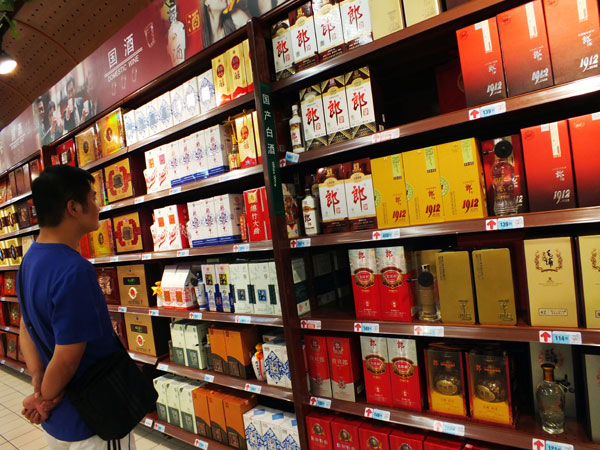 A customer shops for Chinese liquor at a supermarket in Yichang, Hubei province. Sales have plunged since last year, after the central government vowed to crack down on lavish liquor-fueled banquets. Provided to China Daily |
Chill winds are sweeping the Chinese liquor (baijiu) industry, and competition in the low and middle ranks of the market will persist as the government continues a crackdown on luxury official banquets, analysts said.
"We believe the listed baijiu companies saw their business hit bottom in the second quarter," said Dennis Wang, an analyst with UBS on Wednesday, as he released an industry outlook report.
"A modest recovery is likely during the second half of this year. But the full-year growth rate of this sector will be below 20 percent, which is the lowest level since 2003."
Intense competition will occur in the low and middle ranks of the market, where prices range from 100 ($16.30) to 300 yuan per bottle.
Meanwhile, more of the big brands are expanding into the grassroots market, as high-volume purchases shrink largely due to the authorities cutting public expenditure on receptions.
China's leading distiller, Wuliangye Yibin Co, was reported on Wednesday to be planning to introduce two new product lines late this month, at 100 to 400 yuan, as part of its move to seize opportunities in the mid-priced liquor market.
Sichuan-based Wuliangye and Guizhou-based Kweichow Moutai Co Ltd are the most prestigious distilled liquor brands in China, as well as the most popular among government and military officials.
But sales have plunged since last year, after the central government vowed to crack down on lavish baijiu-drenched banquets.
Shares of Wuliangye have slumped more than 27 percent this year.
Other high-end brands like Jiugui and Tuopai Yeast warned in their recent interim reports of 90 and 80 percent year-on-year falls in net profit, respectively.
"Personally, I feel 100 to 400 yuan is the most acceptable price on the market. There are fewer public reception banquets nowadays.
"But the grassroots' need for baijiu is still large, especially at business and wedding banquets," said Shi Liyan, a long-time distilled liquor dealer.
No doubt, high-end liquors are less popular nowadays, but Chinese people say no banquet is complete without liquor, and no business negotiations can be concluded without a banquet, Shi said. Chinese distillers will not die out, even though imported wine is now considered more posh by some people, he added.
As for sales, online platforms are largely reshaping the industry, said Wang with UBS.
Ten percent of liquor purchases are made online, according to China Wine News.
"The e-commerce industry is bringing down the cost of liquor companies' nationwide expansion, which is a big benefit for low-end brands.
"High-end brands are also going online to promote their less-mature, secondary brands," Wang said.
According to Frost & Sullivan, a United States-based market consultancy, white spirit production will reach 17.05 billion liters in 2016, compared with 4.94 billion liters in 2007, for a compound annual growth rate of 14.8 percent.
Sales of white spirits are expected to grow from 110.9 billion yuan in 2007 to 926.5 billion yuan in 2016, with a compound annual growth rate of 26.6 percent.
But analysts said that consolidation of the industry will continue, and excess production capacity will be eliminated in the process.
The output of the nation's distilling industry reached 12 million tons in 2012, or 8 kg per person, which means the oversupply is clearly there, no matter whether it is at the high or low end of the market, said Wang.
According to the China Cuisine Association, by 2015, the number of primary white spirits customers who are aged between 30 and 49 will be 441 million. The post-1980 generation will make up 22 percent of them.
"Chinese liquor is in the blood of Chinese people," said Wang. Companies with clearer branding strategies and a comprehensive pricing mechanism will ultimately win the competition, he said.
















