


Detroit is magnet for China's auto industry
|
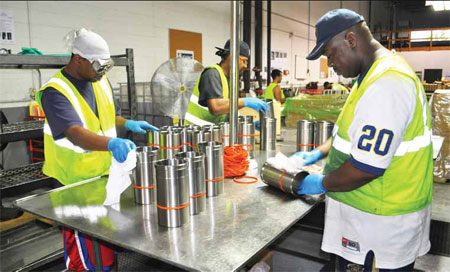
Workers prepare engine cylinder liners for packaging at the US distribution arm of ZYNP China Manufacturing near Detroit. Michael Barris / China Daily |
Despite motown's historic bankruptcy filing, its abundant engineering talent and automobile history lure Chinese auto companies seeking global expansion
Detroit is still Motor City - at least to Chinese automotive companies doing business there.
In the past decade, dozens of them have been drawn to the area, not just because of its existing infrastructure, supply network, abundance of skilled workers or tax benefits, but because of Detroit's pivotal role in automobile history.
"It is the center of modern vehicle technology," proclaims John Yang, chief metallurgist with ZYNP International, the US distribution arm of engine-cylinder maker ZYNP China Manufacturing. The facility is located in Romulus, Michigan, about 40 kilometers southwest of Detroit. "This area still has its strength and its ability in terms of technology and talent," Yang says.
Overwhelmed by debt of at least $18 billion, Detroit has filed for Chapter 9 bankruptcy protection, the largest such filing in US history.
As China's leadership boosts research and development for auto parts, mandated by the latest Five-Year Plan (2011-15), Chinese automotive companies have stepped up their activity around Detroit, doing everything from R&D on behalf of parent companies back home to making parts exclusively for US automakers.
Their arrival is welcomed by the state government, led by Republican governor Rick Snyder, former chairman of California computer maker Gateway Inc, and former chairman and CEO of Michigan venture-capital firm Ardesta LLC. The first-term Snyder administration sees China's interest in learning more about automobile production as a chance to create jobs for a hard-hit region.
Michigan was in the grip of a deep, decade-long recession until 2010. The state, whose economy is disproportionately affected by the automotive industry, lost nearly 218,000 manufacturing jobs from 2000 to 2005. It also suffered further near the end of the decade when auto sales at General Motors, Ford and Chrysler plunged because the Detroit Three could not compete against fuel-efficient Japanese cars at a time of high gas prices.
Last year, the Great Lakes State, struggling to recover from the economic slump, exported $3.2 billion worth of goods and services to China, a 25 percent jump from 2011 and lagging behind only Canada and Mexico. Michigan received more than $917 million in capital from China last year to become one of its top 10 direct-investment states.
"More and better jobs are created both by promoting Michigan exports to China and by attracting Chinese companies to locate operations in Michigan," says Michael Finney, president and CEO of the Michigan Economic Development Corp, a public-private partnership that provides grants, loans and other economic assistance to businesses that make investments or create jobs in the state.
Finney calls China's economic growth an opportunity for Michigan, a feeling that is shared by Chinese officials. During a recent visit to the Detroit Chinese Business Association in Troy, about 40 kilometers north of the city, Zhao Weiping, China's Chicago-based consul general to the Midwest, called Michigan "an important business partner of China".
Detroit's connection to a golden age of American automobile manufacturing fascinates Chinese automotive executives.
"Here in Detroit, we have a tradition," says Jerry Xu, president of the Detroit Chinese Business Association, a nonprofit business network that fosters bilateral business relationships between US and Chinese companies. "We have a lot of history and experience that no other place can have. That is why Detroit is always respected by the Chinese as the place for the automotive industry."
The business association estimates that about 100 Chinese firms, mostly in the auto industry, are active in the region. Those who go there typically aim to make a name for themselves in the global marketplace via Detroit, which has retained its legacy as a model for American innovation, notwithstanding its long decline and financial problems, Xu says.
Sometimes, he says, large companies come with abundant talent and experience in doing business in the US. But "there are a lot of medium and small businesses from China that need help when they come here", Xu says.
The area's abundant engineering talent is a magnet for Chinese auto-related companies looking to increase their knowledge of automobile production.
Hong Su, vice-president in charge of research at the United States R&D center for Chinese automaker Changan, in Plymouth, Michigan, about 40 kilometers west of Detroit, says he has hired about 20 engineers with US auto industry experience in the last few years because of their expertise in developing vehicles.
"In China, at original equipment manufacturers, the senior people - even managers and directors in engineering - have less than 10 years', 15 years' experience," Su says. "And most of that experience is in reverse-engineering, or copying. They don't have vehicle-development experience." Su chuckles as he says the youngest engineer at the US R&D center, which focuses on chassis design, has 19 years of Detroit industry experience.
China has reverse-engineered many cars, but even creating a copy requires vehicle-development know-how, Su says. "Vehicles have copyright issues; sometimes you are forced to modify. If you don't know the principles of how to modify, you can't do it."
Frank Yang, managing director at ZYNP International in Romulus, says the combination of the Detroit area's existing transport and manufacturing infrastructure, talent pool and cost-efficiency, along with government tax breaks, allow that US unit to pursue its plan to be a one-stop, full-service company in the engine cylinder industry. ZYNP International's ability to offer customers R&D, engineering, supply-chain management, manufacturing and financing under one roof "differentiates us from our competitors, either locally or internationally", Yang says.
As proof of the region's resilience despite Motown's well-publicized woes, the Chinese automotive companies' arrival has triggered an influx of companies from other fields. The new arrivals are "looking for clean technologies, looking for environmental and water solutions, looking for medical healthcare", as directed by China's latest Five-Year Plan, says Milan Stevanovich, business community development officer with the Detroit Chinese Business Association.
Some observers see China eventually joining Japan, Germany, South Korea and others in making and selling vehicles in the US. A March report by the US Congressional Research Service said the Chinese government is ultimately "seeking to develop vehicles that will be built in China and exported more widely to other markets, as the Japanese and Koreans did earlier."
China already is a major importer of US auto parts. Last year it imported about $1.6 billion worth of parts, the United States International Trade Commission says. The Congressional Research Service report says recent acquisitions of US parts companies will help Chinese parts makers "target technology and product innovations to enhance their operations" back home while "also permitting a shift from supplying low-margin parts to more profitable activities, such as integrating parts into component systems".
China's recent acquisitions include Wanxiang Group's $250 million acquisition early this year of US battery maker A123 Systems Inc; the purchase by Pacific Century Motors, a joint venture between the Beijing municipal government and another Chinese partner, of Nexteer Automotive from GM for $450 million in 2010; and the purchase by Beijing West Industries, a joint venture of two Chinese State-owned enterprises, of the suspension and brake units of Delphi Corp for $100 million in 2009.
















