Lessons from Denmark on aging
Visiting minister compares systems that care for the elderly and stresses involvement of families
As those of the post-1980 generation become the main breadwinners in China, one of the biggest questions is how the country will be able to support old people, who account for an ever growing proportion of the population.
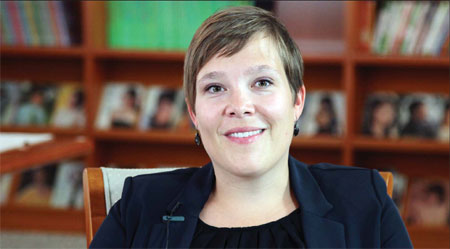
Astrid Krag, the Danish Health Minister, says many other countries including hers face a similar challenge but that it presents an opportunity for China and Denmark to help one another.
"China is so big, while Denmark is so small," Krag says. "But we face the same core challenge from the aging society. In Denmark we have had some experience dealing with the issue, which China can borrow from. China can start from where we are now, and avoid the mistakes we have made."
On her first visit to China, beginning in late August, Krag, 31, led a business delegation, including managers, academics and personnel in healthcare, to Beijing to seek "even stronger cooperation" in the field with China.
Meeting Krag, Wang Pei'an, vice- minister of the National Health and Family Planning Commission, said the Chinese aged-care system faces stiff challenges.
"As the country with the most aged population, China is turning older before getting wealthier," Wang says. "There are many disabled elderly and empty nesters, and a high proportion of the poor are older people."
More than 194 million Chinese citizens were aged 60 and above last year, accounting for 14.3 percent of the population. The figure will reach 300 million by 2025, the Ministry of Civil Affairs says.
There is huge potential in developing industries that provide services for the elderly, such as daily healthcare and medicines, says Hou Yan, a director of the National Health and Family Planning Commission.
"China's health services industry is now a relatively complete system, but the industry accounts for only 5 percent of GDP, whereas in the US the proportion was 17.6 percent by 2009."
Of course, in at least one sense an aging population is good news, given that it means people are surviving illnesses and living longer, but it also means more people need to be cared for, socially and physically, Krag says.
By 2050, one in every four Danish citizens will be older than 65. The sharp rise in the Danish elderly population will be in those individuals in most critical need of care, those over 80. This group alone is expected to grow 20 percent over the next 20 years, says the Home Instead Senior Care Network, a global senior care organization based in the US.
The number of those over 80 in Denmark will double by 2030, Krag says.
"Over the years we have built a social structure with skilled personnel who are not nurses or doctors but trained specialists helping with elderly citizens."
Krag looks on the delegation as a starting point for more cooperation. She met her Chinese counterpart, Li Bin, and discussed aged care and medical devices. Danish companies are leaders in the latter, she claims.
"We also discussed hospital construction and special homes for elderly people."
The Danish delegation visited Golden Heights, a high-end assisted-living community in Beijing whose fees are more than 10,000 yuan ($1,630; 1,240 euros) a month. Most of its residents are retired government employees with welfare benefits, so they have few financial concerns.
Krag was impressed by Golden Heights, and says that in Denmark most people unable to afford such accommodation get financial support from the government.
The aim is to keep the aged out of institutions as long as possible, with emphasis being placed on family-oriented care, as in China.
"It's good for the elderly if they can stay in their own home, and control their own lives. And it's cheaper for us."
The Danish health ministry has trained carers to help single older people in their homes, for example, with housework.
"If the elderly are too weak to live by themselves, we have the aged-care institutions to which you can bring your own furniture and make your own gardens," Krag says. "We want them to feel like they are living at home, but with a better social life."
Danish social welfare emphasizes tax and finance. The feeling is that the aged have worked and paid taxes for a long time, so the government can cover them in the later stages of their lives, Krag says.
Krag is proud that Danish people are willing to pay a high percentage of their salaries as tax, in return benefiting from a good social welfare system that includes free education, free medical care and good aged-care services.
"But if you don't have a tax-finance system to support every elderly person, I guess it's important for governments and families to work together. It's important to make sure that it is not only the people with the most money who have access to social welfare system in the country."
Based on the Danish experience, it is also important to have specially trained people and more public facilities for aged care, Krag says.
zhaoyanrong@chinadaily.com.cn
|
Danish Health Minister Astrid Krag says China and Denmark should help one another in health services. Wu Chuanjing / China Daily |