Music carries Chinese dream
A city is about to tell the world about Chinese culture through Music
This autumn, music lovers in Paris will have the chance to experience the exotic combination of Chinese culture and Western symphonic music.
On September 21, the International Day of Peace, Shenzhen Symphony Orchestra will perform Ode to Virtue at UNESCO's invitation.
Ode to Virtue is a symphony in five movements focusing on the core Confucian values of ren, yi, li, zhi and xin - benevolence, righteousness, propriety, wisdom and faithfulness. The ode uses orchestral music to express the shifts in Confucian thought over the past centuries.
"Confucianism is an important part of Chinese traditional culture, while ren, yi, li, zhi and xin are the core values of humanism, including a profound humanistic care and respect for life," says Wang Jingsheng, head of the CPC Shenzhen Municipal Committee's publicity department.
Wang proposed the idea of having a symphony composed in 2006 to better introduce Confucian philosophy and Chinese civilization to the world. It took six years to complete the music and write the material.
China is trying to revive its culture and to realize the Chinese dream, Wang says. One important element of national rejuvenation is to win world recognition and respect for China's core values.
"That is our expectation for Ode to Virtue. We want to promote the essence of Chinese traditional thinking through symphonic communication between Eastern and Western civilizations."
Ode to Virtue is a choral symphony written by contemporary Chinese composer Wang Ning, with lyrics by Yi Heng and Han Wangxi. Commissioned by the Shenzhen government, the work consists of five movements, plus a prelude and a coda. It tries to interpret the Chinese people's philosophy and attitude through the vocabulary of Western symphonic music. The work also seeks to motivate the Chinese people to strive for the dream of national renaissance.
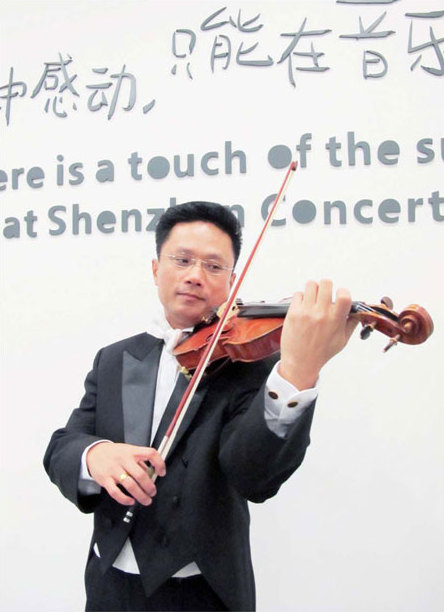
Zhou Long, chief violinist of the orchestra, says overseas audiences will easily understand the essence of Chinese culture through the symphony.
"It will be a good show," says Zhou, 48, who has studied and performed in the US for more than 20 years. He says the combined form is a perfect way to introduce Chinese culture to the world.
"It will be my first time performing for a European audience, but I think our team will bring the best out of the music."
Chen Xueqing, the chief cellist, agrees, saying music has no boundaries.
"There will not be any difficulties for our audience in feeling the Chinese elements in the music," she says. "They will understand the essence of Confucianism better through music than through reading about it."
In July, the Shenzhen Symphony Orchestra, the SSO chorus and the Shenzhen Senior High School Lily Children's Choir premiered the symphony in Pingshan district, Shenzhen, to an audience of about 700.
"The symphony represents the best of Chinese music," says Liu Ping, a Shenzhen resident. "Its lyrics and melody are very inspiring, full of positive energy. I think it conveys traditional Confucianism very well. It gave me an insight into profound traditional Chinese culture, and the end of the performance was exciting."
The first movement, Benevolence, uses harmony to express continuous change. The second movement, Righteousness, uses cellos to express the idea of a righteous person who fights evil, while the third movement, Propriety, is said to be the most refined. Wisdom, the fourth movement, uses a traditional singing style called Yin Song to help create a magical atmosphere. The last movement, Faithfulness, features brass and percussion, and leads to the final part, Wen Ming Yao.
Experts in Confucianism met three times in Shenzhen to reach an agreement on what the symphony would try to present.
After two public performances, seminars were organized for musicians and scholars to offer suggestions. The participants responded warmly and spoke highly of the work.
Xu Peidong, a member of the Chinese Music Association, praised the work during one seminar, saying it manages to convey the development of Chinese culture and also encourages people to think about this culture.
Ode to Virtue was performed from July 15 to July 19 and Aug 25 to Aug 31, in the Shenzhen Concert Hall and the Baoli Theater.
Han Wangxi, who wrote some of the lyrics for the piece, says using symphonic orchestration that is familiar to Westerners to compose a work on Confucianism will make it easier for Chinese culture to move out into the world.
"National rejuvenation needs to rely on culture, and what culture shows is a nation's spirit."
Han says that simply displaying bronze antiques and other items of China's cultural legacy is not enough to fully express the country's culture, which is full of spiritual content.
"Chinese people have a natural sense of intimacy with their history, and tradition is where we should go to find inspiration," says Han, who has a PhD in ethics from Renmin University and is also a visiting scholar at the Chinese University of Hong Kong.
"Ode to Virtue uses a very beautiful form to express traditional content, which today is a good way to promote Chinese culture."
Shenzhen has strived to become a world-class city, and many see this symphony as a symbol of its development. Though it focuses on Confucius, thus highlighting China's traditional culture the work also stresses the value of the current government's policies.
Wang Jingsheng says that Ode to Virtue has made a valuable attempt to reflect and promote Chinese traditional culture and contemporary values.
Shenzhen has always been at the forefront of reform and opening-up. Wang says the symphony is also the dream of Shenzhen: the city will always take the lead, dare to dream, and become the first city to realize the Chinese dream.
Shenzhen's Party Committee Publicity Department said its next step would be to promote the work to the whole country and even to the world to help create a Chinese culture brand.
"Books need translation; language has boundaries," Wang says. "But music has no borders. It can transcend ethnic and national boundaries.
"This is the glory and the dream of a city, that uses music to tell the whole world the story of the Chinese dream. I believe the world will understand."
linjingcd@chinadaily.com.cn
|
Zhou Long, chief violinist of Shenzhen Sympany Orchestra, says its music will help audiences better understand Chinese culture. Lin Jing / China Daily |