


Govt to expand elderly care
|
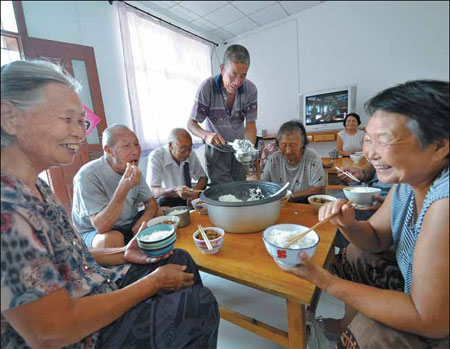
Senior residents have lunch at a nursing home in Cheng'an, Hebei province. The Ministry of Civil Affairs said it will focus on in-home elderly care services in the near future. Hao Qunying / for China Daily |
Support services to be offered in all urban areas by 2015, says official
The government is planning to increase support for families caring for elderly relatives, providing community care assistance to all urban communities and 50 percent of rural communities by 2015, according to a senior official.
"In designing our policies, we will prioritize the improvement of the support system to provide care for senior citizens," Wang Suying, a senior official from the Ministry of Civil Affairs, told China Daily in an exclusive interview.
"The family should be the backbone of the support network for elderly people, regardless of China's circumstances, the needs of senior citizens or international experience," she said.
However, Wang, who is deputy director of the ministry's social welfare and charity promotion department, said many families struggle to meet the demands in caring for elderly relatives and that the government aims to respond to that situation.
Statistics from the ministry show that less than 2 percent of the country's 194 million elderly people lived in nursing homes by the end of 2012. Meanwhile, fewer than 1 million of the 36 million senior citizens requiring care on a daily basis were residents of such facilities, Wang said.
"Chinese society is getting old before it gets rich. Families and senior citizens are not financially and psychologically prepared for this trend, which creates a lot of challenges for us," she said.
The government will improve the in-home care service network, relieving some of the pressure on family caregivers, Wang said.
The strategy will continue government efforts to involve private companies and social organizations in providing care services, including cooking, bathing and medical treatment.
Wang said the government aims to establish elderly care services in all urban communities and 50 percent of rural communities by 2015. At present, care services for senior citizens are available in only 41 percent of urban communities and 16 percent of rural communities.
Legal foundation
China views in-home care as the foundation of its elderly care strategy, a position that is reflected in amendments to the Law on the Protection of the Rights and Interests of the Elderly that took effect on July 1.
Zhu Yong, deputy director of the China National Committee on Aging, said the new law has highlighted the need for improved policies to support family caregivers.
The law states that, "the State encourages family members to live with or close to senior relatives, provides opportunities to allow the elderly to migrate with their spouse or children and provides assistance for family members to take care of the old."
However, to date, there is still no comprehensive policy framework to put these ideas into practice in a workable way, Zhu said.
According to the preliminary findings of a survey conducted by Zhu's organization in July, the services provided to the elderly in their homes are low in both quality and quantity.
"Most service providers who deliver door-to-door services can only take care of the elderly in terms of daily routines such as cooking and bathing, but they can't meet their emotional and physiological needs," he said.
In addition, the majority of caregivers in communities lack formal and specialized training, he added.
"Strengthening the role of families is a necessity for China to cope with population aging in an affordable way," he said. "If the government only develops elderly care facilities but ignores the significance of in-home care, it will increase its financial burden and fail to meet senior citizens' emotional needs."
Ongoing struggle
Chen Binqiang, a resident of Pan'an, Zhejiang province, has been unable to socialize with his friends after his mother got Alzheimer's disease six years ago.
"With a patient at home, it's almost impossible for me to take half a day off to go out together with my wife," said Chen, a 37-year-old teacher. "I really hope there were volunteers who can help take care of my mother, even if it's only for a few hours occasionally."
Chen has to lock his mother indoors when he and his wife go to work and the couple take turns to check on her during the day.
"We often find her lying on the floor after a fall," Chen said. "We have become more and more worried because her conditions are worsening. Now she can't feed herself, use the bathroom or speak."
Chen said he cannot afford to employ a caregiver, as the local price is more than 2,500 yuan ($409) per month, which is equal to his monthly salary.
Du Peng, a professor with the Institute of Gerontology at Renmin University of China, urged the government to learn from overseas experience in ensuring policies that are favorable to caregivers.
Hong Kong encourages adults to take care of aging parents by reducing their income tax, he said.
In Finland, the government provides a monthly subsidy of 380 euros ($507) to 720 euros to families that have elderly dependents, he said. Germany allows families to send their elderly parents to nursing homes for three days each month free of charge, providing caregivers with a respite, he added.
"But in China, the reality is that most families haven't received any financial support or other incentives to take care of aging parents," he said.
Yan Ran contributed tothis story.
hedan@chinadaily.com.cn
















