Up, up and Huawei
The Chinese telecommunications company's fortunes keep on rising in Europe
After the Chinese telecommunications company Huawei opened an exhibition center near Amsterdam recently, Eberhard van der Laan, the city's mayor, sang the companies praises to business leaders in a speech.
"I learnt the concept of clouding technology during my visit to Huawei headquarters in Shenzhen two years ago," he says.
The telling of that anecdote is typical of Van der Laan's unstinting praise of Huawei's contribution to his city and his country.
Yet 10 years ago when Huawei, now a global leader in its field, sent Patrick Zhang to Europe to explore market opportunities, he says he was unsure about what kind of reception it would receive.
The company ended up receiving such a good hearing and gaining such widespread recognition that recently local radio in the Netherlands broadcast live when Huawei hosted a half-day forum on trends in global information technology and big data.
Reflecting the company's growing presence in Europe, it has become the biggest Chinese investor in the Netherlands after 10 years of expansion.
"When we first went to Europe, we virtually wandered the streets like tourists looking for customers," says Zhang, now president of marketing and solutions at Huawei Enterprise Business Group, in an interview in Amsterdam.
"It was very hard, and the first steps were particularly difficult."
Huawei has been highly successfully in Europe thanks to its strategy of localization and attaching great importance to research and development. It now has ties with 560 European channel partners in telecommunications operations, had turnover in the continent of $4.17 billion (3.1 billion euros) last year, and has more than 7,500 staff, most of them Europeans.
With that success, the company decided in 2011 to take a new tack, offering information and telecommunications services to businesses directly rather than through other telecommunications companies.
That business is now growing rapidly, Zhang says, and the company expects it will have annual turnover of $1 billion in the coming three to five years.
Compared with Huawei's expansion in the US, which has run into roadblocks, Zhang says his company has been welcomed in most European countries and will diversify its service portfolio in the continent.
In Europe, Huawei has been "treated fairly", Zhang says, "unlike in the US, where we have encountered access difficulties for groundless reasons given by the US side".
Huawei has 13 R&D sites in eight European countries (Belgium, Britain, Finland, France, Germany, Ireland, Italy and Sweden) and operates dozens of innovation centers in partnership with local telecom and ICT operators.
The company, paving the way for its expansion in Europe, says it plans to create 5,500 jobs on the continent over the next five years.
"Apart from research and development, localization is our key to success," Zhang says.
The exhibition center in Amstelveen, a suburb of Amsterdam, at whose opening Van de Laan spoke recently, is aimed at global and innovative solutions specifically for the enterprise market. The 250-square-meter center is also being used to illustrate and promote cloud computing, the real-world use of big data, and the impact of social media on the success of enterprises.
Huawei says the center is a milestone in its expansion in Europe, particularly in the Benelux countries.
"By opening this new exhibition center I believe Huawei is demonstrating its commitment to long-term development in the Netherlands," says Li Fei, economic counselor of the Chinese embassy in the Netherlands.
"It also demonstrates the Netherlands' favorable investment environment."
Simon Xin, CEO of Huawei Benelux, says the company has expanded rapidly since it was founded in 1987. "We have more than 150,000 employees in more than 140 countries In Benelux we have more than 650 employees, of whom 73 percent are local staff, and we aim for more."
Europe is like a second home market for the company, Zhang says. Nevertheless, the enterprise business in Europe has not been all plain sailing, given the highly competitive market. But if Huawei can succeed in Europe, it can achieve more globally, Zhang says.
The company has about 10,000 staff working in research and development on the business sector to meet mounting demand, he says. The company also sells communications and information technology for railways and says it has nearly 35 percent of the global market.
"We expect to enter this field in Europe, too," Zhang says.
To give its businesses in new markets an extra push, Zhang says the company has changed its communications strategy in recent years.
"We used to deal mainly with telecommunications operators and channel partners," Zhang says.
But offering technology solutions to enterprises has change all that, he says.
"We need to meet a huge number of customers and explain what we do and what we can offer, and we need to become more open-minded."
Nearly half of the company's 150,000 staff work in research and development, and it will invest $5.5 billion in research and development this year, up from $4.85 billion last year, Zhang says.
"Research and development is our growth engine."
However, in May the European Commission decided to use trade defense tools to set barriers against China's mobile and telecommunications products, even though none of Huawei's rivals has complained about the Chinese company's activities.
In the US, Huawei and another Chinese company, ZTE, have been accused of posing a security risk.
"The reasons (offered by the US) are groundless," Zhang says. "The fact is that since we started to go global, there has not been one security complaint against us. Our services and products cover about 2 billion people worldwide.
"In fact, we are always doing our best to offer security and anti-virus solutions to our partners."
fujing@chinadaily.com.cn
|
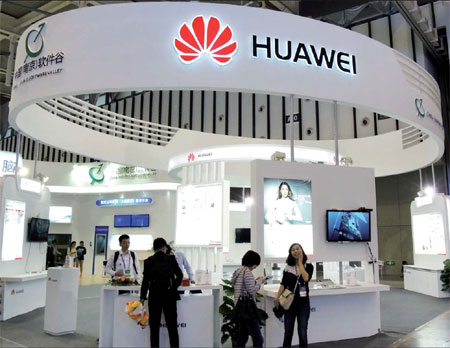
Compared to Huawei's expansion in the US, which has run into roadblocks, the company has been welcomed in most European countries. Provided to China Daily |