


Rural teachers make the grade
Young educators forgo good job prospects to bring learning to remote villages. Hu Yongqi reports in Huize, Yunnan.
When his mother passed away three years ago, Long Yongzheng, now 8, was too young to understand the tough road that lay ahead for him, his brother and his father, a farmer in Longjia village, located in one of the most-remote parts in Huize county, Yunnan province. Long broke his arm last year while harvesting corn, and his father Long Shunjin, 38, could not afford to pay 300 yuan ($51) for an X-ray. Instead of going to a hospital, he took the boy to an old villager considered a "doctor" of traditional Chinese medicine. The man bound the boy's arm in two splints and applied some herbs to it.
After Liu Yuliang, the boy's teacher, discovered why he had been absent for class for so long, he angrily reprimanded the father. Liu donated 300 yuan, and Long was taken to the hospital for treatment, but his bones would never fully recover.
"Sometimes accidents happen to the kids, but their parents are unable to take good care of them due to either a lack of money or awareness. In this small village, teachers have to do more than their jobs," Liu said.
|
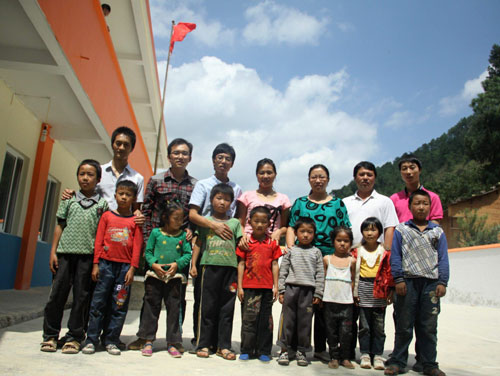 Shown here are seven young teachers who returned to their home county to teach at Longjiacun Primary School and improve education in the underdeveloped village. Photos by Hu Yongqi / China Daily |
The duties of teachers at Longjiacun Primary School do not end when the bell rings because the student body here is special - 80 percent of the school's 139 students are children left behind by migrant workers or come from single-parent families.
Liu, 32, is among a group of seven young teachers at the school, including Cheng Jin, Chen Shihua, Jiang Zhengyang and Zhou Fenghui, who were all born in 1986. Headmaster Liu Shunyue is 30, and Xing Jinzheng, the youngest, is 25.
The seven teachers had the chance to work for higher pay in cities after getting their bachelor's degrees in college. Instead, they returned to their home county on a mission to improve local education in the poverty-stricken village. Locally, they are called the "seven sons and daughters of Huize".
Power of learning
As the sun rises over the Longjia village, children march in line on their way to school. Some students living far away get up before 5 am to be in their seats when classes start at 8 am. When school begins, the small, heavily wooded area becomes alive with the voices of young students.
It takes five hours by bus to travel from the provincial capital Kunming to Huize's county seat, and it is another 100-km trip to the village. On a sunny day, it takes four hours if one is lucky enough to catch the only bus that runs daily. Most residents have to resort to walking, and the trip takes at least a day.
The section of the road from the county seat to the township government of Zhichang twists up to the mountaintop and then winds down. From the township government to the village, the 7-km stretch of highway is a nightmare for most. When the reporter arrived on Sept 18, the shaking bus made some passengers vomit though the road conditions were good and the weather pleasant.
The backward transportation conditions in the region have long been an obstacle on the path to prosperity for locals. Long Yongzheng's father did not follow other villagers, who migrated to cities in search of work. He chose to stay home to take care of his two boys and found himself in dire financial straits as a result.
Lasting poverty deprives village kids of any access to the Internet or television programs in some families. So the courses offered at the school have become a vital channel through which students learn about the outside world. In Long's home, the most valuable item is a gas stove, which is rarely used. Long and his father usually cook their dinner over a fire kindled by pieces of wood, and the smoke has blackened the wall above the fire pit.
No matter how hard life is, the thirst for knowledge remains, said Xing Jinzheng, who joined the school last year as the youngest teacher. His desire to teach at the rural school originates from the educational challenges he faced growing up, he said.
"I was raised by my father alone after my mother's passing. But my father remained determined that he would cover the cost for all of us to attend university if we wanted to even though we did not have enough money. I was the only one of four siblings to go to college," said Xing.
"Therefore, I wanted to come home to pass down what I have learned to the younger generations."
Living far from school in the village of Luobiegu, Xing gets up at 4:30 am and heads for work in total darkness with only a homemade pinewood torch to guide his way.
"The torch usually burns out by the time I catch up to the nearest students. Then we yell to other students and a long line of torches forms on the way," said Xing.
He said a teacher's task is not only to impart knowledge but also to make his students' childhood a happy one.
Liu Shunyue, headmaster of the Longjiacun Primary School, said: "Most of the students are living with their grandparents and about half of the families have difficulty affording the daily expenses at school. Education might be one of the few chances for the kids to change their fate."
With the common experience of growing up in the rural villages, the seven teachers say they know the significance of learning and going to college.
The difference education makes is evident in the lives of Xing and his three siblings. His education has created many opportunities for him, he said. Before coming to Longjiacun Primary School, he had the chance to work in Mengzi, capital of Honghe Hani and Yi autonomous prefecture, where he could be well paid. However, with only a basic education, his sisters and a brother do menial jobs - one is a construction worker and the other two are salespeople in supermarkets.
Liu said: "Because we had a tough childhood, we want the kids to have a better education and life through our instruction. That is the ultimate purpose for all the young teachers."
Making a difference
In the village, most houses are made of loess and wood, and the school's two-story classroom building, newly painted in yellow and orange, stands out as an object of pride in the community.
Every morning, a teacher is on duty to check attendance. On Sept 19, Chen Shihua, the school's director of teaching affairs, was waiting at the front door. The students are trained to salute older people on campus as a crucial show of respect.
Each student pays 80 yuan per month for school lunches. The logistics of getting food are difficult because of the treacherous road conditions, especially during heavy rains. To solve the problem, Chen bought a car with loans from a local bank.
"Before that, food had to be refrigerated for one week after teachers purchased it from the market on a rotating basis. The car can carry more goods, and more importantly, we will be less affected by downpours," Chen said. "Our students can eat fresh vegetables and meat now."
At the end of last year, some local enterprises donated six projectors to the school and funded Chen's plan to introduce his computer to the class, which allow him to show films or slide shows.
"The younger teachers bring more energy. They introduced computers to the class, and teach the kids how to play basketball and table tennis, which is something I couldn't do for the kids," said Sun Xiuming, 53, the oldest teacher at the school, who is planning to retire in 2015.
Eight teachers are responsible for the classes for seven grades - from kindergarten to grade six. Because there are only six classrooms in the two-story teaching building, it is impossible to provide a separate room for the kindergarten. And the pre-school kids have to sit with students in the first grade.
Basically, each teacher takes on all subjects for each grade level - Chinese, mathematics, physical education, music and art. With no professional training, Chen found the music class to be the toughest.
He had to travel to a nearby city to buy an electronic piano for 5,000 yuan, which is double his monthly salary. In his spare time, he learned the fundamentals, such as notation, and practices simple but popular songs. Chen said he is confident that his new skill and equipment will make classes more exciting next semester.
Education is more than classes and knowledge, Cheng Jin said. The kids have to develop independent and sound personalities to cope with any possible difficulties in their lives, she said.
"I hope I can set an example among the kids and then for my 10-month-old daughter. When they grow up, they will know the value of what we have told them," she said.
Li Yingqing and Guo Anfei contributed to the story.
















