


Academics 'explore' new China
The fourth annual Columbia China Prospects Conference held in New York, Explore the Value of China, gathered leaders and intellectuals to discuss China's reforms and developments under the new government leadership.
"China's road to prosperity and power has been full of difficulties, and the Chinese are still exploring solutions of a myriad of economic, social and political challenges that are interlocked with each other," wrote Columbia's Chinese Students and Scholars Association, the organizers of the event, on their website.
In introductory remarks, Jian Nina Ni, the co-president of Columbia University's Alumni Association in Shanghai, cited Xi Jinping's Chinese Dream speech about the importance young people will play in China's future: "[Xi] called upon young people and delivered his [speech]. He told them to dare to dream, to work hard to fulfill [those] dreams, and to contribute to the revitalization of the nation.
|
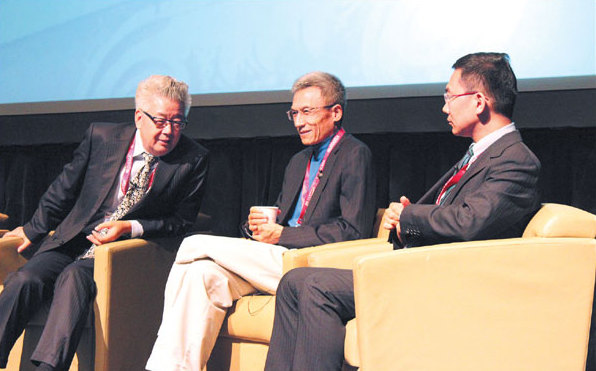
Panelists have a discussion at the Columbia China Prospects Conference event in New York City. From left: Gao Jian, senior advisor and former vice-governor of China Development Bank; Xu Xiaonian, professor of economics at China Europe International Business School; Lang Yongchun, panel moderator and host from China Central TV. Amy He / China Daily |
"What exactly is the 'Chinese dream'? What kind of country will China turn out to be?
"Will China become a black hole in the international resource market? Or a good partner in the global economy?" Ni asked. These are some of the questions that students and young people must focus on answering, Ni said, in order to truly become "global citizens", as much as they think of themselves as "Chinese or US ones."
Terry Tamminen, former secretary of the Californian Environmental Protection Agency, brought up environmental issues that loom over China. He said the country's use of energy could "either propel or stifle the Chinese dream".
"Does the world have enough energy to power China's industrial needs - which in turn powers employment and economic growth - for everyone?" he asked. "Will China's appetite for fuel starve the rest of the world for its energy supplies?"
Tamminen also mentioned pollution, which he said caused nearly 1 million premature deaths annually among China's children and elderly. On the plus side, he pointed out that China does produce a lot of clean energy; it just doesn't use it enough of it.
"In 2010, it surpassed the United States as the world leader of producing wind power - China produces more solar panels than all of the other global producers combined," he said, but they just don't utilize them.
At a time when many American universities are making inroads in China - through academic partnerships with Chinese universities or creating portal campuses in China - Jeffrey Lehman, vice-chancellor of NYU Shanghai, touched on education in his remarks.
He warned institutions of the dangers of establishing relationships with Chinese universities just for the sake of producing profits. "I do not believe an American university should engage with [China with] the goal of creating economic value for itself," he said. "I do not believe an American university should view China as a so-called 'market opportunity', as a source of net profits that might be used to subsidized the universities activities here in the United States."
Lehman went on to say that using China as a means to enhance a university's reputation is not advisable. "Most fundamentally, these kinds of motivations carry a risk of promoting a dualistic - if not even colonial - vision of the university's identity," said Lehman.
Speakers also convened for a panel on China's economy, attempting to tackle the question of what to do with China's slowing growth. The organizers wanted to know, "In the face of the diminishing dividends from the Reform and Opening up policy, will this economic lethargy be a turning point?"
One of the solutions discussed was implementing more reform, and using the reform to help drive economic growth. But Xu Xiaonian, a professor of economics at China Europe International Business School, said the more basic and fundamental question is how to transform reform into action.
"How do you take reform from academic discussion to actual practice? This is the difficulty," Xu said. "The question is not what do we change? The problem is how we even start reform at all."
He suggested a kind of "inclusive reform," reform that didn't trickle down from the top, but rather, reform and change that come from the people.
"We're here discussing reform, but not acting out reform," he said. "[In the 70s] people acted out reform. There was discussion too, but now, there's only discussion, no action."
















