


Chinatowns under threat from gentrification
|
A street corner in New York City's Chinatown, where high-end gentrification threatens to forever change the neighborhood's character. Hu Haidan / China Daily |
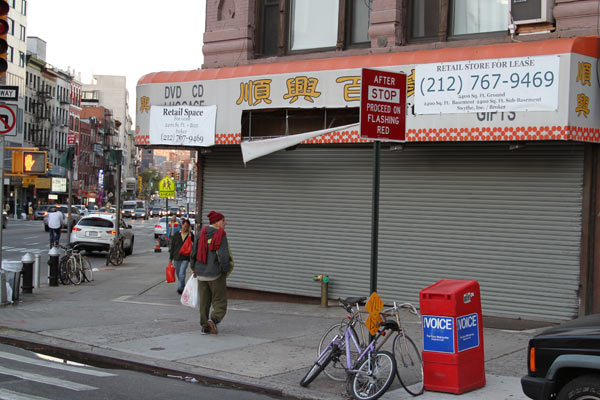
Like other ethnic neighborhoods in large US cities, Chinatowns are at risk of disappearing due to accelerated gentrification, according to a new report.
The Asian American Legal Defense and Education Fund surveyed Chinatowns in Boston, New York and Philadelphia and found that the Asian populations in all communities are decreasing while rent and median housing value are increasing.
In the yearlong study conducted in 2011, the fund gathered information on land use, which showed "the interplay of residential, commercial and industrial uses in Chinatowns and pinpoints where high-end, luxury development areas are concentrated and emerging", said the report.
Luxury condominiums are taking over areas that were previously used as industrial spaces. "The decline of manufacturing has contributed to gentrification as many former industrial spaces have become high-end condos," wrote the authors of the study.
The addition of luxury condos also brought a change in the demographic of the communities' residents, from families and working immigrants to non-family households, including students, young professionals, artists and designers "who often make the neighborhoods 'hip'", said the report.
The organization found that in Boston's Chinatown, the median household income for non-Hispanic whites increased to $84,255 between 2005-09 from $40,554 in 2000, while the median income for Asians dropped to $13,057 from $16,820 in the same time period. According to census numbers, the neighborhood saw a 99 percent increase in its white population between 2000 and 2010, while the Asian population increased only by 12 percent.
A similar shift is happening in New York's Chinatown, though the results of gentrification are not as obvious because Manhattan's Chinatown is larger than those in Boston or Philadelphia, according to the study. The white population increased by 19 percent in a decade and the Asian population dropped 11 percent between 2000 and 2010. The value of houses surged in 2010 to $687,388 from $167,917 in 2000.
Family households in New York's Chinatown are on the decline, which is a "revealing gentrification indicator", the report said. The number of family households decreased by 12.6 percent in a decade, while non-family households increased by 21.4 percent.
Philadelphia has seen the largest white population increase at 233 percent, compared to the 73 percent increase of the Asian population, according to the study.
The report's authors wrote that many factors contributed to the gentrification of these communities, including institutional expansion as well as significant rezoning and commercial development. Boston's Chinatown had to fight Tufts University and the New England Medical Center expanding; New York dealt with a shrinking garment industry after the Sept 11, 2001, terrorist attacks, which made way for million-dollar lofts; and office and factory conversions into hotels in preparation for the 2000 Republican National Convention changed Chinatown's landscape in Philadelphia.
The study showed that real estate developments in the communities have often neglected the needs of Chinatown residents and workers. Bethany Li, staff attorney at the fund and an author of the report, said that New York's Chinatown consists overwhelmingly of small businesses - 94 percent - so the obsession of developers with building hotels, for example, is harmful to the community.
"These small businesses are very focused on selling day-to-day goods that residents and workers in the neighborhood use," said Li. "So the fact that there are so many hotels in the neighborhood seems a little inconsistent, especially as developers are to promote the neighborhood as a place for tourists, because in fact, residents are needing a lot more resources than tourists are."
To help preserve the Chinatowns, the authors recommended that funding be directed toward building more low-income and senior housing units for residents, as well as giving subsidies to small businesses.
"Urban planners and preservationists often tout the need for neighborhoods with distinctive cultures," the authors wrote. "Yet while public and private interests outwardly celebrate neighborhoods like Chinatown, the residents who create that culture are often forgotten. A historical plaque in Chinatown is no substitute for a real life working community full of residents and vitality that such immigrants produce."
amyhe@chinadailyusa.com
















