


Corruption inquiry seen as boost to energy sector reform
|
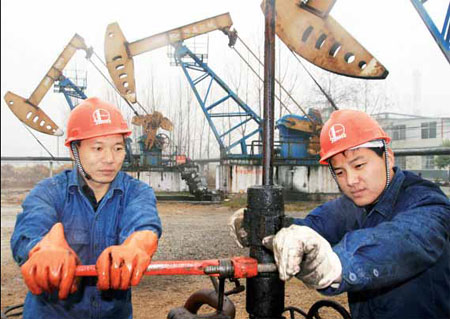
Graft investigations may bring changes to energy companies, experts say. Provided to China Daily |
The central government's move to fight corruption in the oil and gas industry will accelerate the reform of China's energy sector and improve the corporate management of state-owned enterprises, experts say.
China's top discipline watchdog said last month that authorities are investigating Jiang Jiemin, the former head of the State assets regulator.
Jiang, the former chairman of the state-owned Assets Supervision and Administration Commission, SASAC, is being investigated for "grave discipline violations", which usually refers to corruption, according to a statement by the Central Commission for Discipline Inspection.
He was named as the head of SASAC in March after serving as chairman of China National Petroleum Corp, the country's largest oil and gas company, for about two years.
Jiang, 58, was the first company executive to be promoted to the position, rather than a government official. He became the third chief in charge of SASAC, which was established in 2003 to regulate 118 central State-owned enterprises.
Jiang became chairman of CNPC in April 2011. After joining Shandong Shengli Oilfield Co as a technician in 1972, he worked in the petroleum industry, apart from four years as vice-governor of Qinghai province between 2000 and 2004.
The Jiang investigation is mainly related to his previous working experience in CNPC rather than in SASAC. Just a few days before the investigation was announced, another four top executives at the vice-president level in the company were reported to have been put under investigation and resigned from their posts.
Wang Yongchun, deputy general manager of CNPC, Li Hualin, vice-president of PetroChina, CNPC's listed unit; Ran Xinquan, vice-president of PetroChina; and Wang Daofu, PetroChina's chief geologist, are being investigated for suspected corruption by the CCDI.
"The series of corruption probes in CNPC may improve the energy companies' reform process and bring management changes," says Lin Boqiang, director of the China Center for Energy Economic Research in Xiamen.
It is usually a long-term process for energy companies in developing countries to become mature in their corporate management structure, he said.
"In the short term, it will have a bad impact on CNPC in both its public image and its listed-company PetroChina's share price," he says. "However, from a long-term perspective, the case will not bring too many changes to the company concerning its businesses."
Unlike in private companies, the leader of an SOE is not the soul of the company, he says.
"In fact, it doesn't matter too much who in particular will become the head of an SOE, but stricter supervision and better management matter."
The probes on Jiang, Wang, Li and others show the central government's determination and clear attitude to crack down on corruption, says Zhang Yi, vice-chairman at SASAC.
He says the investigations are individual problems and that the central government still acknowledges the achievements and contribution of CNPC.
"The most important task for CNPC is ensuring stable development, production and safety," Zhang says.
On Sept 4 and 5, Zhang went to CNPC's two major oilfields, Daqing and Changqing, to hold meetings about oil exploration and production safety, to ensure the healthy and stable operation of the oilfields.
The Changqing oilfield is located in Shaanxi province, while the Daqing oilfield is in Heilongjiang province.
Changqing oilfield's annual output has soared from 10 million tons to 20 million tons from 2003 to 2007. In the last year, its oil equivalent output reached 45 million tons, exceeding Daqing oilfield where output was 43.3 million tons.
Wang Daofu and Ran Xinquan, both worked in the Daqing oilfield for years starting in 2003.
According to industry insiders, during the period that Wang and Ran were in charge of the oilfields, the company sold "low-quality" oil wells to private companies and it was during that process that corruption occurred.
So-called low-quality oil wells are those with low output and high costs, including taxes and fees.
The company usually sells those wells to private investors and then buys back the crude to raise its total output. However, the sale processes were seldom public and transparent, said an industry insider who declined to be named.
"Unlike SOEs such as CNPC, private companies will cause some environmental problems during crude production because they don't usually invest much in maintaining the sustainability of the wells," the insider said. "To own the rights to explore the 'low-quality wells', the private companies sometimes pay big sums of money in order to get connections.
"It is absolutely not wrong to introduce more private capital to the oil and gas sector, but it should not become a way to make exorbitant profits," the insider added.
Lin the expert said there are many regulations and related documents about bidding for "low-quality" wells. There is no shortage of documents, but there is of supervision.
"Who is responsible for ensuring that these regulations are respected and obeyed is the central issue," he said. "It is not reasonable when someone plays the role of rule maker and supervisor at the same time."
"There are always inside stories. The solution is a better system," says Li Li, research director at ICIS C1 Energy, a Shanghai-based energy information consultancy.
She said the corruption probes will not bring clear changes to well bidding processes in the short term and their impact on the other two major oil and gas companies, Sinopec Group and CNOOC Ltd, will be limited.
So long as the upstream oil fields of the three top majors are not re-divided, their business scale will not change too much, she says.
"However, I believe the industry will develop from an extensive management style to an intensive pattern, which is a good direction," Li says.
"The case will not boost China's oil and gas industry. Other positive policies including political, financial and cultural measures will be the driver for future demand, which will boost the energy market."
"Many factors, including the anti-corruption move, are all pointing in the direction of reform and opening-up."
















