


China can curb pollution: UN
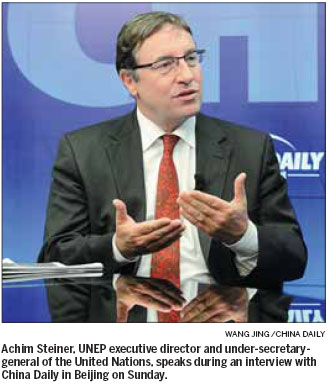
Director of environment program sees shifts in policy
A senior United Nations official said he is confident that China's air pollution problems will be alleviated as the country embarks on a transition toward a greener economy.
"Looking at China's efforts to address pollution in light of its environmental policy of the last 10 years, I must say I could imagine that it is possible," Achim Steiner, UN under-secretary-general, told China Daily.
Steiner also serves as executive director of the UN Environment Programme.
"China has already proved in recent years that once it accepts a problem as scientifically and empirically founded, there are solutions to be implemented," he said.
The State Council, the country's Cabinet, issued an air-quality action plan in September detailing measures to be taken over the next five years for improvement. Efforts will include reducing energy consumption and optimizing the mix of energy sources.
Xie Zhenhua, the country's top climate-change negotiator, said last week that China's air pollution problems will be eased in five to 10 years. Asked to comment on that, Steiner said: "Can the problem be solved? Absolutely. We have the science, the technology, national policy, leadership and implementation.
"What we've already learned from the 18th Party Congress (held in 2012), and also now in the deliberations going on among the new leadership, is that China is seeking to evolve a development model consistent with ecological civilization."
This will inevitably have consequences in different sectors, he said.
The Chinese concept of ecological civilization has drawn international attention. It will require rebalancing, Steiner said, because development is not one-dimensional. It has three dimensions: economic, social and environmental.
"I think ... it (the concept) is more than just a slogan. It is the beginning of trying to bring a new set of parameters and priorities into development decisions," he said.
In the past, China's priorities were industrialization, GDP growth and eradicating poverty, he said. Now, ecological civilization adds new dimensions, with results that will also be measurable - saving human lives, restoring rivers and ecosystems and improving air quality.
"China's citizens deserve a cleaner environment," he said. "I had great joy, like many Chinese, when I arrived in Beijing. ... I see blue skies. I see the smiles that people have. This is how life in the 21st century should be for all of us. We should not live in an atmosphere with air pollution affecting our children."
As a frequent traveler to China, Steiner said he found that public environmental awareness had grown enormously.
"Today, if you come to China, you see people with smartphones and the applications watching the PM2.5 index," he said. "It is a big shift."
But China has a very heavy legacy of environmental pollution and degradation, he noted, which is why it's so exciting to see interest across all sectors in movement to a cleaner, greener economy.
"It is not just you and I living here today on this planet. It is also the next generation," he said. "How can we defend the decisions we make today to pollute, to destroy and even to make species go extinct that future generations will never have the choice of reversing?"
Steiner said UNEP has cooperated extensively with Chinese authorities and academics.
"We are part of an attempt to bring the best lessons the world has learned to Chinese policymakers," he said.
In 2002, the UN agency launched an institute for environment and sustainable development with Tongji University in Shanghai to train Chinese leaders for the future. It has now attracted international students.
In addition, UNEP assisted and advised the Beijing Organizing Committee and Chinese authorities on how the 2008 Olympics could set new standards for environmental management.
"The Olympic Games were one moment when China began to realize that it can actually change the quality of the air, and that it can influence the way the infrastructure will work. And I think the public interest has grown tremendously since then," the UN official said.
Steiner said finance and technology are critically important in the climate arena, and China has already made an important contribution.
"Because of China's great success with wind-power technology ... the price of this technology has come down significantly in the global marketplace," he said.
Contact the writers at zhaohuanxin@chinadaily.com.cn and jiaoxiaoli@chinadaily.com.cn
















