Reform prescribes sound dose for gaokao disorder
Exercising new choices in crucial college entrance exams
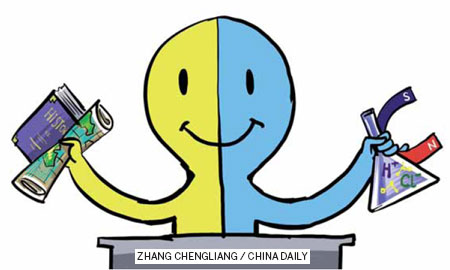
Is your child attending a local high school? Do you want him or her to be a nerdy science student, or a graduate well versed in humanities but with an undisciplined mind?
Both bad choices. But such a possibility is so real that even top Chinese leaders have started calling for an end to the decades-long practice that makes students choose physics, chemistry and biology, or history, politics and geography, as their main subjects during much of their three-year high school education in preparation for the national college entrance examination or gaokao.
The terse directive, buried in a myriad of decisions and instructions, which appeared in a document released by the recently concluded Third Plenary Session of the 18th Central Committee of the Communist Party of China, has created a nationwide stir because tens of millions of high-school students cram for the all-important exam under either the humanities or science stream every year. Although humanities students are officially still required to study science subjects for the first two years, they do not have to take them seriously because so far they are not required by gaokao. Similarly, science students find ways to skip the humanities courses so they can focus on more relevant subjects for the gaokao.
Educators realized a long time ago that such a learning approach would hurt students' future development. At a deeper level, they believe the fundamental flaws of the gaokao system - such as the emphasis on rote memory, holding the same test for different universities to select students from diverse backgrounds and abilities, and admissions based mainly on a single exam - have prompted students to do whatever it takes, including foregoing the opportunity to have a broader and more balanced knowledge, to outperform others in gaokao.
In recent years, several provinces have experimented by having a combination of the two streams. However, such efforts have failed because of the resistance of students, parents and teachers, who believe the widely practiced "bifurcated" approach is the best to achieve a higher gaokao score. Therefore, it has become even more difficult to address the main cause of the predicament. Even in times of widespread mistrust of the privileged and powerful, gaokao results are still seen as the fairest criterion for admission to college, as well as one of the few avenues still open to students from a working-class background to move up the social ladder.
Although greater autonomy to colleges in terms of students' enrollment, rather than State-controlled admission, has been projected as the ultimate solution to the gaokao conundrum, recent scandals surrounding public colleges that sell "reserved seats" have made people more circumspect about any major changes in the system.
On an experimental level, some colleges have been allowed to reserve a small number of seats for students who have not performed well in gaokao but have demonstrated their skills in other fields such as art and sport. Unfortunately, the experiment has gone awry as colleges wallow in money, power and corruption, and trade the seats with the rich and powerful.
So what will make the abolition of different streams in high schools a success this time? For starters, the CPC blueprint for higher education in the next decade offers a much more holistic and coherent course. It includes independent admission to schools based on multiple tests and fewer gaokao subjects, something decision-makers in the education department had long been weighing but were reluctant to roll out at one go because of concerns about social harmony.
At a deeper level, students and parents who fear that changes in the gaokao system will deprive them of the chance of upward social mobility should probably be heartened by the purpose of such social reforms, which, according to the CPC document, is "to allow more benefits from the development to be more equally shared by all people".
The author is editor-at-large of China Daily.