


Regulator eases limits on handling local govt debt
Move made to help deal with increasing risks faced by banks from bad assets
Local governments might be allowed to handle their nonperforming assets in a broader way to tackle the increasing risks feared to exist in China's banking system, according to the country's banking regulator.
The China Banking Regulatory Commission said in a document that asset management companies at the provincial level will be able to sell their bad assets to other provinces as well, instead of only via transactions within the province, Economic Information Daily reported.
|
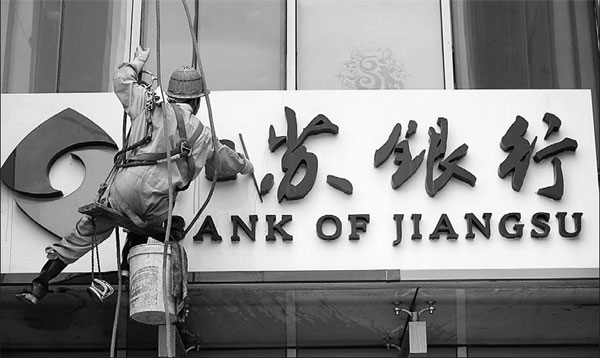
A cleaning worker goes about his tasks at a branch of the Bank of Jiangsu in Beijing. The central government aims to have local authorities assume more responsibilities as debt risks mount in the banking sector. Provided to China Daily |
In the 2012 version of the policy jointly issued by the Finance Ministry and the commission, each province was given permission to set up only one asset management company and could only sell the non-performing assets within the province via debt restructuring.
The new policy will give local asset management companies the same business scope as the "Big Four" asset management companies, which were established in 1999 for the purpose of handling the bad loans of commercial banks that totaled 1.4 trillion yuan ($230 billion) at the time.
In April, local authorities approved the first financial asset management company in Jiangsu province launched by the government-owned Wuxi Guolian Development Co.
But Zhejiang province has taken the lead in putting its asset management company into action. Zheshang Asset Management Co, which is fully owned by State-owned Zhejiang, is now fully operational.
The Zhejiang AMC was set up with registered capital of 1.5 billion yuan. The amount was later raised to 5 billion yuan.
A source within the AMC was quoted by the Economic Information Daily as saying there was currently no capital injection from government finance and it will not accept private investors either, unless otherwise regulated by the relevant authorities.
The information office of Zhejiang International Business Group declined to make any further comments on the issue.
Yang Tao, a financial market researcher with the Chinese Academy of Social Sciences, said Zhejiang, as a key area of financial reform, could provide an example to other regions in pushing forward provincial-level asset management companies.
"Handling nonperforming loans has always been the responsibility of the 'Big Four' asset management companies. However, the central government is hoping more responsibility will fall on the shoulders of local authorities in the wake of the mounting debt risks in the banking sector," Yang said.
Setting up local asset management companies could be a preparatory measure for local governments to undertake more risks, he added.
A recent report by PricewaterhouseCoopers showed that non-performing loan balance of the top 10 listed banks in China was 428.3 billion yuan at the end of September, up 16.6 billion yuan from June 2013. The NPL ratio grew at a faster pace of nearly 1 percent, compared with 0.02 percent at the end of June 2013.
"Asset quality continues to be a concern," PwC said.
Other institutional analysts also said it will be a peak time for banks to perform well from now until the first half of next year, therefore there is a huge potential market for the asset management companies to sell bad assets.
As the market awaits the result of an audit into local government debt organized by the National Audit Office, Standard & Poor's Ratings Services put China's credit outlook on stable in a report last week.
S&P said the government debt to gross domestic demand ratio should remain largely unchanged at 13 to 14 percent during the period of 2013 to 2016.
"However, we believe China's fiscal position to be somewhat weaker than these indicators suggest, because local governments owe significant off-budget debt, but external monitoring of such debts is difficult."
















