


Corruption calls for drastic reform in universities
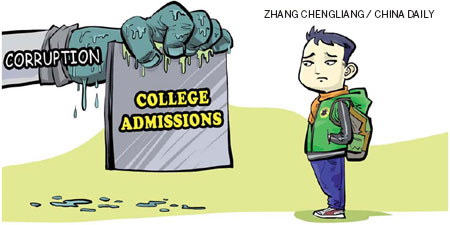
Lasting solutions are needed to plug the holes in college admissions
Chinese anti-corruption officials daring to catch both "tigers and flies" (high and low-level corruption) may already have new targets in their crosshairs: college officials abusing power for personal gains.
Over the past week, the public has been reeling from a barrage of media reports that Cai Rongsheng, head of admissions at the prestigious Renmin University of China, is being investigated for his role in a scandal that involved selling seats in the public university for hefty prices.
The fall of Cai, who reportedly has been detained while trying to flee China with a fake passport, has heightened people's anticipation of a major clean-up, and a possible domino effect at the university, after inspectors from the Communist Party of China said in late September that they had discovered "weak links" in its financial management, officials' pay and students' recruitment, and received tips on problems related to the institution's top officials. Such euphemisms bode ill for officials as they often herald formal criminal investigations.
But the real significance of the events is probably more than nabbing several corrupt officials in the Chinese academe. Instead, they showcase the depths of corruption of some powerful college administrators who seek to make a fortune by taking advantage of a porous monitoring system and defying the rule of law.
China's leading universities, which receive far more applications than the seats they offer, are in hot demand. Students can spend a year or two just for a few points more to outperform others during the all-important national college entrance examination or gaokao.
While recruiting most students through gaokao, as required by the state, public colleges are allowed to keep a small number of seats reserved for students who have not performed well in the exam but have demonstrated talent in other fields such as arts or sports.
Unfortunately, the practice has become a breeding ground for corruption as universities are run like any other government office where all major academic and administrative decisions, including students' selection in the "autonomous" recruitment exercises, are made by higher officials.
Top universities are usually headed by those who are appointed by the central government, with the rank equivalent to a deputy minister. Other officials, such as deans and administrative officials, are given the ranks that correspond to the government hierarchy. Some professors would give up their academic duties in exchange for managerial positions for their unrivalled power.
While college presidents, deans or heads of admissions have been given full power to decide whom to charge and how much when distributing the reserved seats, the details of the deals between the schools and parents are usually kept confidential. The proceeds from the admissions, which could cost up to 1 million yuan ($164,300, 119,670 euros) for a seat at a top school, mostly go to buoy college finances. But corrupt officials often take a cut, as scandals surrounding college recruitment have revealed.
Students admitted to colleges because of their rich parents or connections may have a score dozens of points lower than other freshmen. This has shaken the confidence of millions of parents and students in the gaokao system, which is widely regarded as the pinnacle of China's social justice.
Many critics have been calling for greater transparency in the procedure, making public the information on all students admitted through the "reserved seats" scheme, including their merits and the amounts they paid.
But equally importantly, public colleges should first break the monopoly and dominance of officials who are accountable only to higher authorities and who wield unbridled power on campuses. Lacking lofty education ideals, some are prone to taking a treacherous path when the temptations are high and the chances of getting caught are minimal, like any other bureaucrat steeped in a culture of corruption and lack of transparency.
In the aftermath of the high-profile probe at Renmin University, people expect measures that address the root causes of college corruption, rather than quick fixes to the symptoms of the disease.
The author is editor-at-large of China Daily. Contact the writer at dr.baiping@chinadaily.com.cn
















