


Putting best foot forward in Africa
Chinese shoemaker ups investment to create job opportunities in Ethiopia
Chinese footwear maker Huajian Group plans to make Ethiopia the hub for the global footwear industry and create more than 100,000 jobs locally in the next 10 years.
The company, which first moved to Ethiopia to offset rising labor and raw material costs in China, says it has teamed up with the China-Africa Development Fund and the Ethiopian Ministry of Industry to establish a light-manufacturing base in Ethiopia.
|
Artist's impression of the Ethiopia-China Light Manufacturing Special Economic Zone. |
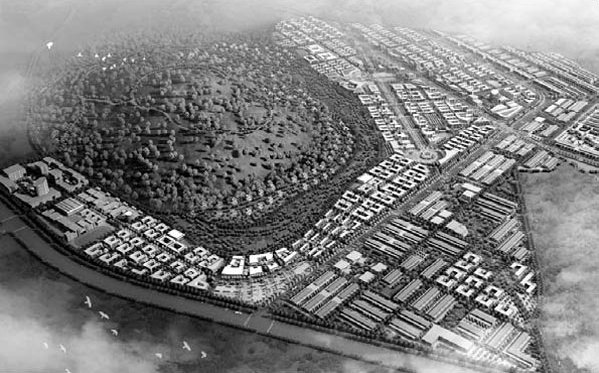
To be called the Ethiopia-China Light Manufacturing Special Economic Zone, the development received the green light from the Ethiopian government in October this year, says Wei Yongquan, general manager of Huajian Group.
Covering an area of 318 hectares near the Ethiopian capital Addis Ababa, the proposed zone will have facilities for shoemaking, other light manufacturing, commercial facilities and residential communities. It will house more than 50,000 families and generate revenue of $4 billion from exports.
According to Wei, Huajian has invested more than $6 million on shoemaking facilities since 2011 at the Oriental Industrial Zone in the Oromia region of Ethiopia.
A four-line shoemaking plant and a shoe materials plant in the park have helped the Chinese company make 837,4000 pairs of shoes in Ethiopia in the first 10 months of this year and generate revenue of $13.06 million.
Wei says that one of the biggest advantages of making shoes in Africa is the huge cost savings.
"The average monthly wage for a worker in Ethiopia is about 400 yuan ($66), while the same is around 3,000 yuan in Dongguan, Guangdong province, where the group is based, and around 2,500 yuan, in Ganzhou, an inland city in Jiangxi province.
"Since there are very few factories in Ethiopia, we do not have any problems in finding labor." Huajian's plants in Ethiopia employ 3,200 people.
The availability of local leather also provides cost savings of more than 30 percent compared with the Chinese mainland, Wei says.
Animal husbandry output accounts for about 20 percent of the gross domestic product of Ethiopia, while its livestock population is ranked among the best in Africa and the 10th in the world, according to an investment guide published by the country's Ministry of Commerce.
Huajian produces 18 million pairs of shoes a year, mostly on an original equipment manufacturing (OEM) basis for brands such as Nine West, Easy Spirit, Enzo, Sears, Coach, Guess, Marco Polo and Zara. More than 80 percent of its shoes are made of genuine leather and 95 percent are for export.
While labor and raw material costs have been the prime factors, Huajian has also gained from the considerable tax incentives provided by the Ethiopian government. According to the Ministry of Commerce, exports from Ethiopia enjoy duty-free access to the European Union and the United States. "Our Ethiopian unit makes OEM footwear for export to the US and European markets."
The company's African plans have received ample support from both governments, Wei says. "It took us just three months to start production."
More than 90 Ethiopian employees were sent to the company's plant in Ganzhou, Jiangxi province, for technical training and familiarization in corporate culture. The company has also deployed some key managerial personnel in Ethiopia to provide ground support, he says.
Huajian's African plan is in line with the growing trend of Chinese companies shifting manufacturing overseas, said former vice-president of the World Bank Justin Yifu Lin at a footwear seminar held in Dongguan in November.
"The relocation not only reinvigorates the industry but also lifts the parent companies in the Chinese mainland to both ends of the smiling curve, with one end being sales and the other being design, brand and quality management," Lin said.
According to Lin, since the relocation process involves the retention of some manufacturing processes on the mainland, it will help Chinese companies move up the value chain and focus on high technology.
"Africa has about 1 billion people and a very young labor force. It's just like China in the 1980s. There is substantial room (in Africa) to accommodate China's labor-intensive manufacturing," Lin said at the 17th China International Fair for Investment and Trade held in Xiamen, Fujian province, in September.
In contrast, the population of South Asian countries is relatively small and wages will go up soon, Lin says. Although there have been suggestions that Chinese factories in the coastal regions should move to the interior rather than overseas, Lin says it is not feasible because the country's central and western regions are expensive.
Huajian, founded in 1996 by Zhang Huarong, the current chairman, started operations as a footwear factory in Jiangxi province. The group has 40 shoemaking lines and employs more than 20,000 people, including 1,000 in research and development.
Its footwear business encompasses facilities in Dongguan and Ganzhou. It covers a wide range of sectors from leather making, materials, shoemaking, equipment assembling and logistics.
The transformation of the group started in 2002, when it invested in new facilities in Ganzhou, Wei says. In 2011, it started to develop a 160,000-square-meter area in Dongguan to turn it into a public service platform for the footwear industry, facilitating research and development, trading, procurement, logistics and brand-building.
With total investment of 2 billion yuan, the project, called World Footwear Headquarters Base, will be able to house 5,000 businesses and generate total turnover of 60 billion yuan a year. It is listed as one of the key projects in the industrial upgrading in Guangdong province. The group also started a vocational school in Ganzhou in 2010 to train people for the footwear industry. It launched its own footwear brand called Craveeor in 2007 and on average invests around 3 percent of its turnover in R&D.
To cope with the rising costs, the group has been reforming human resources management, improving training and cost management along the complete production chain, Wei says.
liwenfang@chinadaily.com.cn
















