


Yutu gets rolling on the moon
|
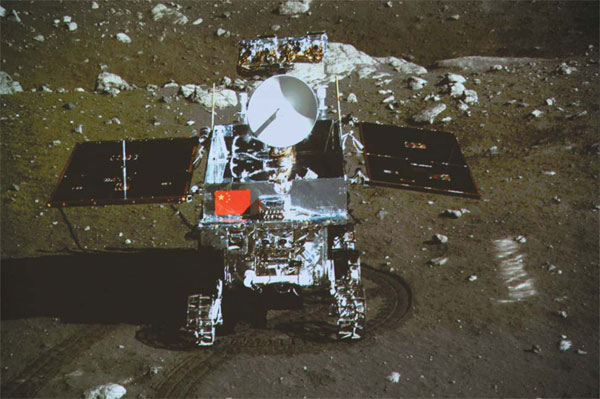
Yutu, China's first moon rover, is shown in this picture taken by lunar probe Chang'e 3's lander on Sunday night. Photo by Xinhua |
Chinese flag appears on lunar surface for the first time
China's first lunar rover and the lander took pictures of each other near mid-night on Sunday, marking the complete success of the country's Chang'e-3 lunar probe mission.
President Xi Jinping and Premier Li Keqiang, who both came to the Beijing Aerospace Control Center late Sunday night to watch the photo-taking session, congratulated scientists for the success.
Ma Xingrui, chief commander of China's lunar program, announced lunar probe Chang'e-3 mission a "complete success", after the lander and moon rover took pictures of each other.
A national flag was shown pasted on the moon rover in a picture taken by the lander. Aerospace experts said the flag, plus another one on the lander, could sustain extreme weather conditions.
It was the first time China's national flag had appeared on a celestial body.
Yutu , which has a designed life span of three months, will also conduct geographic surveys, said Sun Huixian, deputy chief engineer of China's lunar exploration program.
In ancient Chinese mythology, Yutu is the white pet rabbit of the lunar goddess Chang'e.
The rover will analyze major elements on the lunar surface and study energy and mineral resources along its route. A radar system attached to the bottom of the rover can probe up to 100 meters beneath the lunar surface, he said.
Sun Zezhou, chief designer of the Chang'e-3 probe, said Yutu is able to climb slopes of up to 30 degrees and travel at 200 meters per hour, explaining that designers set a low speed for the vehicle because it has to detect and avoid obstacles.
Theoretically, Yutu can travel nearly 10 kilometers on the moon, Sun said, noting that engineers had set up a laboratory on Earth to simulate the rigorous environment on the moon and the rover has passed numerous tests.
Using its ability to detect obstacles, the rover will determine a path of least resistance by coupling onboard navigation systems with remote control.
The moon's wide temperature range - from more than 100 C during day to as low as -180 C at night - presents another challenge to the rover.
To work properly, the rover has to maintain an internal operating temperature range of -40 to 50 C, so both the lander and rover are equipped with radioisotope heater units.
The Chang'e-3's lander will deploy a telescope to observe stars, the galaxy and the universe from the moon, according to Sun.
"This is the first time humankind has placed a telescope on the moon. The special environment on the moon will enable us to conduct observation that could not be done on Earth due to the impact of the atmosphere," he said.
In addition, the lander also carried an extreme-ultraviolet imager to observe the plasmasphere over Earth.
The 140-kilogram, six-wheeled rover touched the lunar surface at 4:35 am on Sunday, leaving deep tracks on the loose lunar soil. A camera on the lander recorded the process and the images were sent to Earth, according to the Beijing Aerospace Control Center.
The Chang'e-3 probe landed on the moon on Saturday night, making China the first nation to do so in nearly four decades.
The last soft landing took place on Aug 18, 1976, with Luna-24, a spacecraft of the former Soviet Union.
Researchers from the United States and other nations viewed Chang'e-3's operations on the moon as "a new scientific opportunity that could potentially enhance studies and observations of the lunar atmosphere", NASA said on Friday.
"The Chang'e-3 details tell me that the US now absolutely must start communicating with the Chinese about lunar cooperation," said US astronaut Buzz Aldrin of Apollo 11 in an interview with Aerospace America magazine.
Russian astronaut Vladimir Kovalenok said the Chinese lunar program is on the right track and China can go down this path while taking into account the pros and cons of lunar programs in the United States and the former Soviet Union.
"China is now a pioneer in this field, and its lunar missions will be a catalyst for lunar explorations in other countries, as the moon can serve as a basis for a 'jump' on journeys to more distant space in the universe," he said.
The Chang'e-3 mission is the second phase of China's lunar program, which includes orbiting, landing and returning to Earth. It follows the success of the Chang'e-1 and Chang'e-2 missions in 2007 and 2010.
China is likely to realize the third step of its lunar program in 2017, which is to land a lunar probe on moon, release a moon rover and return the probe to Earth.
Xinhua News Agency contributed to this story.
Contact the writers at zhaolei@chinadaily.com.cn and zhaohuanxin@chinadaily.com.cn
















