


New family planning rule to create mini baby boom
|
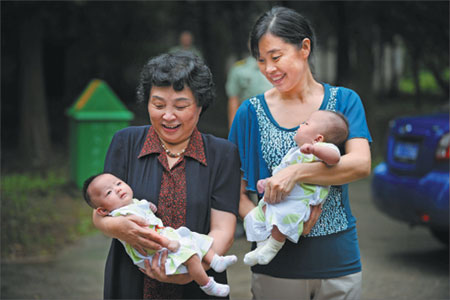
A year after she lost her only daughter in 2009, Sheng Hailin (left), then 60, became the mother of twin daughters using test-tube baby technology. Wu Fang / for China Daily |
The suggested relaxation of the family planning policy is expected to bring China roughly 13 million more babies in five or six years, top demographers said.
The Communist Party of China decided last month to relax the rules by allowing couples to have a second child if one of the parents is an only child. Previously, a husband and wife were both required to be single children if they wanted a second child.
"If China continues the old policy, the birth rate would continue falling and lead to a sharp drop of the population after reaching a peak," Li Bin, minister of the National Health and Family Planning Commission, said when elaborating on the "second child" bill to the top legislature on Monday.
The State Council has submitted a bill to adjust the country's family planning policy to the bimonthly session of the Standing Committee of the National People's Congress, which runs from Monday to Saturday.
The country's working population began to drop in 2012 by 3.45 million annually, and it is likely to fall by 8 million annually after 2023.
Those aged 60 and above will reach 400 million and account for one-fourth of the population in the early 2030s, up from one-seventh now.
"It is the right time to do it as the low birth rate is stable, the working population is still large and the burden to support the elderly is relatively light," Li said.
The change would lead to a mini baby boom lasting five or six years with an additional 2 million births a year on average, said Zhai Zhenwu, director of the School of Sociology and Population Studies at Renmin University of China.
He is among a few experts entrusted by the commission to assess the largest possible population growth arising from the policy change.
The new rules are expected to make 15 to 20 million Chinese couples eligible to have a second child, he said.
Usually, younger women and those in the countryside tend to want more babies, he added.
Most Chinese women first give birth at age 26 or 27.
A survey Zhai conducted a year ago found more than 60 percent of newly eligible families were willing to have a second baby.
Given an average three- to four-year interval between births, second babies are most likely to be born within five or six years after the policy change takes effect, he said.
A peak of about 3 million new births could be expected in the third year.
According to Yang Wenzhuang, director of the family planning instruction department of the National Health and Family Planning Commission, the change may be implemented early next year after local legislatures pass the amended regulation.
Apart from the current 15 to 20 million eligible couples, more will become eligible in coming years and they should be counted as well, Zhai said.
Additional births will eventually settle at 1.6 million each year with little fluctuation, he expected.
Yuan Xin, a professor of population studies at Nankai University, said five or six population scientists were entrusted by the top population authority to analyze the impact of the rule change and forecast the number and trend of population growth.
Though they were making the assessment using data from varied sources, estimates from the scientists were similar to one another, he noted.
However, he said estimates varied a lot for another suggested approach - to immediately allow all Chinese couples to have a second child if they want.
According to his research, that might lead to an annual birth of 40 million babies, Yuan noted.
"Social resources like health and education might fall short of the huge demand if we at once enter a comprehensive two-child era in China," he said.
But both Yuan and Zhai agreed that would definitely be the future trend, if not destination, for China.
shanjuan@chinadaily.com.cn
















