


Urbanization shrinks rural schools
|
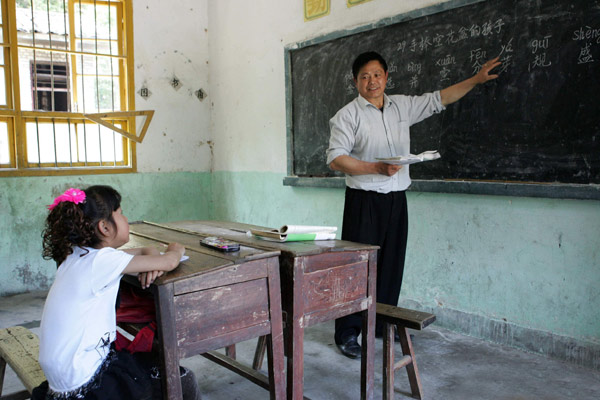 Zhang Guiwang, 55, teaches a class with only one student at Bantianxiao Primary School in a mountainous village in Huilong township, Jianyang, Fujian province. The number of students dropped from more than 80 to only one as parents have been moving to work in cities with their children. Chang Gang / for China Daily |
More Chinese migrant workers have opted to bring their children to the city for quality education, rather than leaving them behind in the countryside.
Luo Yongping, who has toiled for nine years as a carpenter in Jiangxi's provincial capital Nanchang, finally managed to secure a seat for his son at a reputable primary school in the city.
In September, the boy was crammed into an overcrowded first-grade classroom at the primary school affiliated with Nanchang University.
"Whatever the cost, I want my son to lead a better life than mine - specifically, better schooling and better work in the city," says 32-year-old Luo, who laments the divide in education between urban and rural areas.
"I was not well educated, and that's why I can only find backbreaking jobs here," he adds.
The move by a growing number of migrant workers to transfer their children to cities has led to losses of students for rural schools.
Located 35 kilometers away from Nanchang, the Dazhuang Village Primary School in Luo's hometown has seen the number of its students drop by more than half in the past four years, according to principal Xiong Guilian.
With 22 students now, the school has been officially downgraded to a "teaching spot" that only offers the first three grades. Most rooms in the two-story schoolhouse are left unused. "Every time a new semester starts, I find several children missing because they have been taken to the town or city by their parents," Xiong says, describing her feeling as "bittersweet".
In Jinqiao township, which administers Dazhuang village, the number of primary school pupils has plummeted by two-thirds since 2003, with two village schools closed because of a lack of pupils.
A 2012 report on rural education, issued by the 21st Century Education Research Institute, says between 2000 and 2010, an average of 63 primary schools, 30 teaching spots and three junior high schools closed down every day in China's rural areas.
Vigorous urbanization is behind the vanishing schools. Government data shows the country's urbanization rate surged by 12.39 percentage points from 2000 to 2012, indicating more than 150 million farmers moved to urban areas over the period.
Migration to towns and cities might become easier for surplus rural labor in the future, as a high-level work conference that concluded recently pledged to push forward urbanization by enabling migrant workers to obtain urban status, allowing them to integrate better into cities.
"Most Chinese farmers believe that knowledge can change one's destiny, so they would move heaven and earth to get education opportunities for their kids," says Du Xingsheng, principal of the Central Primary School of Jinqiao township.
The loss of students has further weakened rural schools, which are already at a huge disadvantage compared to their fully resourced and staffed urban counterparts, as having more students usually means more investment from the government.
At a teaching spot in Sanwan village, Jiangxi, 13 students from the first to third grades share one teacher, Wang Jiafu. Music, English and computer classes are absent from their curriculum, since Wang still struggles to teach "basic subjects".
"What I'm concerned about most is that no young teacher will take on my job after I retire," says 58-year-old Wang.
In addition to the urbanization drive, another factor contributing to the sharp decline of rural students is a massive government-backed campaign since 2001 to close or merge small rural schools to centralize resources and improve education quality, according to He Yue, professor at Yunnan Normal University.
After their schools were shut down, many children in remote areas dropped out because attending the new school far away from their homes would require a much longer and more dangerous commute. The Ministry of Education suspended the controversial program in November last year.
















