Two-child study quells fears of a baby boom
|
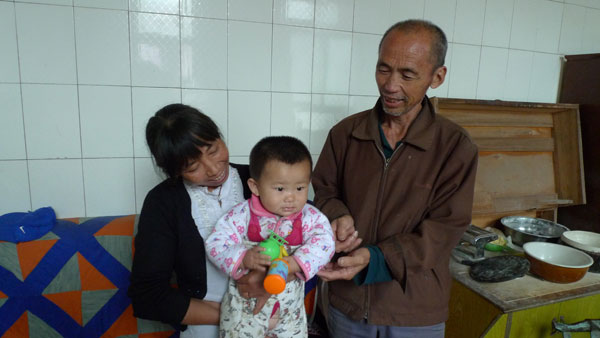
Su Meiling and her father-in-law play with her second child at their home in Yicheng county, Shanxi province. Su and her husband Qiao Weijie had the daughter last year. Xu Wei / China Daily |
Many residents in pilot area opted against adding to family, often due to finances
Editor's note: The relaxation of China's decades-old family planning policy to allow more couples to have a second child has been hailed as one of the key events of 2013. China Daily sent reporters to examine how the policy change is expected to affect people's lives.
Twelve years ago, Su Meiling and her husband Qiao Wenjie decided they would have only one child, even before their son was born. They got a certificate for helping promote the one-child policy and received a monthly subsidy of 50 yuan ($8.20).
|
 Obstetric nurses in the Central Hospital of Enshi, Hubei province, take care of newborns at the hospital. Couples in Enshi are allowed to have two children. Li Yuanyuan / for China Daily |
However, the couple changed their minds in 2011 and had a daughter, even though, according to the rules, they had to give back the subsidies -more than 4,000 yuan in total.
"We just realized one child is not enough," said Su, 38. "If we had two, we knew they'd be companions for life."
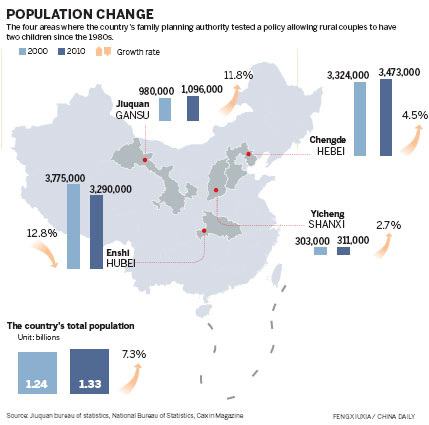
Su and Qiao live in Yicheng, a typical rural county in Shanxi province rich in coal resources. It is one of four areas chosen by the central government in the 1980s to test a policy allowing families to have two children.
In November this year, a decision was made to relax the one-child policy across the whole country. Couples in which one partner is an only child will be allowed to have a second child, according to a decision by the Communist Party of China leadership.
Despite fears of a population boom, demographic indicators from Yicheng suggest giving couples the option to have a second child does not necessarily lead to robust population growth.
Between 1982 and 2010, a time span that encompassed the third and sixth national census, the county's population grew by 22.8 percent, from 254,000 to 311,000, compared with the national average of 29.8 percent. In Shanxi it was 41.2 percent.
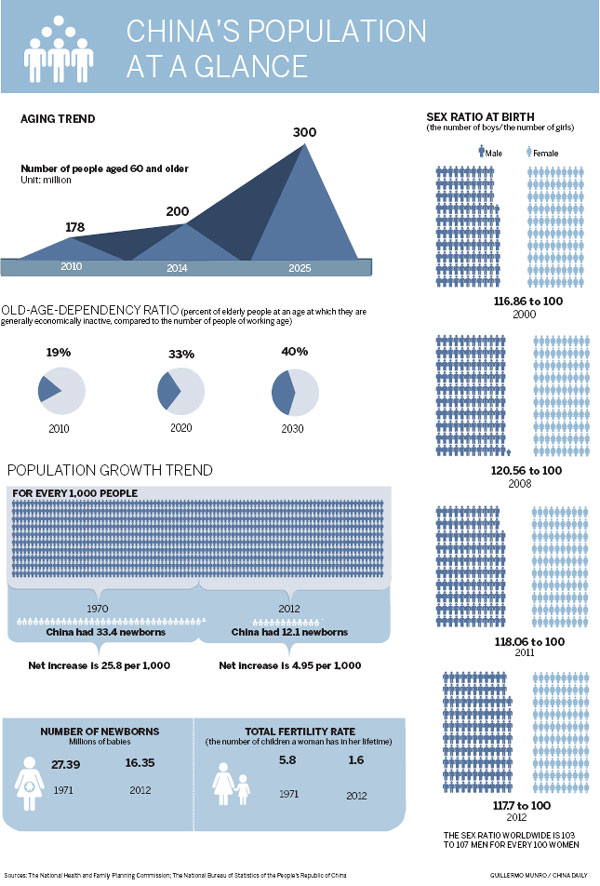
Yicheng has a gender ratio of 101.6 men for every 100 women, according to the 2010 census, while the national figure for men was 105.2.
Liang Zhongtang, a demographer with the Shanghai Academy of Social Sciences who helped facilitate the pilot program in 1985 and has monitored it since, said he has noticed a drastic change in people's concept of fertility since the 1980s.
"The lessons we can draw from the pilot program in Yicheng is that a loose population policy does not necessarily mean that the population will grow out of control," he said. "Plus, even though some areas enforce a strict one-child policy, the goal of population control has not been met."
Proposal approved
In the early 1980s, Liang, who was then a researcher at the Shanxi Provincial Party School, made the proposal to the central government to test his plan to contain population growth.
In September 1980, the Party Central Committee issued an open letter to all members of the Party and the Youth League, suggesting couples should only have one child to keep the population under 1.2 billion, to reduce the mounting pressure on resources and the environment.
Liang disagreed with the one-child policy, holding that the country could still effectively meet its target of keeping the population under 1.2 billion by allowing every couple to have two children while delaying the age of marriage and the age they could have children.
The central government approved Liang's proposal and Yicheng was selected because of strong support from the county's top officials.
Liang applied his test in the county's rural areas because giving birth to more than one child was more popular among rural couples before the family planning policy, and rural households are more prone to violating the policy.
Before the pilot program in Yicheng, Wang Yongliang, a family planning official in Wangzhuang township for about 30 years, said his job was "the most difficult in the world".
"People were giving birth to at least four or five children before the 1970s, and all of a sudden they are ordered to have only one," he said, adding that the policy resulted in conflict between family planning officials and couples.
"Every time you went to a village, people said, 'Here come the gangsters'. They would curse you behind your back," he said. "If we knew a woman was pregnant but already had a child, we tried all means to convince her to give up the baby - taking all the family's precious belongings, tractors, cattle and giving them back immediately after they agreed to abort the child."
In 1985, when the county started pushing the pilot program, many family planning officials were shocked.
"Some were concerned that granting couples two children would see the situation get out of control," said Feng Caishan, then deputy head of Longhua township.
The pilot program stated women could not marry until they were 23 and men 25, and women could have the first child no younger than 24 and the second no younger than 30.
Family planning officials said allowing couples two children has made their work easier, despite there being more procedures.
To ensure the program had the desired effect, women must have contraceptive coils fitted after their first child and must be sterilized after their second.
"We had a lot more work to do, as we had to convince people to have operations after the birth of each child," Wang said. "But importantly the policy is workable because people are willing to cooperate."
In 2007, the county further loosened the birth policies and women could have their second baby no later than 28 years old.
"From the experience in Yicheng we can tell that when the policy goes against the will of people, the people will oppose it," said Feng Caishan, who became director of family planning for the county in 1990 and retired in 2002. "The policy should take the statistics into account, and people's feelings," he added.
Changing attitudes
Looking at the figures, the pilot was a success in effectively controlling population growth. Yicheng accounted for 1 percent of the population in Shanxi in 1982, but just 0.87 percent in 2010.
Meanwhile, in many neighboring counties, the family planning policy has faced a backlash. Some couples are even giving birth to three or four children, according to an official with the Yicheng Family Planning Association who spoke on condition of anonymity. The China Family Planning Association is the largest nongovernmental network active in reproductive health, family planning and HIV/AIDS prevention and care.
Despite being given the chance to have two children, more than 10,000 rural families in Yicheng have chosen to waive the right.
Liang Zhongtang, the initiator of the program, said he believes important factors lie in the changing concept of fertility since the 1980s.
"The key reason lies in the profound change of society, the way people live and work," he said. "People make decisions about the number of children they are going to have after a reviewing their economic and social situation. That does not change with what kind of policy is being put in place."
Feng, the former head of the county's family planning bureau, added: "If people live in an agricultural culture, it is natural for them to have more children as farm work requires more hands. That's why they prefer boys over girls. "Now, against a background of industrialization and urbanization, it is natural that people will choose to have fewer children."
In Beiye village, 14 of its 17 couples have decided to give up their right to have a second child and take the certificate for supporting the one-child policy after giving birth to their first, according to Xu Hongmiao, a family planning worker.
Wei Hongli and her husband, Yang Wenquan, decided to stop at one child after the birth of their son in 1998.
"The cost of living is so high," the 36-year-old mother said. "I can't imagine what our living conditions would be like if we have a second child."
Sun Ruisheng in Taiyuan contributed to this story.
xuwei@chinadaily.com.cn