


Boost to anti-corruption drive
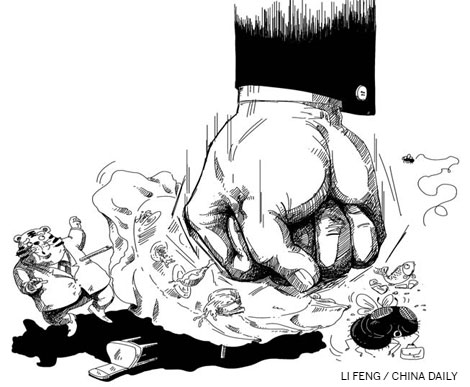
The Communist Party of China vowed on Wednesday to fight corruption firmly and to maintain its "high-handed posture" in the next five years.
"Corruption is still widespread. The soil that nourishes corruption still exists, and the situation remains critical and complicated," said a five-year plan (2013-17) on setting up a system to punish and prevent corruption, issued by the CPC Central Committee.
The fight against corruption has entered a new era thanks to the Decisions on Major Issues Concerning Comprehensively Deepening Reforms, issued by the Third Plenary Session of the 18th CPC Central Committee on Nov 15.
Part 10 of the document on reforms - supervision of power - explains the significance of effectively restricting and supervising power in all-round reform. Although some specific measures have been taken before, this is the first time the authorities have put all the measures together and addressed the question of supervision of power. The measures include restricting power through regulation and supervision of power by the people.
The document advances some new ideas and measures that could influence future development. For example, further reform of the discipline inspection and supervision system, especially the "dual leadership" in the CPC's discipline inspection system, could effectively restrict the use of power by officials. Plus, making it mandatory for senior officials to declare their assets will help build a sunshine government.
The document also advocates some microscopic but important new measures such as an inspection and accountability system for officials' selection and housing allotment. Its focus, however, is on reform of the CPC's discipline inspection system, which is expected to play a key role in China's anti-corruption drive.
Some people assume that "promoting concretization, routinization and institutionalization of the Party's discipline inspection work's dual leadership system", as mentioned in the document, goes against the spirit of the reform, that is, to grant greater autonomy to anti-corruption organs. But that is not true.
According to the Party Constitution, the current "dual leadership system" means discipline inspection work is mainly led by the Party commission of the same level, and higher level commissions only play the role of professional guide. Article 43 of the Party Constitution says: "The Party's Central Commission for Discipline Inspection functions under the leadership of the Central Committee of the Party. The Party's local commissions for discipline inspection at all levels and primary commissions for discipline inspection function under the dual leadership of the Party committees at the corresponding levels and the next higher commissions for discipline inspection."
Besides, Article 44 says: "The commissions for discipline inspection at all levels shall report to the Party committees at the corresponding levels on the results of their handling of cases of special importance or complexity, as well as on the problems encountered. The local commissions for discipline inspection at all levels and primary commissions for discipline inspection shall also present such reports to the higher commissions. If a commission for discipline inspection at any level discovers any violation of Party discipline by a member of the Party committee at the corresponding level, it may take the initial step of verifying the facts and, if it is necessary to put a case on file, it should report to the Party committee at the corresponding level for approval, and if a member of the standing committee of the Party committee is involved, it should first report to the Party committee at the corresponding level and then to the commission for discipline inspection at the next higher level for approval."
Moreover, according to the CPC's cadre selection and appointment system, the Party commission and government at any level have the right to nominate committees of discipline inspection at the same level and can also decide their budgets. And the reform will strengthen higher discipline inspection commissions' leadership vis-a-vis subordinate commissions, reinforcing the discipline inspection system's vertical leadership.
The document mentions three key measures: Higher commissions of discipline inspection should be mainly in charge of nomination and review of secretaries and deputy secretaries of subordinate commissions; discipline inspection commissions at all levels should report to the corresponding-level Party commissions as well as higher commissions when they verify facts and investigate cases; and discipline inspection commissions' investigation into cases that violate Party discipline should be led by higher commissions.
The most crucial measure among the three is nomination of secretaries and deputy secretaries of discipline inspection commissions, because nomination, to a large extent, decides the fate of candidates in the officials' selection and appointment system. According to current official management regulations, local leaders of discipline inspection commissions are nominated and elected by the corresponding-level Party committees.
The document says that higher commissions of discipline inspection will nominate secretaries and deputy secretaries of subordinate commissions, which means the authority to nominate leaders of local commissions has been given to higher commissions. Although the "dual leadership system" of discipline inspection commissions will undergo partial reform, the move means that local discipline inspection commissions, mainly led by the corresponding-level Party commissions, will now be led directly by higher commissions of discipline inspection. This reform will enhance discipline inspection commissions' supervision authority, and change the prevailing situation in which discipline inspection authorities cannot supervise Party commissions at the corresponding levels.
Although rules of inner-Party supervision issued on Dec 31, 2003, stipulate that local discipline inspection commissions can directly report cases that violate Party discipline to higher commissions, it doesn't have much effect in reality. Leaders of local discipline inspection commissions seldom dare to directly report such issues to higher commissions, because they are mainly led by the corresponding-level Party committees. Such weak supervision will change remarkably.
But implementing these reforms will be a real challenge, and without strict implementation the reforms won't be effective. Thus the key to success is overcoming the hurdles on the path of implementation.
And even if the reform goes smoothly, it will take time to take effect. The document emphasizes the combination of top-level design and radical pragmatism, or "crossing the river by feeling the stones". But if the top-level design is not sound and specific enough, it's important to allow local authorities to explore further reform measures instead of being restricted by current rules.
The author is director of the Clean Governance Research and Education Center at Beihang University, and an executive director of Institute of China Supervision.
















