


Toilet bus aids marathon runners
|
Xiamen International Marathon, the first major marathon of 2014, gets underway. The annual event attracted thousands of runners from 45 countries and regions to the island city in Fujian province on Thursday. Chang Haijun / for China Daily |
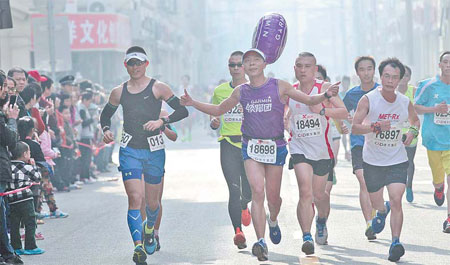
What helped Zhao Wenhui, a student runner from Peking University, stay focused on racing during the 42.195-kilometer course of the Xiamen International Marathon on Thursday wasn't his pre-race plan or support from the crowd.
It was a bus equipped with mobile toilets that followed the main group of runners.
"It really addressed our specific concerns of finding a proper place to urinate in the middle of the race as quickly as we could while not getting caught by public eyes or media cameras," Zhao, who also participated in last year's Beijing International Marathon, told China Daily. "At least I didn't see the embarrassing scenes from Beijing happen here."
The Beijing marathon, which attracted more than 35,000 participants on Oct 20, saw its reputation tarnished by the issue.
After the race, photos of male runners, both Chinese and from overseas, urinating against the outside walls of the Palace Museum along Chang'an Avenue caused an uproar on major news portals and social media.
Public opinion was divided, with some criticizing the runners, saying urinating on a cultural heritage site in public was unacceptable, while others blamed a lack of temporary toilets at the massive event.
Although he admitted that the situation looked embarrassing, Zhao said it was unfair to blame the runners, as long waiting times to use the available toilets would affect their race times.
To prevent similar scenes from happening in Xiamen, where more than 24,000 runners took part in the full marathon, the organizing committee prepared 320 temporary toilets, 20 more than available in Beijing, and arranged them evenly along the course in addition to the mobile-toilet bus.
All the permanent public toilets along the route and around the starting and finishing points were also required to open in advance.
"We saw some runners waiting outside the toilets but we never saw them answering the call of nature in public," said Li Lina, a spokeswoman for the organizing committee and deputy director of the Xiamen Municipal Sports Bureau.
"The increase of temporary toilets played a big part in solving the problem," she said.
After the Beijing marathon, organizers of major events have been urged to ensure they provide at least one temporary toilet for every 70 people, according to a regulation announced by the Beijing Municipal Commission of City Administration and Environment in November.
The commission also emphasized the importance of providing directions to and signs for toilets and cleaning them up soon after the event.
Gu Bin, president of Running Bar, a nationwide amateur runners' club, said public urination is part of marathon running.
"Urinating outside of toilets is commonly seen at marathons anywhere around the world, as it has been part of the sport. It's no big deal," said Gu, who has participated in many marathons in other countries. "Though it seemed inappropriate to pee on the famous wall, it's acceptable to find somewhere with cover, like in a bush or at a corner.
"You will never have enough toilets that easily meet the demand of tens of thousands of people. It's not worth doing that, given the huge expense of producing and transporting them once every year."
Citing the example of the Seoul International Marathon, Gu suggested Chinese organizers use the toilet facilities of office buildings and department stores along the route.
Endeshaw Negesse, an Ethiopian runner who competed at Xiamen for the first time, echoed Gu.
"If it happens to athletes during the race, it's just human instinct. If there is no opportunity (to use a toilet), just use anywhere possible and nobody gets blamed. Everybody would do the same according to my experience," he said through a translator.
Zhou Qinlu, a mass fitness researcher at the Beijing Institute of Sports Science, suggested runners urinate before the race whether they feel they need to or not, and to limit their water intake at every supply point during the race.
Contact the writers at sunxiaochen@chinadaily.com.cn and sunli@chinadaily.com.cn
















