US architects build 'stature' in China
|
Gene Schnair says his architecture firm Skidmore, Owings & Merrill is ready to roll into the next stage in China after 20 years designing 150 projects and getting another some 150 in the pipeline there. Qidong Zhang / China Daily |
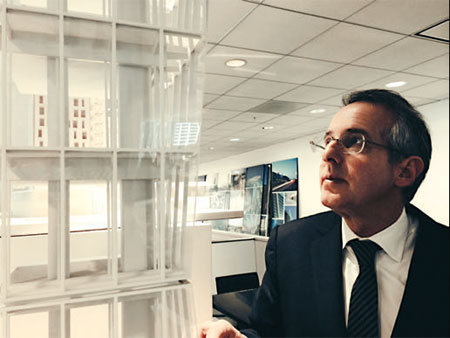
Wanting to be an architect since the age of 5, Gene Schnair's passion today is to pursue the most interesting architectural projects globally. As managing partner and president of Skidmore, Owings & Merrill's (SOM) San Francisco office, that passion has been fulfilled in more than 150 skyscrapers and low-rises in China, with another 150 or so in the pipeline.
The China World Trade Center, Jin Mao Tower in Shanghai. the New Poly Plaza in Beijing. the US Embassy in China and China's "Wall Street" - Beijing Finance Street and more are all products of SOM, one of America's largest and most influential architecture firms, with more than 1,600 architects and 10 branches worldwide.
Founded in 1936, SOM first entered China in 1994 and got fully geared up there in 2000 when Schnair took the helm. The firm is about to set up a full service office in Shanghai in response to the increasing demands of the Chinese market.
"2014 will be a great-leap-forward year for us in the China market," Schnair said. "After almost 20 years in China, we are ready to move to the next level. In order to have the right credentials to become a full-service entity, we need to hire people locally. We are looking into hiring 50-100 professionals and hope that process will be done soon."
A 29-year veteran at SOM, Schnair still remembers his first trip to China in 2000.
"My first time to Beijing was for a project that I had no idea an incredible relationship would be built and carried along for many years. I never realized how valuable and important the relationship would be," he said.
That first project was the $12 million Beijing Finance Street.
Assisting Schnair is Taiwan-born Patricia Yeh, who has been a key liaison between SOM projects and Chinese developers from the start. She said the Beijing Finance Street project was tough at the beginning and took a lot of communication to reach an agreement.
"The developers had never dealt with a foreign architectural firm before," Yeh recalled. "The conversation got so unpleasant that both parties got upset and had to leave the table. After more talking, however, eventually mediation brought us together."
Known as China's "Wall Street" in Beijing's historic center, Beijing Finance Street has become a vibrant and sustainable mixed-use district of 18 residential, hotel, retail, entertainment and office buildings. The walkable center of the West District is anchored by a central park and connected by gardens, courtyards and landscaped pathways.
The "Wall Street" concept was so popular that the developers invited SOM to design similar centers for its Chongqing, Tianjin, Nanchang and Wuhan sites. The business relationship has been carried forward for the 23 years since.
Through that exposure, Schnair saw opportunities in China's booming land development. Specializing in large-scale, complex projects, he steered the firm's practice in China.
"We have developed what we call our distinctive character: simplicity, integration of architectural and engineering disciplines, and collaboration of architectures, engineers, and planners," said Schnair.
According to Yeh, "a grand orchestrator" is needed when it comes to implementing architectural projects in China.
"When you design for a developer, you actually have to deal with local city planning commissions, landlords, construction teams and material selection, from color matching to toning. A lot of details are involved before we even bid," said Yeh.
One of the most emblematic projects for SOM in China came in 2008. The US Embassy in Beijing was one of the largest ever undertaken by the US government. Five American firms competed for the job, all were asked to bring architects and complete the design work in five days.
"Our team worked literally day and night to create a concept for evaluation. Diplomatic atmosphere, trust, environment for families going overseas, the modernization of design, timelessness, all had to come together at the time of the bidding," said Schnair.
Awarded to SOM, the 10-acre site has a glass structure that changes with the sun through the course of a day and at night glows like a lantern. The simple geometries, coupled with landscape elements of lotus water gardens, wooden bridges and courtyards fuse Eastern and Western traditions.
"The project meant a lot to us, it was a milestone for SOM in every sense accomplishing this project, a symbolic bridge between the two countries," Schnair said.
The $540 million 88-story Jin Mao Tower in Shanghai - still perhaps China's most iconic building and for a while its tallest - was designed by SOM's Chicago office and completed in 1999.
"We are very proud of its connection to Chinese culture and symbolism paired with high-performance engineering," said Schnair. "In a way it really highlights the success of China's opening-up policy and of Shanghai's return as a global center of commerce."
With a Master's in architecture and MBA from Washington University in St. Louis, Schnair believes the best way to keep a competitive edge is to understand the business culture and develop a long term relationship.
"Most decision makers in China and the US have been abroad, seen good landmarks and know it when they need to make a judgment call on a bad or good design, which is to our advantage," said Schnair.
One challenge, however, is a shortage of talent in China. "There aren't enough graduates coming into the industry to start with, and the approach to design from Eastern and Western education is very different. Chinese professionals and graduates have a high level of intelligence and capability, but there is lack of training when they take on challenging issues that don't have a black or white answer. We might call it problem-solving, or creative thinking ability. There's just more of entrepreneurial thinking in American culture where young people are willing to take risks, and try new ideas when it comes to design," he said.
Yeh also recognizes challenges in terms of timing. "In China every developer wants fast development, which involves tight deadlines for every project," said Yeh. "This is very different from the US, where we take a long time to get permits, plan, design and work on a calendar step by step."
Schnair is optimistic about the outlook in China and plans to implement the new Shanghai office with mostly local professionals and only a few expatriates from the U.S.
"We plan to cross-train Chinese architects in our US office from six months to a year so that everyone understands our standards and core values. Some foreign companies just go to China, hire a few people and put a sign on the door. Our goal is to grow our office organically from Shanghai and implement our quality service," said Schnair.
"To me China understands the power of great design," he said. "Design excellence creates lasting value, and expresses corporate and national stature."
kellyzhang@chinadailyusa.com