


Dropping 'no-war' pledge a part of Abe's strategy
|
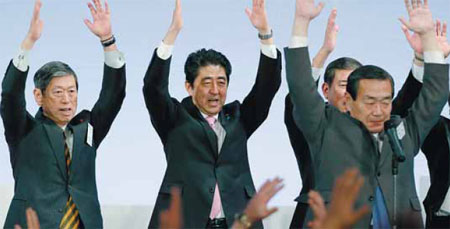
Japan's Prime Minister Shinzo Abe (second from left) and his Liberal Democratic Party lawmakers shout slogans during the annual convention at a hotel in Tokyo on Sunday, where they determined the party's platform for the coming year. Shizuo Kambayashi / Associated Press |
Experts say move represents another gesture embracing militarist past
A longtime no-war pledge has disappeared from Japan's Liberal Democratic Party's annual working policy revealed on Sunday, while the ruling party vowed to continue visits to the controversial Yasukuni Shrine and push ahead constitutional revision, in another move leading the country in a far-right direction, observers said.
At its 81st LDP annual convention in Tokyo, the party removed the pledge that Japan would "never wage a war", China Central Television reported on Sunday.
In another change from last year's policy, the party added a phrase saying it will "bolster veneration for the war dead" - referring to continued shrine visits - and also made clear it will amend the country's constitution. The changes show that Japanese Prime Minister Shinzo Abe, who is also the party chief, will intensify efforts step by step to push Japan further into animosity with neighboring countries, analysts said.
"The changes in the 2014 position indicate that Japan's rightward inclination is getting increasingly obvious. Removing the pledge of not starting a war is a long-term strategy for Abe," said Gao Hong, a researcher on Japanese studies at the Chinese Academy of Social Sciences.
Wang Xinsheng, a professor of international affairs at Peking University, said it is Abe's ultimate goal to "normalize" Japan, as indicated when he avoided mentioning the no-war pledge on Aug 15, the 68th anniversary of Japan's surrender in World War II.
The convention on Sunday was held after Japan's neighboring countries have aired their exacerbated worries over Tokyo's attempts to change its postwar status and return to militarism.
Abe visited the Yasukuni Shrine - where 14 Class-A Japanese war criminals are honored - on Dec 26. He is the first incumbent Japanese prime minister to pay an official visit since 2006.
Abe then reaffirmed the no-war pledge to soothe international anger over his visit, saying he renewed his "determination before the souls of the war dead to firmly uphold the pledge never to wage war again".
According to Japanese media, the no-war pledge appeared in an earlier draft for the 2014 LDP working policy. "By removing the pledge, Abe has revealed his true political ambition, which is to reinstall Japan with the right to wage wars," Gao said.
Under the terms of its surrender in World War II, Japan banned from starting a war, while Article 9 of the Japanese Constitution also forbids Japan from resorting to warfare to settle international disputes.
"Abe has been eyeing a change to the postwar constitution for a long time, and can eventually realize that ambition by writing his intention into the LDP annual working policy," Gao said.
"However, Abe knows that there are still a lot of obstacles in front of him, so he chooses to push ahead step by step."
In August, Abe replaced Tsuneyuki Yamamoto, the chief of the Cabinet Legislation Bureau, who opposed changes to the Japanese official view on war that stipulates Japan's military cannot exercise the right of collective self-defense since such an act would exceed the minimum use of force allowed by the Constitution.
The Cabinet Legislation Bureau has for decades maintained that while Japan has the right of collective self-defense, it cannot exercise it. Experts say that has been a major obstacle to lifting the ban on an expanded role for the armed forces.
After the LDP annual working policy was released, opposition parties in Japan immediately expressed discontent over the removal of the no-war pledge, according to the CCTV report.
Banri Kaieda, chief of the Democratic Party of Japan, said the issue needs to be discussed further, while Natsuo Yamaguchi, leader of the New Komeito Party - Abe's ally in the coalition - again urged Abe to restore Japan's deadlocked relations with China.
Contact the writer at zhouwa@chinadaily.com.cn
















