Lenders urged to plow new fields
Aim is to revitalize rural regions with more access to financial services
China is encouraging private enterprises to initiate setting up small and medium-sized rural financial institutions, signaling the government's determination to revitalize the countryside by further opening up the rural financial industry to private capital, according to a report by Xinhua News Agency.
"The China Banking Regulatory Commission is endeavoring to increase the proportion of private capital in rural financial institutions," a person who works for it told Xinhua. "The move is to be carried out on two principles: giving priority to local investors, such as leading private enterprises and major farm owners, and diversifying the stock structure."
Small and medium-sized rural financial institutions are established mainly through private investment to facilitate the development of rural areas, farmers and agriculture. They are made up of several types of financial institutions including rural commercial banks, rural cooperatives and village banks, among others, serving as an important channel for private capital to enter the banking industry.
China had 468 rural commercial banks, 1,803 rural cooperatives and 1,071 county banks by the end of 2013, according to the commission's statistics.
Rural cooperatives are the major credit provider, accounting for 70 percent of the loan balance.
Rural commercial banks, many of which transformed from rural cooperatives, held 6.3 trillion yuan ($1.04 trillion) in total assets and 78.3 billion yuan in after-tax profits by the end of 2012.
However, the rural financial industry remains the weakest link in China's financial reform in spite of its widespread network.
Shang Fulin, the commission's chairman, remarked earlier that China's rural financial industry is burdened by a series of problems, including an imbalanced credit structure, high demand outrunning insufficient supply, the misplacement of financial resources and a lack of coordination among different institutes.
Lenders often have second thoughts considering the massive uncertainties in agricultural production, a business deeply subject to weather conditions. Worse still, farmers have few production factors that can be mortgaged. As a result, some of the loans meant to facilitate rural development have gone to non-agriculture businesses that easily offer real estate assets as mortgages.
Moreover, rural commercial banks have high non-performing loans, which stood at 61.2 billion yuan by the end of 2013. The non-performing loan ratio was 1.73 percent, compared with 0.83 percent of urban commercial banks.
"When the government fully opens the rural financial industry, it will not ask commercial financial institutions to fulfill political responsibilities of favoring agriculture-related borrowers," said Yi Xianrong, a former financial expert at China Academy of Social Sciences. "Commercial institutions can only operate according to the demands of the market. Otherwise, risks are going to build up in these institutions, and society will eventually pay the price.
"On the other hand, the government should allocate more investment to financial infrastructure construction in rural areas, which is a major liability of the lackluster development of the rural financial sector. Some industries, regions, families and projects also deserve special financial treatment, which is to be initiated by the government."
Meanwhile, the commission is also intensifying its support for village banks, according to Xinhua.
The anonymous commission employee told the agency it plans to develop the current 1,071 village banks, both in operation and about to be opened, into special small community lenders focusing on the development of rural areas, farmers and agriculture.
Among the 987 village banks that have opened for operation, 145.5 billion yuan had been lent to farmers and 182.5 billion yuan to small and medium-sized enterprises by the end of last year, taking up 90 percent of the total loans. Private capital has taken up 71 percent of these banks' total stock.
Foreign capital has also set its sights on the potential of the loan shortfall in rural areas. Commonwealth Bank of Australia, HSBC Bank (China) Co Ltd and Temasek Holdings have opened or co-founded village banks throughout China since 2007.
yangziman@chinadaily.com.cn
|
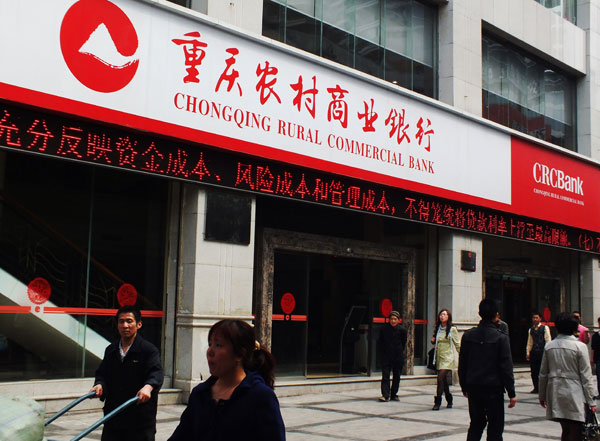
China had 468 rural commercial banks, 1,803 rural cooperatives and 1,071 county banks by the end of 2013, according to China Banking Regulatory Commission statistics. Provided to China Daily |