Shoucheng Zhang: Moutai and a possible Nobel Prize await this Stanford scientist
|
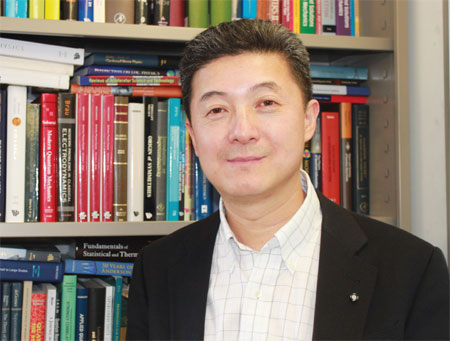
Shoucheng Zhang, a J.G. Jackson and C.J Wood Professor of Physics at Stanford, is internationally recognized for his research in topological insulators, quantum spin Hall effect, spintronics and high temperature superconductivity. Kelly Zhang / China Daily |
His Chinese colleague at Stanford University has prepared half-a-century-old Moutai, known as China's national liquor to celebrate his possible Nobel Prize nomination "any time."
Shoucheng Zhang, a J.G. Jackson and C.J Wood professor of physics at Stanford, is a potential Nobel Prize candidate for his internationally recognized research in topological insulators, quantum spin Hall effect, spintronics and high temperature superconductivity. His scientific discovery that was recognized in 2007 is ranked as one of the top-10 scientific breakthroughs ever, according to Science Magazine.
A condensed matter theorist, Zhang's discovery means a single layer of tiny atoms could be the first material to conduct electricity with 100 percent efficiency at temperatures that computer chips operate.
The new material "stanene", combining the Latin name for tin (stannum) with the suffix used in graphene, can be applied widely, including increasing the speed and lowering the power needs of future generations of computer chips.
Zhang said the discovery involves a special class of materials known as topological insulators, which conduct electricity only on their outside edges or surfaces and not through their interiors. When topological insulators are just one atom thick, their edges conduct electricity with 100 percent efficiency.
"The discovery I made in 2006 basically says we can make electrons to move on defined lanes to avoid collisions and dissipation, and, thereby, extend the life of Moore's Law, which observes that the number of transistors on an integrated circuit doubles approximately every two years. It's going to mainly revolutionize IT and semiconductor industries, ultimately becoming a substitute for silicon used for circuit structures on our mobile phones, and computers," said Zhang.
According to Zhang, the theory and application of topological insulators might lead to a revolutionary development in the field of information technology by equipping mobile phones with a level of power that is the equivalent to the entire Google server farm so they do not have to be charged every day.
"One day in 2010, a friend called to let me know that over 40 million people came to know my theory instantly through the 'Big Bang Theory', since the popular TV show made an episode based on my discovery. I never imagined that a scientific discovery could instantly reach such a wide audience worldwide," Zhang said.
When it comes to a possible Nobel Prize, Zhang would rather talk about the experience of discovery.
"The best part of life should be the experience itself, not the goal," he said. "Seeing that an idea conceived from beauty also turned out to be true in Nature is perhaps the greatest reward for a scientist like me."
Today, Zhang's research still focuses on how materials can be built from the smallest building blocks of electrons and atoms.
"The Greeks postulated that everything in the world is composed of basic elements they called atoms. Ever since that time, one part of basic science looks for the ever smaller building blocks of matter. In the other part of science, we try to find out how these basic building blockscan fit together to give rise to a wonderful complex world," he said.
Zhang is a fellow of the American Physical Society and the American Academy of Arts and Sciences. As an American citizen, he is a foreign member of the Chinese Academy of Sciences, which entitles him to offer advice to the central government.
Other than the Alexander von Humboldt Research Award in 2009, the Johannes Gutenberg Research Award in 2010, he received several distinguished awards in the science field: the Europhysics Prize in 2010, the Oliver E. Buckley Prize in 2012, the Dirac Medal and Prize in 2012 and the Physics Frontiers Prize in 2013 for his theoretical prediction of the quantum spin Hall effect and topological insulators. Many of the recipients of these prizes were subsequently honored with a Nobel Prize.
Zhang's interests go beyond science, and include philosophy, poetry, opera and history. Whenever he travels to conferences, he downloads online classes about the culture and history of the countries to which he is traveling. But he said the most fascinating part of life is his students because they inspire him and give him new ideas for his research.
Many describe Zhang as "God's favored one" and some call him "a genius."
At the age of 15, the practically self-taught Zhang went to Fudan University in Shanghai in 1978 and majored in theoretical physics without going to high school.
In that year, the government started a program under which the top 200 or so students who had scored the highest in college exams were sent abroad to study. After only one semester in college, Zhang was sent to Germany to study, where in 1983 he received his bachelor's degree from the Free University of Berlin. In 1987 he was awarded a Phd from the State University of New York at Stony Brook in New York.
At Stony Brook, Zhang's mentor and role model was Nobel Prize winner Cheng-Ning Yang.
"He has taught me that science, like anything else, utilizes simplicity to reach the ultimate state of beauty. In poetry we use the simplest words to express our complex emotions and deep thoughts, and in theoretical physics we use the simplest equation to describe the world from the smallest atom to the vast universe. In this sense, science and art share the same aesthetic aspirations, and this is what Yang has taught me," said Zhang.
He said Yang, who is 92, remains a close personal friend and that he usually replies to his e-mail within two hours. Yang and Tsung-dao Lee, two of China's Nobel Prize winners in 1957 for their work in physics, also inspired him to study physics.
"Back in 1950s, they were the only ones who proved to the world that Chinese scientists were able to achieve greatness. Their names mean so much to the Chinese and influenced my generation," said Zhang.
One of two children, Zhang attributed his early learning advancement to his intellectual family. His grandfather, Yi Zhang, was one of the first Fudan University graduates in 1908 and his father, Hongfan Zhang, was a graduate of Jiaotong University who majored in ship building.
"I was left ample time to read, play, think and explore. Not much was taught at school at that time, but I was always onto learning something, which is a habit I kept until today," said Zhang.
Zhang said one of his biggest honors came from China in 2009.
"I was one of the scientists invited to the reviewing stage on Tian'anmen Square for the 60th national day celebration in 2009," said Zhang. "It was a truly emotional moment for me. I was so proud to be a Chinese, and have made my motherland proud."
America has made every opportunity possible for him, said Zhang.
"When I first went to Germany in the 1980s, many Germans had never seen Chinese before. They showed great hospitality to me by inviting me to have dinner at their homes, and after three years they were still doing the same - then I realized I was treated as a visiting guest in Germany. America is different. Nobody really pays attention to who you are and where you come from. This is a country that accepts everyone who wants an opportunity, and you can control your own destiny the moment you land," he explained.
A scientist who has attained recognized achievement, he still speaks with great modesty and prudence.
"In physics, we analyze the most difficult phenomena and summarize them into a simple and universal law of nature. I find myself inspired by young students who are creative and think with no boundary," he said.
Other than his scientific research and study, Zhang wants his legacy to be his students. He supervised 20 students who graduated with a Phd in physics and many of them have become academic leaders at Harvard, Princeton, Stanford, the University of California in San Diego, Purdue and Tsinghua University in China.
Zhang's son Brian was an international physics gold medal winner in high school. Now he is a junior at Harvard majoring in physics with a minor in computer science.
His daughter Stephanie is a senior at Gunn High School in Palo Alto, California, who wants to help under-privileged children worldwide with online educational classes. She went to Qinghai last year to initiate a sociology study on local children in a remote area where educational resources are scarce.
Zhang's wife Barbara, whom he has known since kindergarten, is a software engineer at IBM.
A firm promoter of self-motivation, Zhang believes the most important thing an educator or parent can do to influence the younger generation is to leave space for them to find their interest and passion.
"Today, young people are stuffed with so much homework and sometimes they are tired of studying or have no time to think about what they are really interested," he said. "We should leave enough space for young students to find their true passion and guide them to self exploration. Only passion and self motivation are sustainable in the long run."
Zhang attributes his academic achievements to Stanford, which he said is his source of "happiness."
"Every morning coming to work, I still can't believe there is such a great job in the world like this. We have fabulous weather in California, beautiful environment. I teach the most brilliant minds in the world, and have the ultimate freedom to carry out my research," said Zhang, "life couldn't be better."
kellyzhang@chinadailyusa.com