


Russian opera makes a comeback
|
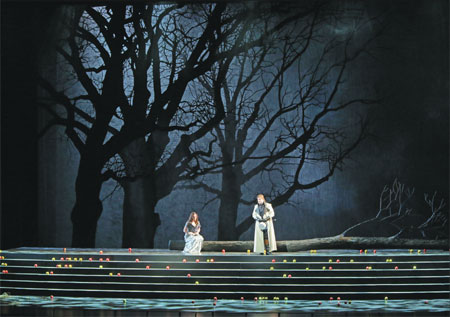
The National Center for the Performing Arts will start its annual opera festival with Russian opera Eugene Onegin, a co-production of Mariinsky Theater and the National Center for the Performing Arts. Provided to China Daily |
Chinese fans have had their fill of the Italians-now the Russians are coming, bringing one of the country's classics to the Beijing stage. Chen Jie reports.
Chinese opera fans have watched enough Verdi and Puccini in recent years, and the producers of the National Center for the Performing Arts believe the time is right for Russian operas to make a comeback. Eugene Onegin, a co-production between Mariinsky Theater and the NCPA, will mark the opening of a three-month opera festival on March 14. Valery Gergiev will conduct the NCPA orchestra and choir. The Russian cast will perform on the opening night, the Chinese cast will perform on March 17 and a mixed cast will perform on March 15 and 16. "NCPA has tried to present a variety of operas since its opening in 2007, from the popular Carmen and Turandot to Wagner's The Flying Dutchman. Russian opera is not familiar to local audiences. People know Tchaikovsky's ballet but not his opera," NCPA's production director Wei Lanfen says.
She says the production is a challenge not only for the audience but also the performers because over the past 30 years Chinese conservatories seldom taught Russian operas.
NCPA decided to work with Mariinsky, the most prestigious theater in Russia. They began their collaboration in February 2011.
Mariinsky highly values the collaboration because it's their first co-production with an Asian company in its 230-year history.
Maestro Gergiev says Eugene Onegin is a "logical continuation of collaboration with NCPA". Mariinsky's opera and ballet company performed at NCPA's opening in December 2007. The company has also toured independently in China.
"I can safely say that over the years we have presented a broad range of Russian music and our great musical traditions (in China). Every time we meet the appreciative Beijing public, it is a source of sheer pleasure for me and all our performers," Gergiev says.
"I respect China's long history, fantastic economy and progress. Classical music has been booming in the past 10 years.
"I am thrilled that it is the Mariinsky Theater and our wonderful team that will introduce Chinese audiences to this well-loved Russian opera, which occupies an exceptional place in the history of Russian music. It was here that, for the first time in Russian opera, Tchaikovsky tackled a plot that essentially dealt with his contemporaries, writing about emotions that everybody knows and that touch everyone."
The co-production by stage director Alexei Stepanyuk, set designer Alexander Orlov and costume designer Irina Cherednikova gracefully and faithfully depicts the world of Tchaikovsky and Pushkin. Its premiere in Moscow in early February received widespread acclaim.
Beijing-based music critic Lun Bing, who attended the premiere in Moscow, says: "It's an impressive production. It reminds me of my youth when China and Russia were on good terms and people in the two countries exchanged art, music and drama. What's more, the director and designer recreated visually the incredibly complex world of the protagonists."
Gergiev says: "It's Pushkin's and Tchaikovsky's opera, a real Russian opera. You have different versions of Eugene Onegin. In French people's eyes, Russians are poor.
"If you respect your country, your own tradition, you don't need to invite conductors and directors from foreign countries."
The stage director Stepanyuk says his production is a contemporary stage director's take on this subject.
"And not just of a contemporary stage director, but of a contemporary person in general. I would like young people to discover themselves in my production," Stepanyuk says.
He says that, over hundreds of years, manners change, language changes and people's behavior changes, but the essence of humanity remains.
"So, on the one hand, I want to hear pure Russian language and see the manners, etiquette and the behavioral nuances of Pushkin's time. On the other hand, it's very important that the production is not some kind of 'historic guide'. It should be psychologically convincing and all of its characters-starting with Onegin and ending with Zaretsky-must be real people.
"Our sets and costumes are historically accurate, but this is not literal history. They are rather miserly and yet, at the same time, highly emotional. The result is a somewhat ascetic though imaginative production.
"For me personally, Tchaikovsky is closer, of course, because emotionally he has greater effect. If Pushkin's Onegin is an encyclopaedia of Russian life, then Tchaikovsky's opera is an encyclopaedia of the Russian soul. The most difficult thing for me is to combine the vast range of emotions we hear in Tchaikovsky's music, with its ironic language, somewhat distanced from Pushkin.
"I want everything to be very natural. As Stanislavsky once said of a play by Chekhov, 'nothing happens, people sit, have lunch and human lives are destroyed'."
The director says it's even difficult for today's Russian actors to sing and perform the opera, let alone the Chinese cast.
The NCPA invited the director and singing coaches from Russia to audition and train Chinese performers last year. Wei believes that the Chinese cast will give audiences a pleasant surprise.
"This is my first opera singing in Russian," says baritone Yuan Chenye, who performs the title role Onegin. "It's destiny that I won the Tchaikovsky Music Competition in Moscow 20 years ago. Because of the relationship between the two countries, we learned little Russian opera in the past three decades.
"This time, the Russian director and coaches remind me that in 1990, when I worked at the China Opera House, I met a Russian director who impressed me with the great Russian drama tradition. He can sing, dance and perform. He can do anything onstage."
The NCPA's opera festival will present 10 operas, including La Traviata, Turandot, Il Trovatore and Chinese original operas.
"The NCPA has hosted the annual opera festival since 2009. This year's theme will be: Western opera is spreading while Chinese opera is blossoming," Wei says.
Contact the writer at chenjie@chinadaily.com.cn.
















