Martyrs remembered
The War of Resistance against Japanese Aggression (1937-45) was a dark period in history, and the complex politics of China over the past century means many who fought bravely to expel the invading army were forgotten. Li Yang reports from Yunnan about the special place the National Martyr Cemetery there has in the hearts of the local people.
The National Martyr Cemetery has a special meaning to the half a million people living in Tengchong, a county bordering Myanmar in Southwest China's Yunnan province that was the first county in China liberated from occupation by the Japanese army in World War II.
Across the street from the cemetery is the Confucius Temple, which was used by the Japanese army as a place to rape "comfort women" from May 1942 to September 1944.
By taking Tengchong, the Japanese army cut the road connecting Myanmar and China, an important channel for the United States to send supplies to the Chinese army.
The 20th Group Army of the Expedition Army of the Kuomintang took the county back in Sept 14, 1944, after a bloody 127-day battle, killing about 6,000 Japanese troops and losing 9,168 Chinese soldiers and 19 US soldiers.
The cemetery, covering an area of 53,300 square meters, was built in July 7, 1945, with donations from local people, most of whom were descendants of soldiers who came to defend the border from Jiangsu and Gansu provinces in the Ming Dynasty (1368-1644).
All the bodies of the Chinese soldiers were incinerated together and their ashes were put into 3,346 porcelain altars and buried on a 30-meter-high hill in the center of the cemetery. A tombstone carrying a martyr's name and his military rank was erected on each grave.
On the top of the hill, a monument was erected, made of local igneous rock and inscribed with the calligraphy of Huo Kuizhang, the commander-in-chief of the 20th Group Army of Kuomintang. It reads: "Martyrs liberating Tengchong never die."
Pine trees, cypresses and bamboos are planted throughout the cemetery, giving the graveyard lots of shady areas.
In the middle of the hill are the cenotaphs of 19 US soldiers and three wooden buildings of memorial and exhibition halls, around which stand a group of stone tablets inscribed with eulogies by Kuomintang generals and officials of the martyrs and local residents, and their accusations of the Japanese army's actions in Tengchong.
Statues of Chinese soldiers, US army commanders Joseph Stilwell and Claire Lee Chennault, and the brave county head Zhang Wende, who refused to surrender to Japanese, dot the large stretch of grassland at the foot of the hill.
A small tomb named "Japanese invaders' grave" covered with wild grass is at the border of the grassland facing the martyr's hill and statues. Four Japanese soldiers' bodies were buried in the tomb in a kneeling position, as if to offer an apology to the Chinese and US soldiers.
The cemetery was damaged by the Red Guards during the "cultural revolution" (1966-76) and used as a Party school until the mid-1980s, when it was refurbished and turned into the only cemetery marking the Kuomintang's sacrifice in the frontline battlefield against the Japanese invasion of the Chinese mainland.
"Local people had never stopped visiting the cemetery stealthily - including me - despite the special political environment," says Lu Caiwen, 88, a veteran of the 20th Group Army and a graduate of the Whampoa Military Academy in 1942.
"Some of my comrades-inarms are buried there. Sitting near their tombstones, I feel I am with them again. They never get old in my eyes and always remain young just as if it were yesterday."
Most of the famous generals that were victorious in the War of Resistance against Japanese Aggression (1937-45) in Tengchong and Myanmar surrendered to the army of the Communist Party of China during the Chinese civil war from 1945 to 1949.
Their military achievements in Tengchong were largely uncelebrated by the Kuomintang as well as the Communists.
It is a custom for local residents to visit the cemetery not only on important memorial days, but also when they feel they need to attain a kind of inner peace. "Visiting the cemetery for local people is like going to church for Westerners," says Duan Shengkui, a famous local collector of relics from the war. Duan has collected about 87,000 military articles of the Kuomintang, US and Japanese armies from the old battlefields since 1986.
He lives beside the cemetery and has operated a private museum there since 2005.
The county government built a large museum for him beside the cemetery, which opened on Aug 15, 2013, the anniversary of the Japanese surrender to China.
"I am honored to have the museum built near the cemetery and I hope my collection can supplement the visitors' understanding of the Expedition Army that has been long ignored," Duan says.
"I found paper cranes, a symbol of peace, made by primary school students and coins donated by the kids in a rusting helmet with bullet holes, which I exhibited in my private exhibition. I was touched by the children's wish for peace and made up my mind that I should make my collections accessible to more people. Thanks to the government's help, my dream came true."
Both Duan and Lu hope the National Martyr Cemetery can serve as a public reminder to the long forgotten war in Tengchong.
The Japanese army developed a weaponized plague during the war, and the ancient disease was spread among Chinese civilians in Tengchong by infected white mice. It still lingers to this day.
Just like the virus, the trauma of the war is still evident and is felt in the hearts of the local people, says Huang Minghui, a local villager visiting the cemetery on the weekend.
"Learning from history is the best way for both China and Japan to strive for a better future," Lu says. "As cross-Straits ties thaw, the cemetery will win complete recognition from Chinese people and that piece of history."
Contact the writer at liyang@chinadaily.com.cn.
Li Yingqing and Huo Yan contributed to this story.
|
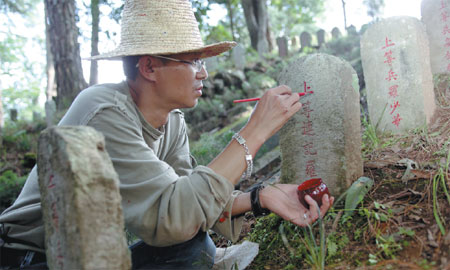
A worker repaints the inscription on a tombstone at the National Martyr Cemetery in Tengchong, Yunnan province. Huo Yan / China Daily |