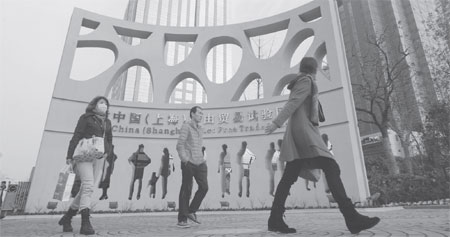
Shanghai FTZ hasn't taken bold steps in financial reform
The establishment of the Shanghai Free Trade Zone last year has put the city on the frontline of China's financial reform.
The central government is looking to the Shanghai FTZ to try out policies for national financial reform, and to better prepare China for such regional free-trade framework as the Trans-Pacific Partnership.
President Xi Jinping and Premier Li Keqiang have reiterated on different occasions that Shanghai should take bold steps to experiment with new practices that will benefit national financial reform and China's further integration into global trade.
But the Shanghai government still has a wait-and-see attitude, and Shanghai officials seem to be missing the bigger picture.
If Shanghai wants to regain its title as a global financial center, it should not regard as its achievement the guaranteeing of freedom for standard practices of international financial centers.
The Shanghai FTZ administration published the first "negative list" in China last year, a symbolic move meant to cut the government's red tape. But the list contained more than 1,000 banned areas.
"More troubling is that few details were given at all," commented the Economist in one article about Shanghai's FTZ.
Paradoxically, the local government is curing its bureaucracy without mincing steps.
Shanghai was already a global financial center a century ago when Tokyo, Hong Kong and Singapore were little known. In its quest to regain the title, Shanghai needs to catch up with the front-runners, but not always be content with leading other Chinese provinces.
If the Shanghai FTZ administration cannot acquire an international vision, the Shanghai FTZ may follow in the footsteps of the Pudong new district. A desolate area east of Huangpu River before the 1990s, Pudong was the central government's early effort to renewal. It became a local showcase, contributed to the local economy's growth and promoted several local officials to the central government.
But unlike Shenzhen, Chinese mainland's first special economic zone bordering Hong Kong that was initiated in the 1980s, Pudong has not generated as much spillover for other parts of China.
Local officials remain growth-driven despite their pro-reform pledges. Many of them tend to equate an FTZ with tailor-made preferential policies in land, tax and export.
Although the central government stresses repeatedly that it will not roll out any preferential policies for an FTZ, it still cannot dampen local counterparts' desire to set up an FTZ.
At least 30 provinces and cities have shown willingness to set up an FTZ this year, in a similar mania as they showed in the 1990s when they applied to set up high-tech development areas and industrial parks at various levels. The areas and parks flourished on low tax and cheap land. Many have withered now with the rise of labor costs and the decline of exports.
The national FTZ craze motivated the Shanghai government in its most recent rules last week to pressure the Shanghai FTZ to mete out valuable and reproducible lessons for national financial reform in less than the planned three years.
Analysts believe that deepening financial reform within the FTZ and effective control over the border between the FTZ and the rest of China are central to its success.
There should also be an effectively controlled border between the FTZ and the rest of China to manage the risks, across which capital flows are permitted under close supervision, in case speculators and arbitragers take advantage of the incompleteness of the renminbi's exchange-rate reform.
Xia Bin, a senior economist with Tianjin-based Nankai University and a counselor for the State Council, proposed that all financial sector practices should be done according to market rules and international conventions in the Shanghai FTZ. "Otherwise, the FTZ loses its meanings," Xia said.
|
The main entrance of Shanghai FTZ Administration Commission. Yang Yi / for China Daily |