Auto financing a key driver in auto industry
|
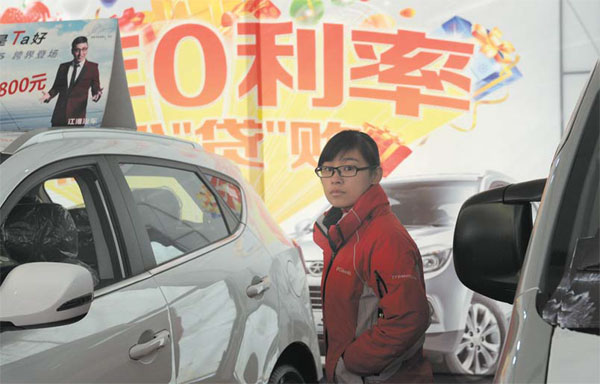
A dealer promotes a "zero interest rate" for car buyers. The auto financing sector is expected to see robust growth in China. Provided to China Daily |
New business area enters rapid development phase
Last year was remarkable for China's automotive industry as passenger vehicle sales reached 18.1 million units, up 16.5 percent from 2012. Commercial vehicle sales reached 40.5 million units, growing 15.7 percent.
Everyone has their own predictions for the future of the industry, but for us, detailed analysis of market drivers and trends that push the industry is the most important element of a good forecast.
One of the most important drivers in the automotive industry we have observed was auto financing.
Auto financing for personal and commercial vehicles is a fairly young business in China. It began in late 1998, when the central bank released regulations for the sector.
Financing for Chinese passenger vehicles is about to enter a phase of rapid development, driven in part by increasing sales volumes of passenger vehicles, which reached 18.1 million units in 2013, and are expected to continue growing, although at a slowing pace.
The passenger vehicle financing business is expected to grow at a significantly higher rate than actual vehicle sales. The number of signed contracts is expected to increase at a forecasted compound annual growth rate of 25 percent between 2013 and 2017.
A growing business
The penetration rate of passenger vehicle financing is expected to rise from 17 percent in 2013 to 30 percent in 2017. This growth is rooted in changing consumer habits, the availability of financial products and the escalating buying power of consumers born in the 1980s and 1990s, as they become the main consumer group.
On the demand side, this new generation of younger consumers, who are more open to alternative financing methods, is driving the increasing popularity of loans and leases for financing new cars. Furthermore, demand for luxury cars is growing. In 2013, sales growth rates for most luxury car brands in China were around 20 percent, with some brands seeing growth rates as high as 60 percent.
On the supply side, auto finance companies, dealers and other automaker-affiliated finance companies provide auto finance services in order to increase sales.
Independent leasing companies have also grown rapidly and are perceived to offer more flexible products than bank loans but also carry higher risks. Bank loans still do the heavy lifting in the passenger finance market. Auto loans have a shorter term and high interest rates, making banks much more willing to lend.
'Grey leasing'
Unique to the Chinese passenger vehicle financing market is the phenomenon of "grey" leasing.
In Shanghai, Beijing, and some other major leasing markets, auto leasing is subject to strict regulations. For instance, in Shanghai, corporate leasing qualifications and leased vehicle licenses are strictly limited. However, the huge demand for auto leases means that many non-qualified vehicles are in operation. So far, the government has taken no action against these irregular leases, allowing a grey area to develop into a thriving local car lease market.
The penetration rate of commercial vehicle financing in China is higher than that of passenger vehicle financing, especially for heavy-duty trucks. The penetration rate of financial leasing for trucks overall reached 30 percent, suggesting that the truck leasing industry is set for rapid development.
Finance leasing in particular has become a popular new product, especially for buyers who require low down payments and better tax benefits.
Operating leases, on the other hand, can reduce annual payments and offer flexibility and value-added services that are attractive to corporate customers.
In the commercial vehicle loan market, banks continue to dominate as they do in passenger vehicle loans.
Banks maintain a 45 percent market share, mainly due to their low-price advantage resulting from low finance costs. However, financing companies affiliated with automakers, which regard loans as a strategy for promoting commercial vehicle sales, are beginning to become more important, and now occupy 30 percent of the market.
Several domestic automaker-affiliated companies provide finance leases for trucks, including Dongfeng and Sinotruk. Among international automakers, only Daimler and VW Financial Services obtained the required licenses.
These automaker-affiliated companies comprise 40 percent of the commercial vehicle finance lease market. Independent players such as Siemens Leasing have established themselves as major participants in the finance leasing market. Banks, on the other hand, are less active than in the loan market, maintaining a relatively low market share of 10 percent.
Like the passenger vehicle financing market, the commercial vehicle financing market in China has its own regulatory grey area, in which a substantial amount of business takes place.
About 80 percent of heavy truck buyers in China are owner-operators, but most of them do not hold a valid transport license. Moreover, there are no operational standards, and legal processes are murky at best.
'Guakao' companies
Consequently, about 75 to 85 percent of the owner-operators register their vehicles under the names of so-called "guakao", or backing companies, and pay either monthly or annual management fees to those companies.
These guakao companies are usually registered as logistics companies; some actually are logistics companies with their own fleets.
China's auto financing institutions have adopted a variety of methods to avoid risks associated with this particular arrangement, including outsourcing to dealers, third-party agreements, and pricing strategies.
Although vehicle sales in China are expected to slow in the near future, the number of potential consumers of auto financing products will increase and therefore contribute to the continuing growth of the market.
In addition, clearer regulations, supplier consolidation and growing demand of logistics companies will positively impact the growth of financing products. The market will also be driven by an increasing number of automakers and dealers offering auto financing products to promote new vehicle sales and increase profits.
The rapid growth of the Chinese automobile finance market will certainly drive the transformation of China's automotive industry and a new chapter is on the horizon.
Zhang Junyi is the partner, Andreas Maennel, principal analyst, Stephan Bueb, project manager, and Zhao Wenting, consultant at Roland Berger Strategy Consultants