


Joint navy drill provides chance to evaluate information sharing
|
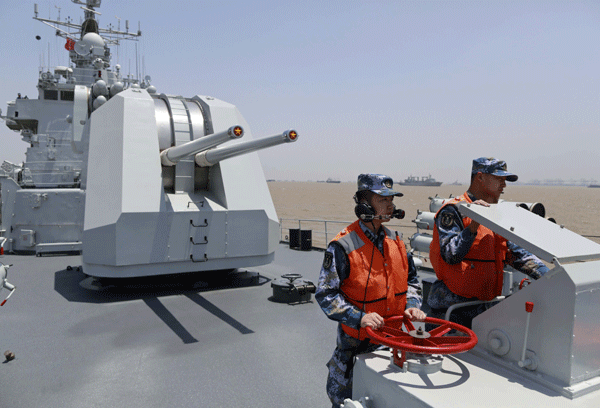 Chinese destroyer Harbin sets off on Thursday for the Joint Sea-2014 drill between Chinese and Russian navies. Fourteen ships, two submarines, nine fixed-wing aircraft and six helicopters from the two militaries are taking part in the weeklong drill that started on Tuesday. Feng Yongbin / China Daily |
The ongoing joint drill between the Chinese and Russian navies will test their communication capabilities, an expert said on Thursday.
"Communication and information sharing are very important for forces from different militaries in coordinating operations and can be decisive for the drill's outcome," Zhang Junshe, a researcher with the PLA's Naval Military Studies Research Institute, told China Daily.
"Commanders from the two navies must discuss and decide how to communicate or relay information via radio," he said.
"If two ships are not far from each other, they can also use semaphore, which is limited to a distance of up to 5.55 kilometers."
The United States navy has long used the tactical digital information links system to exchange information with some of its allies. The latest version, Link 16, features high security, huge communication capacity and near real-time transmission.
According to earlier reports, the Chinese navy has employed tactical data links on its ships.
Senior Captain Ge Cong-bo, who is in charge of communication for the week-long Joint Sea-2014 drill, said communication officers from both sides are maintaining good cooperation to ensure commands and data are transmitted in a timely and smooth manner.
"Disparities in communication equipment have been among the major factors that affect information transmission during joint drills," he said, adding that the two navies have overcome such difficulties and drawn up specified rules for communication issues.
A total of 14 ships, two submarines, nine fixed-wing aircraft and several helicopters from the two navies are taking part in the exercise, which started in Shanghai on Tuesday and will be performed in the northern part of the East China Sea.
All participating ships set sail on Thursday morning and performed a drill that simulates defense of the sites where the ships are anchored.
Starting on Friday, the joint forces will practice anti-ship assaults, anti-submarine combat, air defense, and identification, rescue and escort operations.
The exercise is the third of its kind, after joint drills off the coast of Russia's Far East in July and the Yellow Sea in April 2012. The two countries have also held six joint anti-terrorism exercises since 2005.
During the drills, the two sides use Russian to communicate, according to Wu Dahui, who studies contemporary Russia at Tsinghua University in Beijing.
Some of the Chinese navy's commanders speak Russian but most Chinese officers don't, so interpreters are indispensable, he said.
However, for a handful of Chinese veterans, language is never a problem.
Wang Chao, head of a coordination team from the Chinese navy who participated in the previous two joint naval drills, told Xinhua News Agency: "When we are planning a tactical operation, we even do not need an interpreter."
It is because the language barriers have given way to "unified tactical thoughts", he said.
Contact the writer at zhaolei@chinadaily.com.cn
















