


Japanese firm in search of perfect nipple
|
A 3-month-old baby is fed by his mother as Satoru Saito (bottom right), general manager of Pigeon Corp's research and development center, conducts a study last month on how babies drink milk at Pigeon's facility in Tsukubamirai, Japan. Toru Hanai / Reuters |
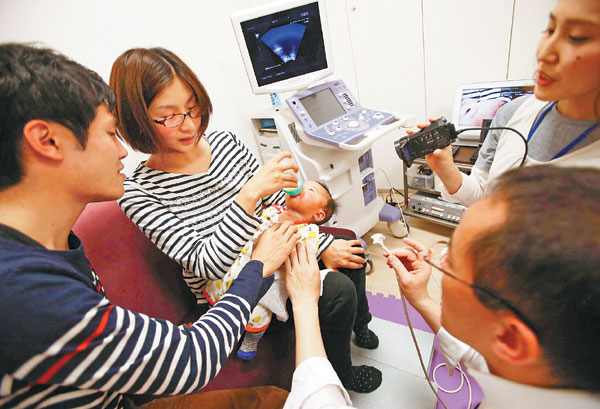
In a quiet side room at Pigeon Corp's spacious lab north of Tokyo, researchers are on a high-tech quest to create a teat for babies' bottles that matches a breast-feeding mother's own.
At its 15,400 square-meter facility at Tsukubamirai, some of the more than 100 researchers involved in product development place ultrasound devices under suckling babies' chins to monitor how their tongues move.
That's a step forward from the old method of placing cameras under the bottles to monitor how babies drink milk and a giant leap from the research methods of the company's founder.
In a Japan recovering from World War II, Yuichi Nakata spent six years traveling around the country asking lactating mothers if he could drink from their breasts. He sometimes offered to pay, and it is said he suckled the milk of around 1,000 women to learn more about their nipples.
"My grandfather was even slapped by women after he made the proposal," said Yusuke Nakata, a grandson who is now the managing director of Pigeon's Singapore office. "Our final goal is to make a teat as close as possible to a real mother's nipples."
Pigeon today has 200 paid volunteers, mothers with babies, who take part in the research.
"Babies can't tell us if they're comfortable with the bottles. For those who can't drink from the bottle well, we can't ask what's bothering them, so we came up with using ultrasound devices," Nakata said.
Babies are born with a natural reflex to help them find and latch on to the mother's nipple which, when it touches the roof of the baby's mouth, triggers rhythmical cycles of sucking - called the peristaltic movement - in which the tongue compresses the nipple.
While the World Health Organization promotes breast-feeding as the best source of infant nourishment, many mothers opt for bottle feeding for a variety of reasons.
"When a difficult baby drinks using our prototype teats, we're thrilled," said Satoru Saito, who has worked at Pigeon's research and development center for 17 years and is now general manager.
Pigeon's first teat was made of rubber, but these tended to crack easily and have now been replaced by softer, stretchable silicon teats.
Reminiscing about how the company started, Nakata, 42, said his grandfather wanted to be in a business that made the world a more peaceful place after the war.
In 1948, he met a Chinese businessman who started a company selling baby bottles.
"The Chinese partner left as sales struggled, but my grandfather stayed, convinced there would be strong demand for baby bottles," Yusuke Nakata said. "Japan was trying to recover from the wartime devastation, and he thought there would be more women in the workforce in the future."
Originally intending to call his company "Dove" because of its association with peace, the elder Nakata mistranslated the Japanese word, and Pigeon has stuck to this day.
Recognizing the importance of product development, Nakata recalled how his grandfather's product manager was one of the few Japanese people to own a car at the time. "He thought a manufacturer would make money only when it had goods ready to sell, so the product management's key person got special treatment," he said.
Foreign ownership
Pigeon is almost 50 percent foreign-owned in a country where average foreign ownership is just 28 percent. Its share price has tripled over the last two years, but foreign investors say they're keen to hold the stock for the long term.
"The China business has been the driver, with margins higher than in Japan, and where new products like diapers have been introduced," said Kabir Goyal, equity analyst at Wasatch Advisors in Salt Lake City, Utah, which owns close to 3 percent of Pigeon.
"Going forward, we're excited to see Pigeon aggressively enter new markets, such as the United States, Europe and India," he said.
Valued at more than $1.8 billion, Pigeon had sales of 77.47 billion yen ($762 million) last year, with operating profit jumping more than 46 percent to 10.37 billion yen.
Overseas sales were 38.54 billion yen, with around 60 percent of that in China, where Pigeon's high-margin baby and health products compete against the Nuk brand of German companies Mapa GmbH and Philips Avent.
Current year operating profit is likely to increase more than 15 percent, according to analysts surveyed by Reuters. The company expects profit to rise almost 12 percent.
















