Africa has to make the best of China ties
|
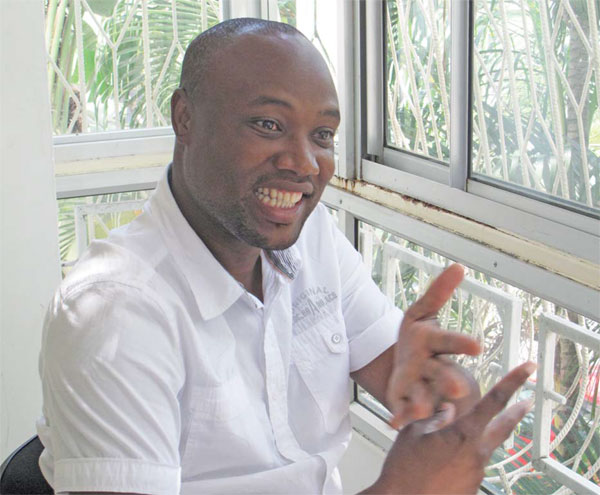
Sergio Chichava says trading blocs are the key to Africa's economic development. Wang Chao / China Daily |
Mozambique academic says continent not grasping the opportunity with alacrity
Sergio Chichava insists it is up to Africans to get the best out of their new relationship with China.
The 39-year-old Mozambican academic argues the responsibility lies with governments across the continent to shape a new partnership.
"I think the Chinese have opened their doors to Africa and now it is for Africans to show how to benefit from this Chinese openness. This really depends on Africa itself. It is not a Chinese matter."
Chichava was speaking in the offices of the Instituto de Estudos Sociais e Economicos where he is a senior researcher.
The white-painted offices in the palm-tree lined Avenida Patrice Lumumba in Maputo, a stone's throw from the Indian Ocean, appear a Portuguese colonial legacy but were built about the time of Mozambique's independence in 1975.
Chichava, relaxed and confident, has just edited a book, China and Mozambique: From Comrades to Capitalists, with Chris Alden, professor of international relations at the London School of Economics and a leading China-Africa expert. It includes chapters from no fewer than 10 authors, including the co-editors.
The book looks at Mozambique - a much-studied African country in the West - in the context of the growing economic relationship between China and Africa, which saw mutual trade increase from just $10 billion in 2000 to more than $200 billion in 2013.
"One of the aims of the book was to look at how the relationship between China and Mozambique has evolved," he says.
"As the title of the book suggests we wanted to look at how it had changed from before independence when many of the freedom fighters of Frelimo (now Mozambique's ruling party) visited China and forged strong links with the Chinese Communist Party to the more business-orientated relationship we have today."
Chichava says that one of the conclusions was that Mozambicans are open to China's involvement in their country.
"People as a whole do not blame the Chinese presence in Mozambique. The main issue for them is if they see local elites benefiting from the relationship. That is where any difficulty lies."
Chichava is emerging as one of Mozambique's most prominent academics with a number of papers published in international academic publications and journals. Last year he held an African research fellowship at the London School of Economics. In 2008, he was visiting fellow at the Oxford Research Network Programme at Oxford University.
The Mozambican believes that Africa needs to fully utilize bodies such as the Forum on China-Africa Cooperation, which was set up at the turn of the century and had its last meeting in Beijing in 2012.
It has come to symbolize the relationship between China and Africa, no more so than in 2006 when representatives of 48 African countries descended on the Great Hall of the People in Beijing. Former Chinese president Hu Jintao hailed it as a new "strategic partnership" between China and Africa.
"You cannot say it is not an important organization for Africa. It clearly is. The Chinese are looking out for their own interests, but they are also willing to support Africans. It seems to me, however, that we are not taking seriously this opportunity. The Chinese will not push us if we don't push ourselves to make the best of this opportunity," he says.
Chichava was born in the south of Mozambique, the second oldest of seven children.
Like many in his district, his father Inacio, now 63, worked in the Johannesburg gold mines.
When he first started at school, he found it a challenge since the lessons were in Portugese and not in his native Changana.
"My late mother (Ana Eugenio), who had only four years of formal education herself, at that point decided that from then on we would all speak Portuguese at home. I think that was one of the reasons I was able to make academic progress," he says.
Eventually doing well at school, he went on to study social sciences and public management at Eduardo Mondlane University in Maputo.
From there he won a French government scholarship to study at the University of Bordeaux, where he eventually received a master's and a doctorate in political science.
He returned to Mozambique to work for the newly created IESE, where he specializes in rising powers and development with a particular interest in both China and Brazil. He also lectures at his alma mater Eduardo Mondlane University.
One talking point in Mozambique has been whether the country might be the next Dubai within 20 years, following a recent discovery of major gas reserves. Chichava believes this is highly unlikely.
"We would have to change many things for this to happen. You know there is no strategic plan for development. In our first 10 years after independence there was a clear plan of how Mozambique must be in the future. There is no longer that clear vision," he says.
He says if Mozambique and other African countries are to make further progress on the journey to development then South-South co-operation between developing nations is important.
"There is a lot of discussion here as to whether China is still part of the south. We cannot pretend our relationship with China is still in any way horizontal. I think this would apply to Brazil also. Both are at a much more advanced stage," he says.
Chichava believes that China has a certain advantage when doing business in Africa because it comes with less baggage than the West.
"We have a very complicated history with the West. With China we don't have this colonial past. This, however, doesn't mean that the relationship with China is that different. They are here to teach rather than to learn from us, just the same," he says.
The academic says that China has had a particularly effective role in infrastructure in Mozambique being responsible for funding a number of key projects such as the $2-billion Mphanda Nkua Dam and the Maputo ring road. China Exim bank recently agreed a loan of $416 million for the road linking Mozambique's second port city of Beira to Machipanda on the Zimbabwean border.
"This road is very important for our economy and it is also investments like this that will make bodies such as the Southern African Development Community work, so it is easier for countries in the region to trade with each other. Trading blocs are the key to Africa's economic development," he says.
Chichava believes the Chinese do not employ a double standard when dealing with Africa and that to some extent is refreshing.
"They know what they want and they are not hypocritical. They don't want to interfere with political affairs and they are essentially pragmatic," he says.
But he believes it will take more than Chinese investment for Africa to becoming a rising economic force later this century. He is somewhat skeptical of the recent McKinsey & Co report, Lions on the Move: the Progress and Potential of African Economies, which predicted the continent would be driven forward by its young consumers.
"I think the big problem is that we don't have the human resources skills. The skills of the people are just not there. The authorities are just not interested in education. We just don't take education seriously enough."