Camaraderie born of academic rigor
|
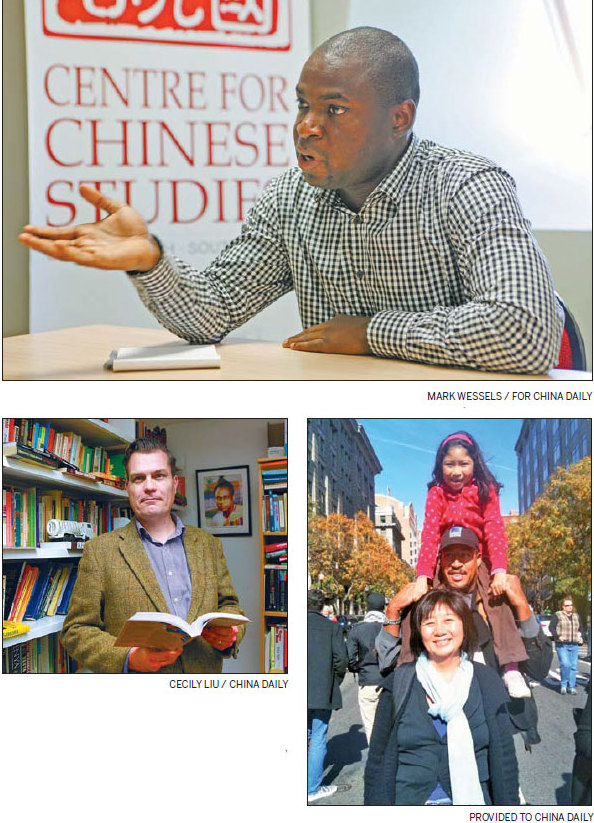
Clockwise from above: Daouda Cisse, Centre for Chinese Studies; Yoon Jung Park, convener of CAAC Research Network; Ian Taylor, University of St Andrews. |
Growing body of research creates strong new community
China-Africa think tanks and centers, in and out of educational institutions, have grown fast in the past decade, spawning not just an expansive body of knowledge on China-Africa relations but also experts across a diversity of disciplines.
One consequence of the increase in the production of information about the relationship is that institutions worldwide are forming partnerships, formal and informal, for joint projects.
A distinction can be made between research networks established by governments and those that emanate from scholars keen to forge interactive projects.
Of government-led initiatives, the China-Africa Think Tanks Forum housed in the Institute of African Studies at Zhejiang Normal University stands out. Another government-led initiative is the China-Africa Joint Research and Exchange Program, in operation since 2009 with several joint initiatives to its name.
Is the credibility of government-led research initiatives sullied by the predilection of governments for less critical research, the kind done only in the service of policy? Not at all.
An example is the China-Africa Think Tanks Forum conference in Ethiopia in 2012 during which disagreement as much as agreement was the order of the day. Another example is the China-Africa Joint Research Exchange Program-sponsored conference in Nairobi, also in 2012, whose critical appraisal of China-Africa research can be seen in a candid conference report edited by James Shikwati, director of the think tank Inter Region Economic Network.
Forums of all sorts are a good place to start when looking at the world of China-Africa research. A perusal of conference invitations, proceedings and reports shows that certain scholars are always on these conference circuits in a way that suggests a community of intellectuals focused on analyzing relations between country and continent has been formed.
One particularly informative conference recently, during which scholars discussed methods for studying China in Africa, was organized by the Social Science Research Council in New York and held at Yale University. Among the attendees were many well-known China-Africa scholars, including: He Wenping, Chinese Academy of Social Sciences; Liu Haifang, African Studies Center, Peking University; Tatiana Carayannis, Social Sciences Research Council, US; Sanusha Naidu, Open Society Institute, South Africa; Chris Alden; London School of Economics and Political Science, UK; Paul Kamau, University of Nairobi; and Daouda Cisse, Centre for Chinese Studies, Stellenbosch University, South Africa.
It was at the Yale conference that Immanuel Wallerstein, famous for his world systems theory, gave an important lecture on the place of China and Africa in geopolitics. But perhaps more importantly, the conference looked at the important question of what methods and theories can be leveraged in the study of China-Africa relations. The conference also provided an opportunity for China-Africa researchers to engage and learn from each other and plan collaborations.
The conference was organized by the Social Science Research Council because this think tank has a China-Africa Knowledge project on whose board sit established scholars such as: Deborah Brautigam, Johns Hopkins University, US; Mamadou Diouf, Columbia University, US; Daniel Large, Central European University, Hungary; Li Anshan, Peking University; and Jason Tower, American Friends Service Committee, China representative.
However, partnerships are not limited to African, US and Chinese scholars. For instance, Peking University's Center for African Studies has a longstanding collaboration with the Nordic African Institute in Uppsala, Sweden.
One of the recent publications coming out of this collaboration is an insightful paper on the workings and architecture of the all important Forum on China-Africa Cooperation, written by professors Li Anshan, Liu Haifang and He Wenping. The paper was edited by Fantu Cheru, originally from Ethiopia and senior research fellow and coordinator of China-inclined studies at the Nordic African Institute.
To appreciate the multi-pronged nature of the networks, consider that Cheru sits on the editorial board of the China Monitor, which is published by the Centre for Chinese Studies at Stellenbosch University, South Africa, with professors Chris Alden, Karen Harris and Garth le Pere, both from the University of Pretoria, Liu Haifang, Yoon Jung Park and Ian Taylor, University of St Andrews, UK. Notice that Park, Alden, He, Li and Haifang, to mention but a few pop up everywhere, not just in conference presentations but also in institutional affiliations and the literature they churn out.
Collaboration need not be just at institutional level alone. Indeed, it is noticeable that certain partnerships have had a staying power of their own kind. A case in point is the substantial body of literature on China-Africa perceptions, attitudes and opinion and related topics by professors Barry Sautman of Hong Kong University of Sciences and Technology and Yan Hairong of Hong Kong Polytechnic University.
Probably the key contributor to the formation of China-Africa networks is the role that organizations such as the Chinese in Africa and the Africans in China Research Network play. Almost every day, Yoon Jung Park fires off a volley of upcoming conferences, calls for papers in journals and books and job opportunities from the US to eagerly waiting researchers. It is these opportunities that eventually lead to face-to-face meetings at forums and ultimately result in the forging of friendships and partnerships. Clearly, the forthcoming conferences will add impetus to the strong academic ties that are redefining ways in which the China-Africa field is studied.
For China Daily