Traditional Chinese medicine's heavy pollution threatens lives
The difficulty that traditional Chinese medicine (TCM) meets in entering the international market is not caused by the so-called prejudice of foreigners as many Chinese conveniently suppose, but by heavy metal pollution and pesticide residue.
Yet, in the home market, TCM's popularity increases continuously as an alternative to the expensive Western medicine and dietary supplement for China's fast aging society.
The old-brand TCM retail stores in Shanghai and Beijing are always crowded and wholesale markets boom.
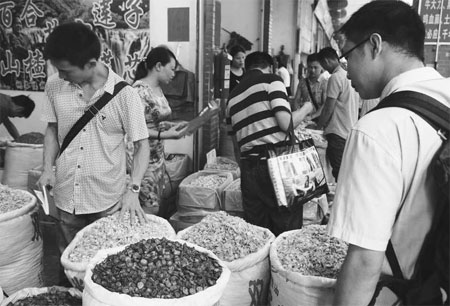
Yulin won the title of "South China Medicine Capital" last month. The government of the small city in Guangxi Zhuang autonomous region celebrated the title with its giver - the China Association of Traditional Chinese Medicine, a non-profit organization.
Yulin used to be a trade center of TCM in ancient China, and today produces large amounts of TCM raw materials in its mountains, and its wholesale market sells about $1 billion of such materials.
In China, there are markets of similar scale in the four old medicine capitals: Bozhou of Anhui, Zhangshu of Jiangxi, Yuzhou of Henan and Anguo of Hebei.
In the Yulin market, the eye-opening medicine materials ranging from dried seahorses and centipedes to seal penises are accompanied by the sellers' eloquent promotion, with one message: everything cures.
But some of them kill, not because of their own poisonous, which can be transformed while processing with the other ingredient materials, but because of some pollutants from the pesticide and polluted soil.
In 2011, drug administrations in Hong Kong recalled three kinds of TCM from the Chinese mainland because of heavy-metal pollutants in them.
Canada and the United Kingdom warned consumers last year about the heavy-metal pollution in some TCM products exported from China.
Last year, Green Peace, a non-profit environmental organization in Hong Kong found nearly half of the TCM it sampled - which involved many well-known TCM brands - in Hong Kong and nine main cities in the Chinese mainland contained pesticide residues.
But when these messages are reported back to the Chinese mainland, all relevant TCM dealers and producers remained silent about them. The TCM administration departments also played down the "imported" news and simply responded that they would strengthen the non-compulsory quality check, a toothless rule that was passed 12 years ago.
The hoopla in Yulin's TCM trade fair last month, which was attended by all key players in the field, indicates that pollution issues sizzling from two years before have not affected the industry.
Vendors in Yulin, from which almost all of the popular TCM brands buy raw materials, said their business is good.
Last year, the overall production value of China's TCM industry, which consists of 1,500 enterprises, hit 410 billion yuan ($65.81 billion), about twice that of five years ago, among which 14 billion yuan is for export, an increase of 16 percent year-on-year.
The booming home market does not mean an improvement in supervision. The test list of the US drug administration consists of more than 360 kinds of pesticides. Germany tests 325 kinds, and Canada 251. Only 90 appear in the Chinese test list.
The Chinese watchdogs only test the samples sent by the producers, and seldom conduct casual inspection in the market.
The supervision for the raw materials of TCM, like some plants, animal parts and insects, is difficult because there is not a clear classification system in the field.
None of the business, food, drug and agricultural inspection authorities thinks it should be their sole responsibility to check such a variety of sundries. But even when they work together, no parties take the job seriously.
Most Chinese consumers are kept in the dark about the loose standards and quality inspection of the TCM industry.
The TCM enterprises, some of which are old brands dating back to Qing Dynasty (1644-1911), promote their products by playing up deep-rooted concepts of Chinese that TCM are natural products, good for people's health and much less poisonous than Western medicines. The Fact is few raw materials for TCM today are natural any more.
After 2000, the wild herbs and animals in China could not meet the rising demand for TCM from home and abroad.
People started planting herbs and raising animals and insects for the market. The industrialization of the herbal trade, which was mostly done by individual farmers and collectors in mountains before, exposes the herbs and animals directly to artificial pollutions of chemical fertilizers, pesticides and heavy metals in the soil.
The official survey shows, among the 10 largest rivers and 63 major lakes in China, nearly 40 percent cannot provide drinkable water, and 16.1 percent of land is contaminated by heavy metals and over use of pesticides.
The environmental pollution is one root cause for China's food safety issues. The herbs planted in farms are also victims.
Yet, compared with the noteworthy food-safety issue, TCM safety has long been ignored in the agenda collectively set by the industry, a number of research institutes and associations that live on it.
China's TCM industry is probably going through a similar crisis as the one for China's dairy industry.
Before 2008, it was an open secret in China's dairy industry that many enterprises used melamine, a harmful chemical, to improve the protein content of their products. Were it not that a business reporter, who died recently of a strange disease, found the link between dozens of sick babies inflicted with kidney stones in poor west China with the formula powder they took in 2008, the Chinese would still be guzzling the melamine milk.
Some vendors use forbidden chemicals to preserve and beautify them, which adds new fatal pollutants to the drugs.
The raw materials produced by the planting and animal breeding farms already show much weaker efficacy desired by doctors than the wild ones.
The loose supervision and lack of self-discipline in the market keep TCM a deficit trade for China.
Although China is the largest raw material provider, Japan and South Korea produced nearly 80 percent of TCM products because of their higher standards and strict checks in the TCM world.
A worrisome tendency in China is the TCM industry, with the scholars and administrators behind it are spoiled by the big easy market at home, which is largely dominated by home brands. As long as consumers do not realize the damage done by the poisonous TCM to their health, the industry can continue to make easy money at home.
Unlike the food safety, a convenient shield for drugs is that people believe sick people die of their diseases, but not the medicines they take to treat the diseases.
The old independent veteran TCM doctors, who were active in grassroots villages for thousands of years, are dying out in China. It means the people, who are independent from the interest groups of the TCM industry and have the expertise to differentiate good medicine from bad medicine, become fewer and fewer.
Money talks in the drug industry, sometimes at the costs of lives.
John Mengda Fu and Huo Yan contributed to this story.
liyang@chinadaily.com.cn
|
Wholesale market of raw materials for traditional Chinese medicine in Yulin of Guangxi. Huo Yan / China Daily |