


Stuck with white elephant stadiums
|
Arena das Dunas in Natal was filled to capacity for the June 24 World Cup group match between Italy and Uruguay. Hassan Ammar / AP |
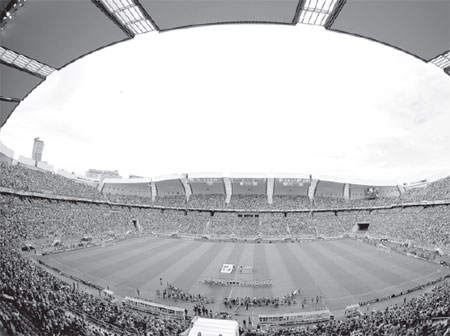
Once the World Cup and its traveling circus leaves town, four gleaming stadiums that cost $1.6 billion to build and hosted massive crowds will fall silent as their owners struggle to find a use for them.
In the western Brazilian city of Cuiaba, Chilean and Colombian fans produced sellouts of 40,000 at Arena Pantanal for the World Cup.
The next big game at the $260 million stadium is on July 20 - for the championship of Brazil's third division. Officials are hoping for 4,000 fans.
Similar letdowns await at least three other stadiums built for the World Cup, in the capital Brasilia, the Amazon jungle city of Manaus and in Natal on the northeastern coast.
None of them has a big-time team, which means no permanent tenants to fill the stands, pay the bills or service the debt.
The lavish cost of the venues could have been aimed at rundown schools, shabby hospitals and poor public transportation instead of going to white-elephant soccer stadiums.
Government auditors say the bill for the Brasilia stadium will reach $900 million, the most expensive soccer venue ever built after Wembley Stadium in London.
Brazil did not require all 12 stadiums used at the World Cup. FIFA demanded a minimum of eight, but organizers decided it would build four more than were needed, mostly to satisfy local politicians.
"The only thing worse than spending a bunch of money on a stadium is spending a bunch of money on a stadium that no one uses," said Victor Matheson, a sports economist at the College of the Holy Cross in Worcester, Massachusetts.
"No academic economist thinks that spending money on sports facilities is a particularly good investment."
All four stadiums bill themselves as multi-functional venues that can also play host to social and cultural events and conventions. They have websites advertising themselves and looking for occupants.
Mauricio Guimaraes, who heads World Cup projects in Cuiaba, said the stadium might host agricultural fairs, business events, or "could provide an incentive for the area's third- and fourth-division teams to seek promotion."
In Natal, the stadium will hold a Serie B match next week between America and Bragantino that is expected to draw about 3,000.
The situation is similar in Manaus and Brasilia.
Jose Maria Marin, president of the Brazilian Football Confederation, said finding uses after the World Cup "will all depend on creativity - the imagination of the owners and the operators of these stadiums."
History suggests the four are ill-advised outlays. But even if they are, it's a tiny expense for a country with a $2.5 trillion economy. If the World Cup pays off in international goodwill, more tourism and boosts the re-election chances in October of President Dilma Rousseff, politicians - if not economists - will conclude it's been worth it.
Recent World Cups and Olympics have left expensive relics.
The $600 million Cape Town stadium from the 2010 World Cup has hosted just seven soccer matches in four years. It was the postcard image of South Africa's Cup, built on the seashore and under Cape Town's famous Table Mountain. Officials argue it will pay off in time.
Mega-events have been awarded recently to the so-called BRICS - an acronym for Brazil, Russia, India, China and South Africa - countries with fast-growing economies that are marketing themselves using the Olympics or World Cup.
Brazil's new stadiums make matches safer, but they are also driving up ticket prices and shutting out the working class and poor who have supported the game.
"Natal and other northern cities have had a history of violence associated with football matches," said Luis Eduardo Pereira, a spokesman for the Natal stadium. "We hope that the more secure arena will encourage families to come back to football."
Brazil's top league draws fewer fans than the MLS in the United States, or China's up-start Super League.
"We need to find a way to get the poor and working class into the stadiums," Brazil Sports Minister Aldo Rebelo said at the World Cup. "You cannot take the democratic character out of the stands. Such is the soul of football."
A recent study showed that average ticket prices at Rio's Maracana Stadium, the site of the World Cup final, had increased about 30 times over the last nine years.
















